At the 1988 French Open, Steffi Graf beat Natalia Zvereva 6-0, 6-0 in the singles final. It was the most emphatic stop on a journey that took her from Melbourne to Paris, London, New York and, finally, Seoul. By the end, she held all four major singles titles and an Olympic gold medal-the first calendar-year Golden Slam in tennis.
That season can overshadow the rest of her story. But her career lasted long enough to bridge generations, from finals against Martina Navratilova to a last Wimbledon meeting with Lindsay Davenport. She left with 22 major singles titles, 107 tour singles trophies and a game built around the forehand opponents knew was coming but often could not contain.
A childhood game becomes a profession
Born Stefanie Maria Graf on June 14, 1969, in Mannheim, West Germany, she first picked up a racket at three. Her father, Peter, introduced her to tennis and directed her early development. The family later settled in Brühl, the town closely associated with her upbringing.
By October 1982, childhood practice had become professional competition. Aged 13, she made her tour debut in Filderstadt, losing to former Australian Open finalist Tracy Austin.
Progress was quick, but trophies did not arrive immediately. She spent several seasons learning against established professionals before winning her first tour singles title at Hilton Head in 1986, beating Chris Evert in the final. It was a meaningful result: the teenager was no longer merely troubling the leading players. She could beat them with a title at stake.
Pavel Slozil, her coach from 1986 to 1991, helped guide the next stage. Her speed and forehand were already obvious weapons; increasingly, she could sustain them through the biggest matches.
Paris opens the door
The 1987 French Open final gave Graf her first major championship and a demanding test of nerve. Against Navratilova, she won 6-4, 4-6, 8-6, holding her ground through a deciding set with no room for a careless service game.
Navratilova answered by beating her in the Wimbledon and US Open finals that summer. Their rivalry was a contest between contrasting methods: the established serve-and-volley champion trying to close the net, the younger challenger looking to pass her or dictate from the baseline.
On August 17, 1987, Graf reached world No. 1 for the first time. She finished the season by winning the year-end championships, confirming that Paris had been a breakthrough rather than an isolated success.
Then came a season for which tennis needed a new label.
Five stops to the Golden Slam
The 1988 Australian Open brought a straight-sets final victory over Evert. At Roland Garros, Zvereva could not win a game against her in the championship match.
Wimbledon required a different response. Navratilova had won the previous six singles titles there and took the opening set of their final. Graf recovered to win 5-7, 6-2, 6-1, breaking the defending champion’s hold on Centre Court.
Victory over Gabriela Sabatini in the US Open final completed the calendar-year Grand Slam. Later that month, she beat Sabatini again for Olympic singles gold in Seoul.
No other player has won all four major singles championships and Olympic singles gold in the same calendar year. Graf also took doubles bronze in Seoul with Claudia Kohde-Kilsch; earlier that summer, she had won the Wimbledon doubles title alongside Sabatini.
There was little immediate let-up. In 1989, she won the Australian Open, Wimbledon and the US Open, missing another calendar Grand Slam only through defeat to Arantxa Sánchez Vicario in the French Open final. A third consecutive Australian Open title followed in 1990.
Seles changes the contest
Monica Seles brought a new challenge. Taking the ball early and driving it hard from both sides, she could rush Graf in ways few opponents managed.
Seles won their 1990 French Open final and replaced her at No. 1 in 1991. Graf remained formidable, winning Wimbledon in 1991 and 1992, but the biggest titles were now being contested on different terms.
Their 1992 French Open final captured the tension of the rivalry. Seles won 10-8 in the deciding set. Graf answered with a decisive victory in the Wimbledon final a month later, before Seles beat her in the 1993 Australian Open final.
In April 1993, Seles was stabbed by a spectator during a match in Hamburg. The attack kept her out of competition for more than two years, abruptly interrupting the rivalry. Their results cannot be separated from that absence.
Graf won Roland Garros, Wimbledon and the US Open in 1993. When Seles returned, they met in two more major finals, at the 1995 and 1996 US Opens, with Graf winning both. Across their six Grand Slam singles finals, they finished level at three victories each.
Another surge, then the injuries
Heinz Günthardt became her coach in 1992 and remained with her until retirement. That year also brought an Olympic singles silver medal in Barcelona, where Jennifer Capriati beat her in the final.
A fourth Australian Open title followed in 1994. Sánchez Vicario became an especially persistent opponent during this period, using speed, defensive skill and patience to make Graf work for her openings.
Their 1995 Wimbledon final turned on a remarkable 20-minute game late in the deciding set. Graf eventually broke serve and then served out the match-an example of how much endurance could lie behind her apparently direct attacking tennis.
In both 1995 and 1996, she won Roland Garros, Wimbledon and the US Open, along with the year-end championships. These were sustained runs of success, not occasional reminders of her earlier dominance.
Injuries increasingly disrupted the next two seasons. Knee surgery in 1997 contributed to a long absence, and her place among the leading contenders became less secure.
One last French Open
At Roland Garros in 1999, Graf worked through a draw that included Lindsay Davenport and Seles before facing world No. 1 Martina Hingis in the final.
Hingis won the first set and served for the match in the second. Graf stayed in it, drew on the support of the Paris crowd and came back to win 4-6, 7-5, 6-2. It was her sixth French Open singles title and her 22nd major.
She reached the Wimbledon final a few weeks later, losing to Davenport. On August 13, 1999, she announced her retirement, aged 30 and ranked world No. 3.
Her major singles collection comprised four Australian Opens, six French Opens, seven Wimbledons and five US Opens. She had spent 377 weeks at No. 1, a women’s tour record, and won the year-end championships five times.
The forehand-and the work behind it
“Fräulein Forehand” was an apt nickname, though it described only the finishing weapon.
Graf’s footwork created the shot. She moved quickly around her backhand to strike inside-out forehands, forcing opponents to defend while leaving herself court to cover. Her speed made that risk manageable.
The one-handed backhand was usually sliced, staying low and changing the rhythm until she could attack again. She could drive over it when needed, but rarely built matches around doing so.
Her manner was similarly economical. Between points there was little display; the intensity showed in her movement and concentration rather than elaborate celebrations.
Stefanie away from the scoreboard
That reserve occasionally gave way to dry humor. During Wimbledon in 1996, a spectator shouted a marriage proposal. Her reply-“How much money do you have?”-became one of the tournament’s enduring crowd exchanges.
Family life also brought difficult public scrutiny. Her father was convicted of tax evasion in 1997 over his handling of her earnings. Graf was investigated but was not charged.
In 1998, she founded Children for Tomorrow, a charitable foundation supporting children and families affected by war, persecution and violence. Its work focuses on psychological care, a less conspicuous part of her public life than tennis exhibitions or appearances alongside her husband.
She married Andre Agassi in 2001. They have two children, Jaden and Jaz Elle, and established their family home in Las Vegas. Jaden pursued baseball rather than following his parents into professional tennis.
Away from competition, she has said she prefers Stefanie. The shorter name remains attached to the scoreboards and record books; the longer one belongs to a life no longer organized around the next tournament.
FAQ
How many Grand Slam titles did Steffi Graf win?
She won 22 major singles titles: four Australian Opens, six French Opens, seven Wimbledons and five US Opens.
What was her Golden Slam?
In 1988, she won all four Grand Slam singles tournaments and Olympic singles gold in the same calendar year.
When did she turn professional and retire?
She made her professional debut in October 1982, aged 13, and announced her retirement on August 13, 1999.
How long was she world No. 1?
She spent 377 weeks at No. 1, first reaching the top ranking on August 17, 1987.
Who is Steffi Graf married to?
She married Andre Agassi in 2001. They have two children, Jaden and Jaz Elle.
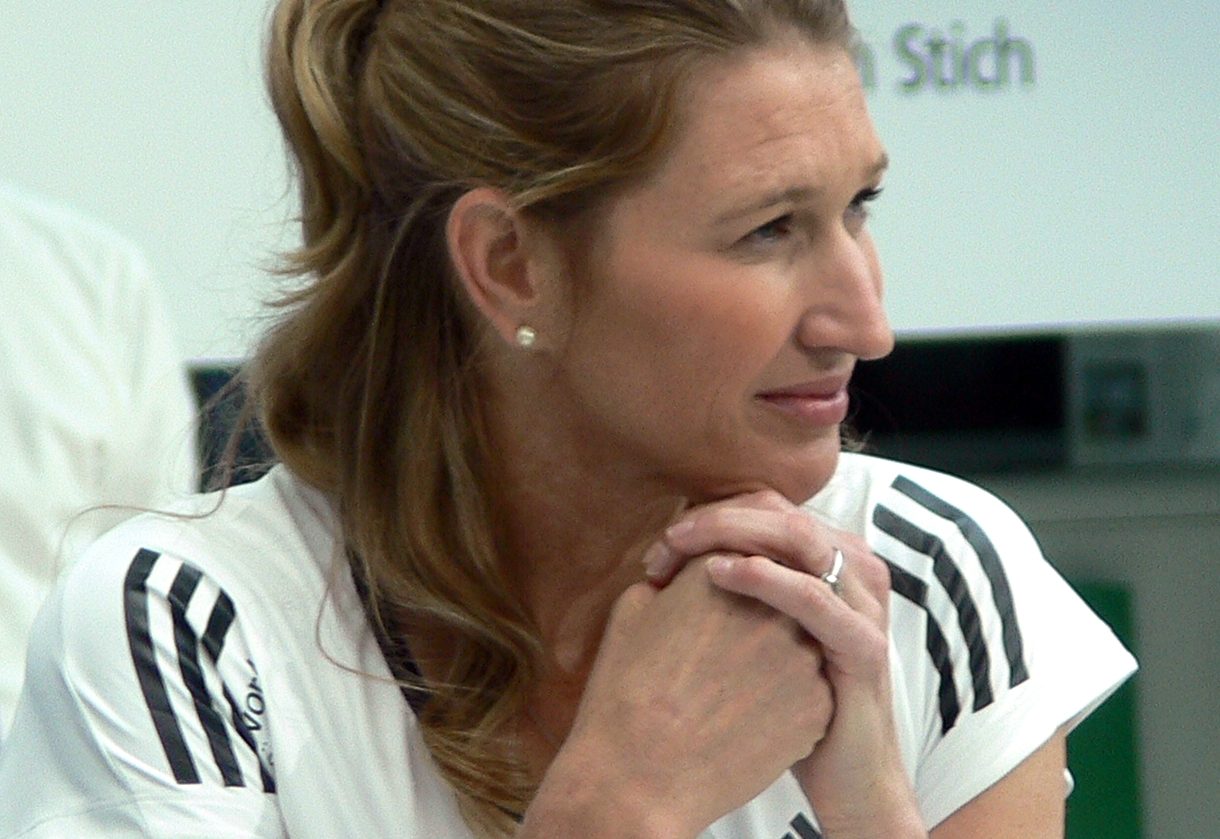
Photo: Mark Henckel from Hamburg-Altona, Deutschland (…, CC BY-SA 2.0, via Wikimedia Commons