A tennis career can turn on a small detour. In Aryna Sabalenka’s case, it started when her father noticed some courts while driving and decided to stop. From that chance moment grew one of the most forceful careers in women’s tennis: a player from Minsk who rose to world No. 1 in singles, also reached No. 1 in doubles, and built her reputation on first-strike power.
From Minsk to the pro tour
Aryna Siarhiejeŭna Sabalenka was born in Minsk on May 5, 1998. She picked up the sport young, trained in Belarus, and developed outside the usual prodigy script. Unlike many future major champions, she did not make her name through the junior Grand Slams. Her junior ranking peaked well outside the top tier, and her early progress came more quietly, through lower-level events and steady work on a game that was already bold by instinct.
She began playing ITF events as a teenager and won her first titles there before stepping fully into the professional game. Even then, the outline of the player she would become was easy to spot. Sabalenka wanted control of the point immediately. She served big, took the ball early, and accepted the risks that come with trying to hit through opponents rather than outlast them.
That style could look raw at first. It could also look overwhelming.
The Belarus Fed Cup run that changed her profile
Her first real jump into the wider tennis conversation came in 2017. Belarus, not a traditional heavyweight in the women’s game, made a surprising run to the Fed Cup final, and Sabalenka was central to it. She beat higher-ranked opponents, handled the pressure of team competition, and suddenly looked less like a prospect and more like a player ready for the top level.
Later that season, she reached her first WTA final in Tianjin. She did not win the title, but the result mattered. It showed that the power game was no longer just eye-catching; it was producing week-long runs on the main tour.
Wuhan, big titles and a dangerous doubles partnership
The next step came fast. In 2018, Sabalenka won the Wuhan Open, one of the biggest titles of her career to that point. She beat top players, handled a demanding draw, and announced herself as a genuine threat at elite events. A year later, she defended the Wuhan title, a harder task than winning it the first time. By then, she was no longer discussed mainly in terms of potential.
Around the same period, she became one of the best doubles players in the world as well. Her partnership with Elise Mertens clicked immediately because their games complemented each other: Sabalenka brought explosive pace and aggressive returns, while Mertens added sharp instincts and consistency. Together they won Indian Wells and Miami in 2019, completing the Sunshine Double in doubles, and later that year took the US Open doubles title.
That success mattered for more than the trophy count. It sharpened Sabalenka’s net play, improved her returning patterns, and underlined the range in her game. She was not simply a hitter from the baseline.
Climbing toward the top
By 2020 and 2021, Sabalenka had moved into the top bracket of the WTA Tour. She won Doha in 2020 and carried strong form into the following season. In singles, 2021 brought one of the best stretches of her early career, including the Madrid Open title and semifinal runs at Wimbledon and the US Open, both her best Grand Slam singles results at that point.
She also reached world No. 1 in doubles in February 2021. That made her part of a small group of players to have led the rankings in both disciplines, a marker of how complete her development had become.
At the Australian Open in 2021, she and Mertens won the doubles title, giving Sabalenka her second major doubles crown after the 2019 US Open. Singles, though, remained the bigger target. The power was there, the ranking was there, and the sense persisted that a major breakthrough was close if she could steady the emotional swings and manage the double-fault spells that sometimes disrupted her biggest matches.
The difficult stretch before the breakthrough
Not every rise is smooth. In 2022, Sabalenka went through one of the most turbulent serving periods of her career. Her double faults became a recurring story, and with them came obvious frustration. Yet the season was not a collapse. She still reached the semifinals at the US Open and qualified for the WTA Finals, reminders that even when parts of her game were unstable, she remained among the best players in the world.
That year, more than any title run, revealed something important about her. She kept showing up. She kept competing. And she kept trying to solve the problem in public, on the biggest stages.
Australian Open champion at last
The breakthrough arrived in Melbourne in 2023. Sabalenka won the Australian Open, beating Elena Rybakina in the final for her first Grand Slam singles title. It felt less like a surprise than a release. For years, her game had looked major-worthy; now there was proof beside the ranking.
She backed it up through the rest of the season. In Madrid, she won another big clay-court title, beating Iga Świątek in the final. At the US Open, she reached her first final there before losing to Coco Gauff. Even in defeat, the season pushed her to the top of the sport. After the tournament, she rose to world No. 1 in singles for the first time.
That was a significant milestone in any Aryna Sabalenka biography, but it was also a fair reflection of the season. She had become more than a dangerous power player. She was now a week-to-week standard at the top of the tour.
Backing it up with more majors
Winning one major changes how a player is viewed. Winning another confirms the shift. Sabalenka defended her Australian Open title in 2024, becoming the first woman since Victoria Azarenka to win back-to-back singles titles in Melbourne. Later in the season, she added the US Open singles title, beating Jessica Pegula in the final.
Those results gave her three major singles trophies: Australian Open 2023, Australian Open 2024, and US Open 2024. They also strengthened the case that hard courts are the natural stage for her best tennis. The serve skids through, the return can do immediate damage, and her first forehand often decides the shape of a rally before it really begins.
She also continued to collect major tour titles beyond the Slams, including more deep runs at WTA 1000 level. By then, the list of Aryna Sabalenka titles had real weight: major singles champion, major doubles champion, WTA 1000 winner on multiple surfaces, and world No. 1.
Rivalries that define her era
Top players are often measured not only by trophies, but by the opponents who keep appearing across the net. For Sabalenka, three names stand out.
Iga Świątek has provided the stylistic contrast: Sabalenka’s direct power against Świątek’s heavy topspin, movement and point construction. Their meetings have often carried ranking implications and the feel of a contest for control of the tour.
Coco Gauff has become another important rival, especially after the 2023 US Open final. Gauff’s speed and defense ask Sabalenka to hit one more clean ball, then another, and that tension makes for compelling matches.
Elena Rybakina, meanwhile, brings a different kind of power duel. When they meet, points can be short, scorelines can swing quickly, and the margins are often tiny.
How Sabalenka plays
Sabalenka is right-handed with a two-handed backhand, but the mechanics only tell part of the story. Her tennis is built on initiative. She looks to take time away, attack second serves, and turn neutral rallies into offensive ones with a single strike.
The serve is a major weapon, especially when she lands a high first-serve percentage. Her forehand is the shot most associated with her, struck flat and hard, often crosscourt to open the court and then down the line to finish. The backhand, once seen mainly as a support shot, has become a clean and reliable source of pace.
Hard courts suit her best, though she has also won big titles on clay, including in Madrid. On faster surfaces, though, the full version of her game comes into view: serve, return, first blow, scoreboard pressure.
Her nickname, “The Tiger,” fits naturally. It comes from a tiger tattoo on her left forearm and from the ferocity of her on-court presence.
Life away from the baseline
Off the court, Sabalenka’s public story has always included her family. Her father, Sergey, was a former ice hockey player and played a major role in introducing her to tennis. He died in 2019, a loss she has spoken about openly. Her mother is Yuliya Sabalenka.
She has also shown a lighter side in interviews over the years. She has talked about her sweet tooth, and her public persona often mixes intensity on court with a more playful, relaxed presence away from it.
Sabalenka has been based in Miami, Florida. As for her relationship status, reports and public appearances linked her with Georgios Frangulis, a businessman associated with Oakberry. Because private life can shift and not every detail is formally confirmed by the player, it is best treated cautiously unless she states it directly.
One issue around her career has gone beyond tennis. Following Russia’s invasion of Ukraine, Belarusian and Russian players have competed at many events as neutral athletes, without national flags displayed beside their names. Sabalenka has therefore often appeared in tournament listings without the Belarusian flag, despite representing Belarus in the broader sense of her sporting identity.
FAQ
How many Grand Slam titles has Aryna Sabalenka won?
She has won three Grand Slam singles titles: the Australian Open in 2023 and 2024, and the US Open in 2024. She has also won two Grand Slam doubles titles.
Has Aryna Sabalenka been world No. 1?
Yes. She reached world No. 1 in singles in 2023 and had already reached No. 1 in doubles in 2021.
Who has Aryna Sabalenka won doubles majors with?
She won both of her Grand Slam doubles titles with Elise Mertens: the 2019 US Open and the 2021 Australian Open.
What is Aryna Sabalenka’s playing style?
She is an aggressive baseliner known for a powerful serve, flat groundstrokes and a first-strike approach, especially effective on hard courts.
Why does Aryna Sabalenka sometimes have no flag next to her name?
Because Belarusian players have often competed as neutral athletes at events following Russia’s invasion of Ukraine, official listings may omit the Belarusian flag.
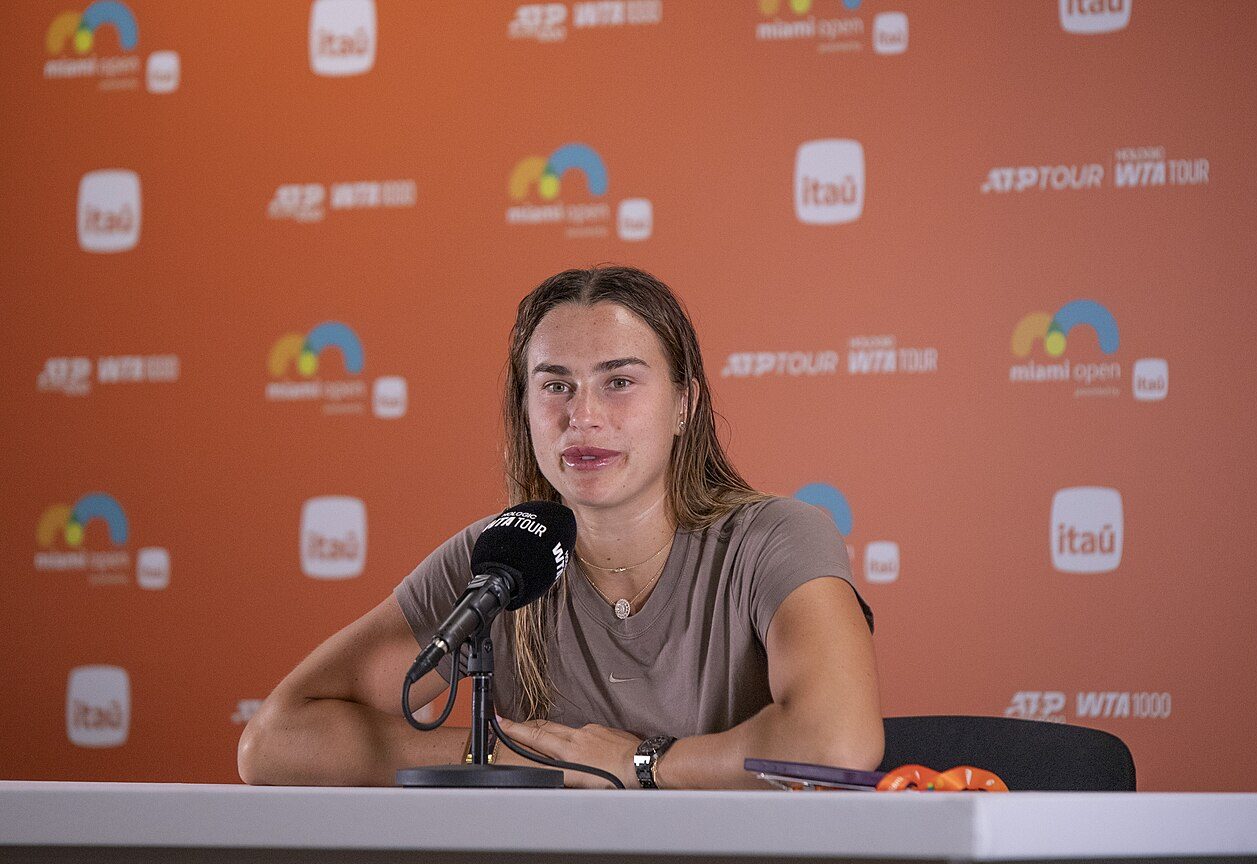
Photo: Vbrunophotog, CC BY-SA 4.0, via Wikimedia Commons