Eight major singles titles, an Olympic gold medal and a career that somehow included both a collapse to No. 141 and a return to world No. 1: Andre Agassi’s story never moved in a straight line.
Born in Las Vegas on April 29, 1970, Andre Kirk Agassi grew up in a house where tennis was less a pastime than a daily demand. His father, Mike Agassi, had represented Iran as a boxer at the 1948 and 1952 Olympics, and he brought that same hard edge to his son’s training. The family’s backyard court became Andre’s first workplace. Long before he was a global star, he was a kid hitting ball after ball under his father’s eye.
At 13, he left home for the Nick Bollettieri Tennis Academy in Florida. That move pushed him into a more serious tennis world, one built around repetition, competition and the expectation that top juniors would become professionals. Agassi turned pro in 1986, still only 16, and it did not take long for the results to catch up with the reputation.
The teenage star with the loud game
His first top-level title came in 1987 at Itaparica in Brazil. By the end of the decade, he was one of the most talked-about young players in men’s tennis: denim shorts, long hair, huge groundstrokes, and a style that felt very different from the sport’s old-country-club image. The look drew attention, but the tennis held it.
Agassi reached the semifinals of the French Open and US Open in 1988, then climbed to world No. 3 in 1989. He was already a major figure on tour before he had won a Grand Slam title, and that early phase of his career carried a strange mix of promise and impatience. He was clearly good enough to contend for the biggest prizes. The question was when he would settle into winning them.
That tension showed in 1990. Agassi reached his first two Grand Slam finals that year, at Roland Garros and the US Open, and lost both, first to Andrés Gómez in Paris, then to Pete Sampras in New York. Still, it was a breakthrough season. He also won the year-end ATP Tour World Championships, beating Stefan Edberg in a five-set final, and helped the United States win the Davis Cup.
Wimbledon changed the picture
Another French Open final slipped away in 1991, this time against Jim Courier. By then, Agassi had become established enough that his losses in major finals were part of the story. He was too talented to be called an underdog, but not yet a champion at the highest level.
Then came Wimbledon in 1992, the title that changed how he was viewed. Agassi had skipped the tournament earlier in his career and was not considered a natural grass-court player. His game was built around taking the ball early from the baseline, not around the classic serve-and-volley patterns that had long dominated the All England Club. Yet he adapted brilliantly and beat Goran Ivanišević in five sets in the final for his first Grand Slam singles title.
That same year, he again helped the United States win the Davis Cup. Suddenly the player once treated as a flashy outsider had a Wimbledon trophy and a central place in the sport.
Andre Agassi and the climb to No. 1
The next few seasons filled out his résumé. He won the US Open in 1994, beating Michael Stich in the final after entering the tournament unseeded. It remains one of the most striking runs of his career. In 1995, he won the Australian Open for the first time, defeating Sampras in the final, and on April 10 of that year he rose to world No. 1 for the first time.
Andre Agassi would spend 101 weeks at the top ranking across his career. For a while, it looked as if the sport’s balance of power might tilt his way. But the 1990s men’s game was crowded with rivals, and none mattered more than Sampras.
Their rivalry framed much of Agassi’s career. Sampras led the head-to-head 20-14 and beat him in three US Open finals, in 1990, 1995 and 2002, as well as the 1999 Wimbledon final. Agassi, though, was never just a supporting character in Sampras’s era. He won across all surfaces, stayed relevant into a new generation, and built a body of work that was broader than almost anyone’s.
The slump that nearly swallowed everything
The sharpest turn in his career came in the late 1990s. Injuries, loss of form and personal turmoil all played a part. By the end of 1997, his ranking had fallen to No. 141. For a former world No. 1, that was not a dip. It was a collapse.
What followed became one of the defining comebacks in modern tennis. Agassi went back to the Challenger circuit, rebuilt his fitness and stripped his game down to its essentials. The image changed too. The long hair was gone. The showman’s exterior gave way to something leaner and more direct.
By 1998 he was climbing again. Then, in 1999, the comeback reached full force.
The French Open, the Career Grand Slam and a second act
Roland Garros had been the missing piece. Agassi had lost in the French Open final twice before, and clay was supposed to reward patience more than the early-strike aggression that defined his game. But in 1999 he fought through to the title, beating Andriy Medvedev in five sets after coming back from two sets down in the final.
That victory completed the Career Grand Slam. He became only the fifth man in the Open Era to win all four major singles titles, and later added the US Open crown that same season. He also reached the Wimbledon final, where Sampras beat him again.
The scale of that year is easy to miss if it is reduced to a list. Agassi did not simply win another major. He rebuilt his career from the edge of irrelevance and turned himself back into the most complete player in the men’s game.
Why the Australian Open suited him so well
If one tournament came to feel like his natural home, it was the Australian Open. Agassi won there four times, 1995, 2000, 2001 and 2003, and for long stretches he looked almost untouchable on those hard courts.
The reasons were technical as much as statistical. His return of serve was among the best the sport has seen. He read direction early, took the ball on the rise and redirected pace with unusual control. Against big servers, he did not just block the ball back; he often turned the return into the first attacking shot of the rally.
That skill made him especially dangerous on hard courts, but it also explains why his success traveled. Wimbledon in 1992 proved he could adapt to grass. The French Open title in 1999 showed he could win the slowest, most physically demanding major as well.
Playing style: early timing, clean hitting, relentless pressure
Agassi played right-handed with a two-handed backhand, but those basics do not quite capture what made him difficult to face. His game was about time, or rather, taking it away.
He stood on or inside the baseline, met the ball early and hit flat, penetrating groundstrokes that rushed opponents into shorter decisions. His backhand was compact and dependable, his forehand powerful without being wild, and his return game set the tone for everything else. On a good day, he made even elite players feel hurried.
He finished his career with 60 singles titles, including 17 Masters titles, eight Grand Slam singles titles and the singles gold medal at the 1996 Atlanta Olympics. That Olympic win made him a Career Golden Slam champion in singles when combined with his four major titles.
Life away from the court
Off the court, Agassi remained one of tennis’s most visible figures, but the more durable part of that visibility has been his work in education and philanthropy. The Andre Agassi Charitable Foundation raised substantial funds for at-risk children in Las Vegas, and the Andre Agassi College Preparatory Academy opened there in 2001.
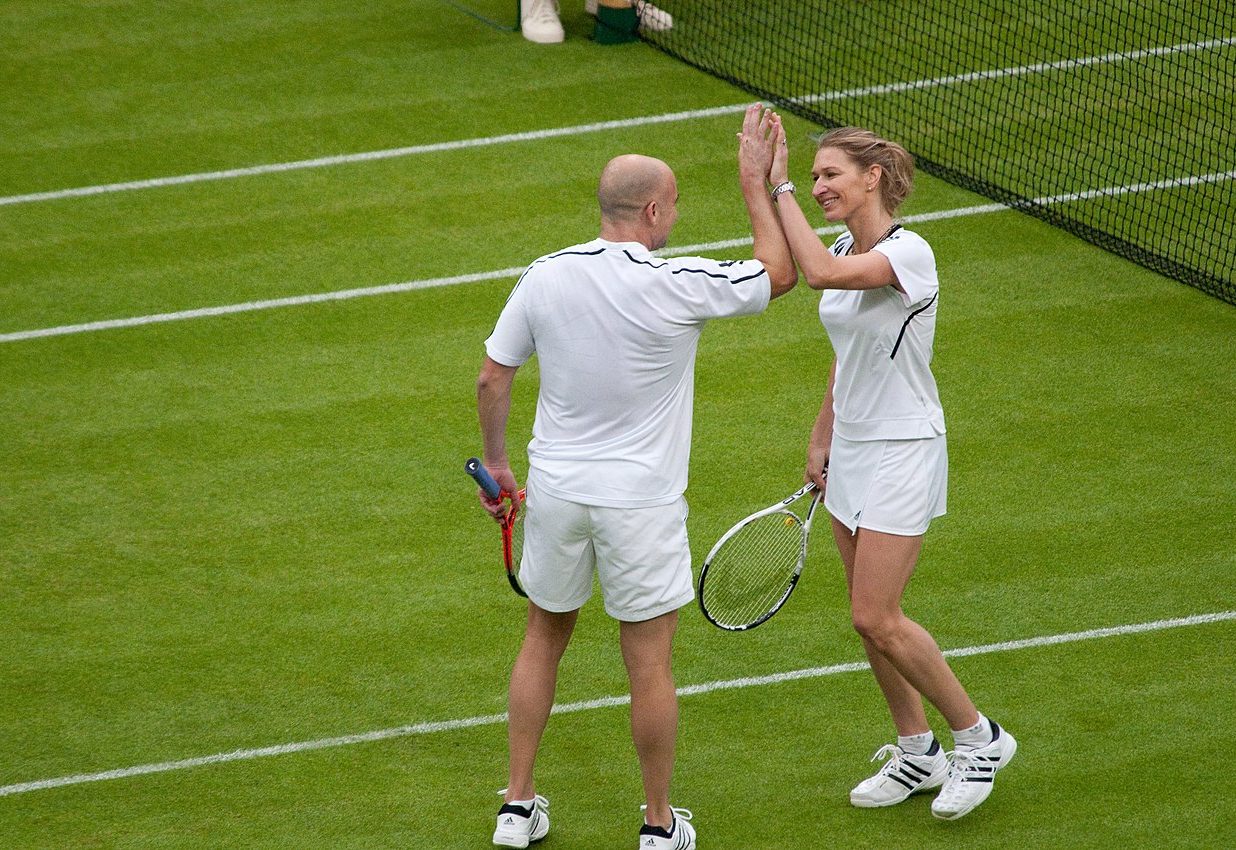
His personal life drew attention too. He married Steffi Graf in 2001, creating one of tennis’s most famous couples. They have two children and have long been associated with Las Vegas.
Some of the most widely discussed details of his private life came from his autobiography, Open. In that book, Agassi wrote that he used crystal meth in 1997 and lied to the ATP about it after failing a drug test. He also wrote that he wore a hairpiece during the 1990 French Open and worried it might come off during the final. Because those accounts come from Agassi himself, they are not rumor; they are part of his published version of events.
Other stories around him need more careful framing. He dated Barbra Streisand in the early 1990s, something both were open about publicly. Claims about his musical tastes, including reported affection for Barry Manilow and Celine Dion, have circulated in media features, but they belong more to celebrity trivia than to the core of his tennis story.
Agassi has also had business interests beyond the sport, including ventures linked to real estate and sports equipment. In retirement, he remained connected to tennis in shorter coaching roles, most notably with Novak Djokovic in 2017 and 2018.
The final years on tour and retirement
Agassi’s last phase as a player stretched his relevance into a new era. He reached the US Open final in 2002, losing to Sampras, and won his final major at the 2003 Australian Open. In 2005, at an age when most of his early rivals were gone, he made one more Grand Slam final at the US Open before losing to Roger Federer.
He retired after the 2006 US Open, leaving the court with a résumé that covered almost every major marker in the sport: world No. 1, a Career Grand Slam, Olympic gold, Davis Cup success and longevity across multiple generations of opponents. He was inducted into the International Tennis Hall of Fame in 2011.
For all the image changes and career swings, the core of the Andre Agassi story stayed remarkably consistent. He was a baseline player who took the ball earlier than almost anyone, a champion on every surface, and a rare star whose second act was as compelling as his first.
FAQ
How many Grand Slam titles did Andre Agassi win?
Andre Agassi won 8 Grand Slam singles titles.
Did Andre Agassi complete the Career Grand Slam?
Yes. He completed the Career Grand Slam by winning the 1999 French Open.
Who is Andre Agassi married to?
He is married to Steffi Graf.
When did Andre Agassi retire?
He retired after the 2006 US Open.
What was Andre Agassi’s highest ranking?
His career-high ranking was world No. 1.
Where is Andre Agassi from?
He was born in Las Vegas, Nevada, in the United States.
Photo: Chris Eason from London, CC BY 2.0, via Wikimedia Commons