Nine Grand Slam singles titles were on the board before Monica Seles turned 20. Few players have ever changed the pace of women’s tennis so quickly, or so young.
Born on December 2, 1973, in Novi Sad, then part of Yugoslavia, Seles grew up in a family that shaped both her game and her temperament. Her father, Karolj Seles, was her first coach, and his methods were unusual enough to become part of tennis lore: he was a professional cartoonist who drew pictures on court to keep practice playful and clear. Her mother, Esther, and older brother, Zoltan, were part of the same close family unit that traveled with her through the early years.
That childhood also explains the stroke production that made her instantly recognizable. Using a racquet that was too heavy for her as a small child, she learned to hit with two hands on both sides. What looked unconventional at first became a weapon. The two-handed forehand and backhand let her take the ball early, redirect pace, and strike with unusual balance from either wing.
The results arrived early. Seles won the Yugoslav 12-and-under title at nine, the European 12-and-under championship at 10, and the Orange Bowl 14-and-under title in 1985. By the time she moved into the Nick Bollettieri Academy in Florida, the outline of a future top player was already visible. The academy sharpened it. The baseline aggression became more relentless, the timing cleaner, the intent unmistakable.
A teenager who took over the tour
Seles turned professional in 1989, and the adjustment period barely existed. She won her first WTA title in Houston that spring, still only 15, and quickly established herself as more than a precocious junior with unusual strokes.
The real breakthrough came the following season in Paris. At the 1990 French Open, she beat Steffi Graf in the final and became the youngest women’s singles champion in tournament history at 16 years, 6 months. It was a result that changed the hierarchy of the sport in one afternoon. Graf was still a towering presence, but Seles had arrived as a force who could hit through anyone.
From there, the rise turned into a rush. She won the season-ending WTA Tour Championships in 1990, 1991 and 1992. She collected major titles across surfaces and built a record that still reads as startling because of how compressed it was.
Her Grand Slam singles titles came in a burst:
- French Open: 1990, 1991, 1992
- Australian Open: 1991, 1992, 1993
- US Open: 1991, 1992
That made eight major singles titles before her 20th birthday, an Open Era record. She also won the first six Grand Slam finals she reached, a measure of how quickly she turned opportunity into trophies.
On March 11, 1991, she rose to world No. 1. In total, Monica Seles spent 178 weeks at the top ranking. For a stretch in the early 1990s, she was the player everyone else had to solve.
Why Monica Seles was so hard to stop
The game looked simple enough from the stands: stand on the baseline, take the ball early, and hit hard. In reality, it was far more disruptive than that.
Seles was left-handed, which already changed angles, but the real pressure came from her ability to attack off both sides without a visible weak wing. She flattened out groundstrokes, redirected pace almost on instinct, and rushed opponents by taking time away from them. On clay, she could pin players behind the baseline. On hard courts, she could make points feel one shot shorter than normal.
She was also loud on contact, her grunts becoming one of the most discussed sounds in the sport. They were controversial in some quarters, but they were also part of the rhythm of her game: explosive, repetitive, and impossible to ignore.
At the Australian Open, where her style was especially effective, she won 33 straight matches before that streak ended later in the decade. At Roland Garros, she became the first woman since Hilde Sperling in the 1930s to win three consecutive titles.
The Graf rivalry, and the context around it
Any Monica Seles biography eventually runs into Steffi Graf, because the two careers were intertwined at the top of the sport.
Graf was the established champion when Seles broke through. Seles then won their most important early meeting in the 1990 French Open final and took over the No. 1 ranking the next year. Their rivalry never had the full uninterrupted length it might have had, but it still defined the era’s central tension: Graf’s athletic elegance and all-court speed against Seles’s blunt, early-striking power.
By the spring of 1993, Seles had won eight majors and was still only 19. She was the top-ranked player in the world and, by results, the dominant one.
Then everything changed in Hamburg.
The stabbing in 1993
On April 30, 1993, during a quarterfinal match against Magdalena Maleeva at a tournament in Hamburg, Seles was stabbed in the back during a changeover by Günter Parche, a man later identified as an obsessed fan of Graf.
The physical injury healed far faster than the emotional damage. Seles stepped away from the tour for more than two years. In later interviews and in her memoir, she spoke openly about the depression, trauma and struggles with disordered eating that followed. Parche received a suspended sentence and did not serve prison time, a detail that remains part of the anger surrounding the case.
It is impossible to tell her tennis story honestly without treating that day as the dividing line. Before Hamburg, she was building one of the most overwhelming teenage runs the sport had seen. After Hamburg, every result carried the weight of what had been interrupted.
The comeback and the second chapter
When Seles returned in August 1995, the response from the tennis world was emotional, but the tennis itself mattered just as much. She did not come back for exhibitions or nostalgia. She came back to compete at the top.
Her first event back was in Toronto, where she won the title. Then she reached the US Open final that same season, losing to Graf. It was a reminder of both truths at once: Seles was still elite, and the sport she had once controlled so completely had moved on during her absence.
She added one more major at the 1996 Australian Open, beating Anke Huber in the final for her ninth and last Grand Slam singles title. That victory gave her four Australian Open crowns in total and confirmed that the comeback was not symbolic. It produced major success.
There were more deep runs after that. She reached the US Open final again in 1996 and the French Open final in 1998. Wimbledon remained the missing piece in her résumé. She made the final there in 1992, losing to Graf, but never won the title.
By then, she was representing the United States, having become an American citizen in 1994. She later helped the U.S. win the Fed Cup in 1996, 1999 and 2000, and she earned an Olympic bronze medal in singles at the Sydney Games.
The second chapter of her career was strong enough on its own terms: major final appearances, another Slam title, team success, and a long presence near the top of the game. What it did not become was a return to the relentless accumulation of titles that marked her first act. That is not a criticism so much as the plain reality of what had happened to her career.
Injuries, retirement and the numbers
A foot injury in 2003 effectively ended her time as a regular competitor. Her last match on tour came at the 2003 French Open, and she formally announced her retirement in 2008.
By the end, Monica Seles had won 53 singles titles and 6 doubles titles. Her official WTA prize money totaled $14,891,762. She was inducted into the International Tennis Hall of Fame in 2009.
Those numbers matter, but they only tell part of the story. The larger measure is influence. Seles helped normalize a more aggressive baseline style in women’s tennis, and she did it with a game that looked unlike anyone else’s.
Monica Seles off the court
Away from competition, her life has been public in careful, selective ways. She became a U.S. citizen in the mid-1990s and has long been associated with Florida. Reports and public references have linked her to Sarasota, and later to the Orlando area, though private residence details are best treated cautiously unless she has confirmed them directly.
She has written books, including the memoir Getting a Grip: On My Body, My Mind, My Self, which dealt candidly with the aftermath of the stabbing and her relationship with food. She has also appeared in television projects, including Dancing with the Stars.
Her personal life has also drawn attention. Seles has been married to businessman Tom Golisano since 2014, according to widely published reports. That is a well-documented part of her public biography, unlike the many celebrity-style claims that often circulate online without sourcing.
She has also spoken publicly about health. In a later interview with People, she shared that she had been diagnosed with myasthenia gravis, an autoimmune neuromuscular condition. Because health disclosures depend on what a person chooses to make public, that belongs in her story only because she discussed it herself.
What does not belong as fact are vague assessments about her “competitive energy” after the comeback. Some commentators and retrospective profiles have argued that she was never quite the same player psychologically after 1993, but that is interpretation, not a statistic. The record shows enough on its own: another major title, more Slam finals, and years of high-level tennis after an event that would have ended many careers entirely.
FAQ
How many Grand Slam singles titles did Monica Seles win?
She won 9 Grand Slam singles titles.
When was Monica Seles stabbed?
She was stabbed on April 30, 1993, during a match in Hamburg.
Who stabbed Monica Seles?
The attacker was Günter Parche, who was later identified as an obsessed fan of Steffi Graf.
Did Monica Seles ever win Wimbledon?
No. She reached the Wimbledon final in 1992 but did not win the title.
When did Monica Seles retire?
Her last tour match was in 2003, and she officially announced her retirement in 2008.
Is Monica Seles married?
Yes. According to widely reported public accounts, she has been married to Tom Golisano since 2014.
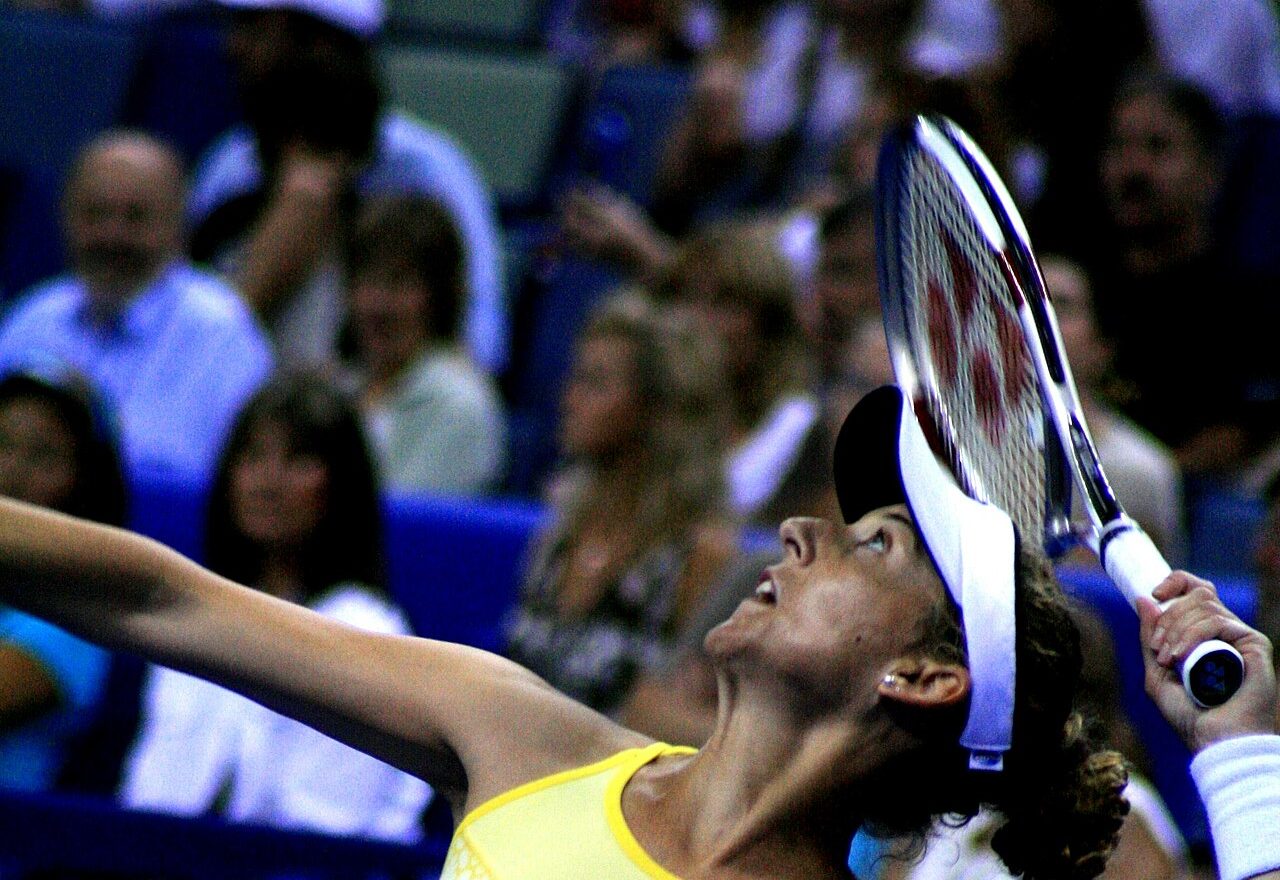
Photo: Stacey Warnke from New Orleans, LA, CC BY-SA 2.0, via Wikimedia Commons