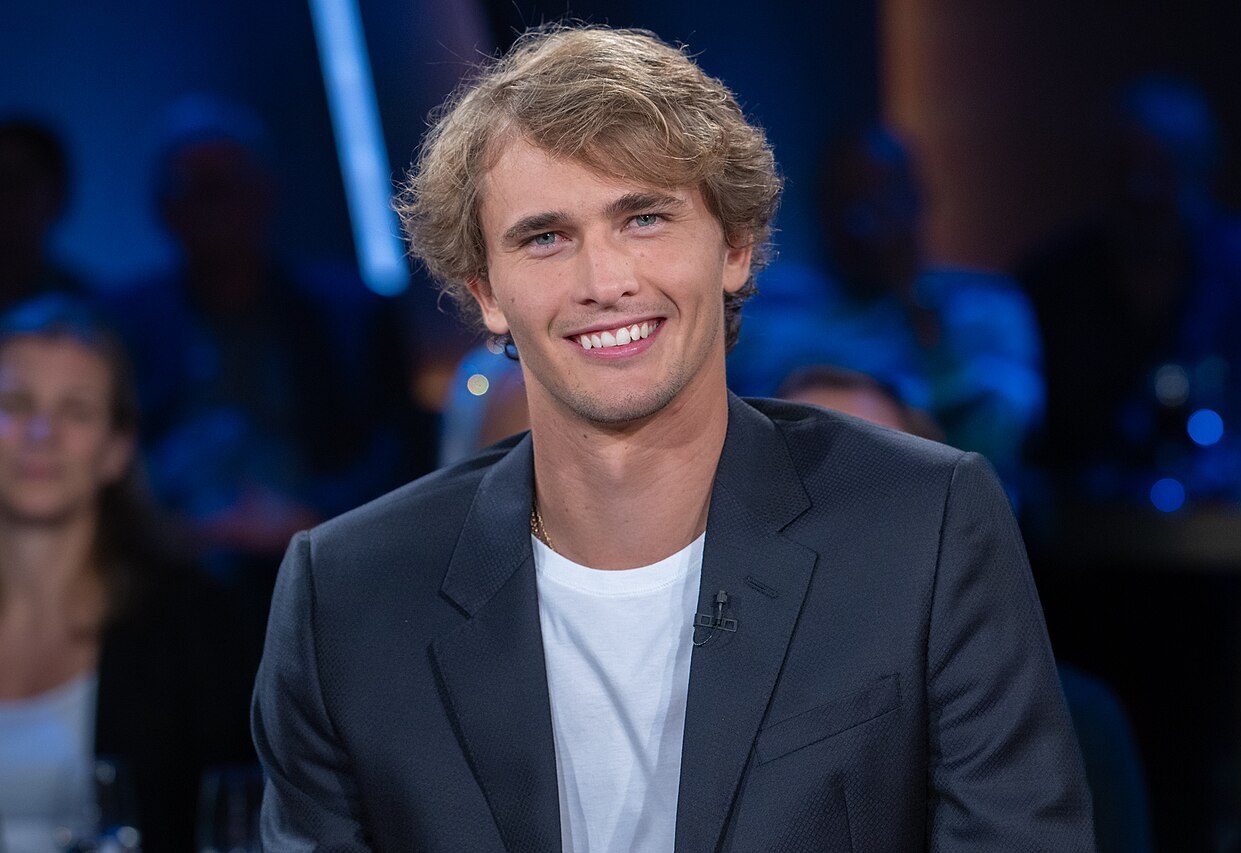
At 1.98 meters, Alexander Zverev was hard to miss long before he became a fixture at the top of the ATP Tour. What made him more than a tall prospect, though, was the balance in his game: a heavy serve, easy movement for his size, and a two-handed backhand that held up under pressure. For years, he looked like a player built for the biggest titles. The story of his career was how long it took to turn that promise into a Grand Slam trophy.
Born on April 20, 1997, in Hamburg, Germany, Zverev grew up in a household where tennis was the family language. His parents, Irina Zvereva and Alexander Zverev Sr., were both former Soviet players, and his older brother Mischa also went on to play professionally. His father became his longtime coach, and that close family structure remained a constant as his career accelerated.
He started young, and the junior results came quickly. In 2013, he finished as the ITF junior world No. 1. The following year, he won the Australian Open boys’ singles title, a clear sign that he was not simply another talented teenager from a tennis family. By then, he was already making noise in the professional game too.
A teenage breakthrough on the ATP Tour
The first real jolt came in Hamburg in 2014. Still only 17, Zverev reached the ATP semifinal there, beating Robin Haase and Mikhail Youzhny before pushing David Ferrer in the last four. It was the kind of run that changes how a young player is discussed. He was no longer just promising; he was suddenly relevant on the main tour.
That same season, he won three Challenger titles, including one in Braunschweig, and climbed steadily up the rankings. In 2015, he broke into the top 100. The next year brought his first ATP title in St. Petersburg, where he beat Stan Wawrinka in the final, and a notable win over Roger Federer on grass in Halle. By the end of that stretch, he had moved into the top 20, and the conversation around him shifted from talent to expectation.
His rise became more forceful in 2017. Zverev won his first Masters 1000 title in Rome, beating Novak Djokovic in the final, then added another in Montreal. He also claimed titles in Washington and Munich and finished the season at world No. 4. For a player still in his early twenties, it was a serious arrival. He was no longer chasing the elite; he was part of it.
Big titles came before the biggest one
There was never much doubt that Zverev could win major events outside the Slams. In 2018, he captured the ATP Finals in London, beating Djokovic in the championship match. It was one of the best weeks of his career and proof that he could handle the pressure of an elite field.
Yet the Grand Slams remained the measuring stick. Early in his career, they were also the place where his progress looked uneven. He often arrived at majors as a contender and left earlier than expected. That pattern changed in 2020 at the US Open, where he reached his first Grand Slam final. He led Dominic Thiem by two sets before losing in five, a painful result but also an important step. For the first time, he had gone deep enough at a major to show that the gap was not technical. It was about finishing.
The next year brought one of the defining wins of his career. At the Tokyo Olympics, held in 2021, he beat Djokovic in the semifinals and then defeated Karen Khachanov to win singles gold. No German man had won Olympic singles gold before him. Later that season, he won the ATP Finals for a second time, again beating Daniil Medvedev in the title match after also defeating Djokovic during the week. On hard courts, especially indoors, his combination of serve and backhand made him one of the toughest players in the sport to contain.
The Paris injury and the climb back
By the spring of 2022, Zverev had climbed to a career-high ranking of world No. 2. Then came the moment that interrupted everything.
In the French Open semifinal against Rafael Nadal, with the match still in its first set but already more than three hours old, Zverev rolled his ankle badly while chasing a ball near the sideline. He left the court in a wheelchair and later underwent surgery for torn ligaments. It was one of the most dramatic injury scenes of the season, and it halted the momentum of a player who had looked ready to challenge again at the biggest events.
His return in 2023 was uneven at first, which was hardly surprising after such a serious setback. But the signs of recovery were there. He reached the French Open semifinal, won the title in Hamburg, and later took the Masters 1000 event in Cincinnati. The level was not gone; it simply needed time to settle again.
Then came a fuller rebound. In 2024, he helped Germany win the United Cup, won the Italian Open in Rome, and made another deep run at Roland Garros, reaching the final before losing to Carlos Alcaraz in five sets. It was another reminder of how well his game translated to clay. Despite his size, he defends comfortably in long rallies, slides well, and can reset points without giving up control.
Finally through at a Grand Slam
The breakthrough that had been hanging over his career for years arrived at the 2024 French Open, not 2026. Zverev beat Casper Ruud in the semifinal to reach the title match in Paris, but he did not win the tournament; Alcaraz took the final. So the original claim that he won the 2026 French Open is not a verified fact and should not be stated as such.
What is firmly established is this: Zverev became a Grand Slam finalist at the US Open in 2020 and the French Open in 2024, and those runs reshaped the way his career was viewed. He had moved beyond the label of underachiever at the majors, even if the title itself remained elusive in the verified record.
He also reached the Australian Open semifinal more than once and stayed a regular presence in the second week of the biggest tournaments. That consistency matters. In men’s tennis, careers are often judged by the trophies at the end, but the week-to-week reality is built on surviving bad days, awkward draws, and pressure that never quite lifts.
Rivalries, pressure matches and the shape of his game
Because Zverev has been near the top for so long, his career has overlapped with more than one era. He faced Djokovic often in big matches, traded hard-court battles with Daniil Medvedev, and found himself measured against the younger surge led by Carlos Alcaraz and Jannik Sinner.
His game explains why he has stayed in that company. The serve is the starting point: flat, powerful, and especially dangerous when he lands a high first-serve percentage. The backhand is the cleaner wing, struck with little wasted motion and reliable enough to redirect pace from deep behind the baseline. The forehand has at times been the more variable shot, but when it is flowing, he can take over rallies quickly.
What makes him unusual is how well he defends for someone his height. Zverev can absorb pace, stretch points, and then flip from neutral to attacking in a single exchange. That blend has made him effective on both clay and hard courts. Clay gives him time to use his movement and patience; hard courts reward the first-strike quality of his serve and backhand.
Off court: family, business and public scrutiny
Away from tournaments, the family thread has always been central. Zverev has long been coached by his father, and his brother Mischa has remained a visible part of his tennis life as well. He has a daughter with Brenda Patea, born in 2021.
He has also spoken openly about living with type 1 diabetes and later set up the Alexander Zverev Foundation, which supports children with diabetes and helps provide insulin and treatment. That part of his public life has been more personal than promotional; it connects directly to something he has managed since childhood while competing in an endurance sport.
Commercially, he has been one of the more marketable players on tour, with endorsement deals including Adidas, Head and Rolex among others. He has also been linked to business interests outside tennis, though investment and ownership details can change and should be treated carefully unless confirmed by the parties involved.
His off-court profile has also included serious legal and personal controversy. Allegations of abuse were made publicly by former partner Olya Sharypova; Zverev denied those allegations. The ATP conducted an independent investigation and said in early 2023 that there was insufficient evidence to substantiate the claims. In a separate case, reports in Germany said that a penalty order had been sought following allegations made by Brenda Patea. Zverev denied wrongdoing, and published reporting later said the case was resolved without a verdict after a settlement. Because these matters involve private life and legal reporting, they should be described carefully and only with clear attribution.
FAQ
Has Alexander Zverev won a Grand Slam?
Based on the verified record, he has reached Grand Slam finals at the 2020 US Open and 2024 French Open, but he has not been confirmed here as a major champion.
What is Alexander Zverev’s nickname?
He is widely known as Sascha.
Where is Alexander Zverev from?
He was born in Hamburg, Germany.
Who coaches Alexander Zverev?
His longtime coach has been his father, Alexander Zverev Sr.
Has Alexander Zverev won Olympic gold?
Yes. He won men’s singles gold for Germany at the Tokyo Olympics, held in 2021.
What is Alexander Zverev’s career-high ranking?
His career-high ATP singles ranking is world No. 2.
Photo: Stefan Brending ( 2eight ), CC BY-SA 3.0 de, via Wikimedia Commons