Nine Wimbledon singles trophies still stand as the women’s record. Add 18 major singles titles, 31 in women’s doubles and 10 in mixed, and Martina Navratilova’s career starts to look less like a run of success than a complete remaking of what a tennis player could be: fitter, bolder at the net, and durable well beyond the usual limits of the sport.
Martina Navratilova: from Prague prodigy to champion in exile
She was born Martina Šubertová in Prague on October 18, 1956, in what was then Czechoslovakia. Tennis was woven into family life. Her mother, Jana, played and taught sport; her stepfather, Miroslav Navrátil, became her first serious coach and gave her the surname the world would come to know. By childhood, the game was already central.
There was loss early on too. Her biological father died when she was young, and the household she grew up in was shaped by both discipline and instability. What emerged from it was a gifted left-hander with unusual ambition and a game that did not wait politely for rallies to develop.
By 15, she had won the Czechoslovak national championship, taking the title in 1972. She turned professional in 1975 after already competing on the international circuit as a teenager. The rise was quick. So was the pressure of trying to build a career while living under a restrictive political system.
That tension came to a head at the 1975 US Open, when Navratilova sought political asylum in the United States at 18. It was one of the defining acts of her life, not just her career. She left Czechoslovakia with little certainty about what came next, and for a time she was effectively cut off from home. The move gave her freedom, but it also came with loneliness, scrutiny and the practical challenge of starting over in public.
Even before the titles arrived, the results showed what was coming. In 1975 she reached major finals at the Australian Open and the French Open, losing both to Evonne Goolagong and Chris Evert respectively, and she made the US Open semifinals. She was no longer simply a prospect from Eastern Europe. She was already in the sport’s top tier.
First Wimbledon title and the climb to world No. 1
The breakthrough that changed her status came at Wimbledon in 1978. In the final she beat Chris Evert in three sets, 2-6, 6-4, 7-5, to win her first Grand Slam singles title. It was a fitting place for her arrival. Grass rewarded her instincts: the left-handed serve, the quick first volley, the willingness to move forward when others hesitated.
She first reached world No. 1 in singles in 1978 and would spend 332 weeks there in total. In doubles, she later added 237 weeks at No. 1. She remains the only player to have spent more than 200 weeks ranked first in both disciplines, one of those records that says as much about range as it does about dominance.
Navratilova became a US citizen in 1981. Much later, she regained Czech citizenship, giving her dual Czech-American nationality. That long arc, from Prague to exile to belonging in more than one place, remained part of her story long after the tennis had become familiar.
The years when Martina Navratilova overwhelmed the tour
The early 1980s turned excellence into control. She won the Australian Open singles title in 1981, added the French Open in 1982, then began stacking up the biggest trophies with startling regularity. Her rivalry with Evert sharpened her, but so did a deeper transformation in her own approach to training. Navratilova became one of the first women’s players to make elite conditioning a central competitive weapon, treating fitness, diet and strength work as part of the craft rather than side notes.
The results were relentless. She won Wimbledon six straight times from 1982 through 1987, part of a total of nine singles titles there: 1978, 1979, 1982, 1983, 1984, 1985, 1986, 1987 and 1990. No woman has won more Wimbledon singles championships.
Her other major singles titles filled out one of the most complete records in the Open Era. She won the Australian Open three times, the French Open twice and the US Open four times. In all, she finished with 18 Grand Slam singles titles.
Then there is the wider total, which is almost absurd in scale: 59 major titles across singles, women’s doubles and mixed doubles. That includes 31 women’s doubles titles and 10 mixed doubles crowns. She also completed the career Grand Slam in singles, doubles and mixed doubles, the full “boxed set” of major titles across all three disciplines.
Outside the Slams, the title counts are just as striking. Navratilova won 167 singles titles and 177 doubles titles, both Open Era records. At the season-ending championships, she won eight singles titles. No padding is needed here; the numbers do the work.
Two seasons in particular capture the force of her peak. In 1983, she went 86-1 in singles, one of the best winning percentages the sport has seen. Across 1983 and 1984, she put together a 74-match winning streak, the longest in women’s professional tennis in the Open Era.
Chris Evert, Steffi Graf and the matches that defined an era
Every great career is partly written through its rivals, and Navratilova’s most important was Chris Evert. They played 80 times, with Navratilova leading 43-37. That volume alone is extraordinary. For more than a decade they kept meeting in finals, semifinals and title matches, forcing each other to adjust constantly.
Evert’s steadiness from the baseline met Navratilova’s attacking instincts head-on. Their contrast in styles made the rivalry easy to understand, but the real substance was in how often the stakes were high. Wimbledon finals, US Open finals, year-end championships, they kept arriving at the same place.
Later, Steffi Graf became the player who interrupted Navratilova’s hold on the top. Navratilova lost the Wimbledon finals of 1988 and 1989 to Graf, and she also fell to her in the 1987 French Open final. Those defeats mattered because they showed the other side of a long career: not just domination, but adaptation, resistance and the refusal to disappear when a younger champion arrived.
One of the most memorable late moments came at Wimbledon in 1994. At 37, Navratilova reached the singles final one last time before losing to Conchita Martínez. It was not a title, but it was a reminder of how long she had remained relevant at the sport’s most demanding level.
Playing style: left-handed pressure, first-volley precision
Some champions control points by attrition. Navratilova preferred to seize them early.
She played left-handed with a one-handed backhand and built her game around serve-and-volley tennis, quick transitions forward and exceptional work at the net. Her serve dragged opponents wide; the next shot often landed at their feet. On grass and indoor courts, that pattern could feel suffocating. On hard courts, it was nearly as effective because she moved so well and read passing shots so early.
What made her different was not simply that she attacked, but that she attacked with structure. The first volley was rarely decorative. It was placed to open the court or end the point. Her overhead was reliable, her reflexes sharp, and her court coverage better than many baseline players despite how often she was moving in the opposite direction.
She also changed expectations around preparation. Strength training and conditioning are standard now. In her prime, they were far less common in the women’s game. Navratilova helped push that shift.
Retirement, return in doubles, and life beyond the baseline
She stepped away from full-time singles after 1994, but that was not the end of her competitive story. Navratilova returned to tour-level doubles and mixed doubles later on and extended her major record deep into her forties. Her final Grand Slam title came in mixed doubles at the 2006 US Open, where she partnered Bob Bryan. She was 49.
That late chapter matters because it fits the rest of the career: versatility, longevity and a refusal to be boxed into one version of herself.
Away from competition, she moved naturally into broadcasting and writing. She has worked as a television analyst, including for Tennis Channel and the BBC’s Wimbledon coverage, and she published an autobiography, Martina, as well as fiction. Her public voice remained prominent because she had never been only a former player; she had long been a public figure.
Martina Navratilova off court: public life, marriage and health
Long before many athletes felt safe doing so, Navratilova lived openly as a gay woman. That made her a significant figure beyond tennis, though it also exposed her to years of attention that went far beyond sport. In 2014, she married Julia Lemigova in New York.
Some reports and entertainment coverage have linked the couple to The Real Housewives of Miami through Lemigova’s role on the show; where that is mentioned, it is best understood as a pop-culture footnote rather than a central part of Navratilova’s biography.
Her advocacy has covered LGBTQ rights, animal welfare and other public causes. She has also remained outspoken on contentious issues, which has at times brought criticism alongside support. Where those disputes belong in her story, they belong as part of her public life, not as gossip.
There was also a serious health chapter late in life. Navratilova announced that she had been diagnosed with throat and breast cancer, and later said she was cancer-free after treatment. As with so much else in her life, the news was handled in public.
What remains most striking, though, is the shape of the whole career. Prague prodigy. Defector. Wimbledon champion. Singles No. 1. Doubles No. 1. Rival, pioneer, broadcaster, activist. Few tennis lives have covered so much ground.
FAQ
How many Grand Slam titles did Martina Navratilova win?
She won 59 major titles in total: 18 singles, 31 women’s doubles and 10 mixed doubles.
How many Wimbledon singles titles did Martina Navratilova win?
She won nine Wimbledon singles titles, the women’s record.
What was Martina Navratilova’s playing style?
She played aggressive left-handed serve-and-volley tennis, with elite net play, strong movement and all-court variety.
When did Martina Navratilova become world No. 1?
She first reached world No. 1 in singles in 1978. She spent 332 weeks at No. 1 in singles and 237 weeks at No. 1 in doubles.
Is Martina Navratilova married?
Yes. She married Julia Lemigova in 2014.
When did Martina Navratilova retire?
She retired from full-time singles after 1994 and ended her professional playing career in 2006.
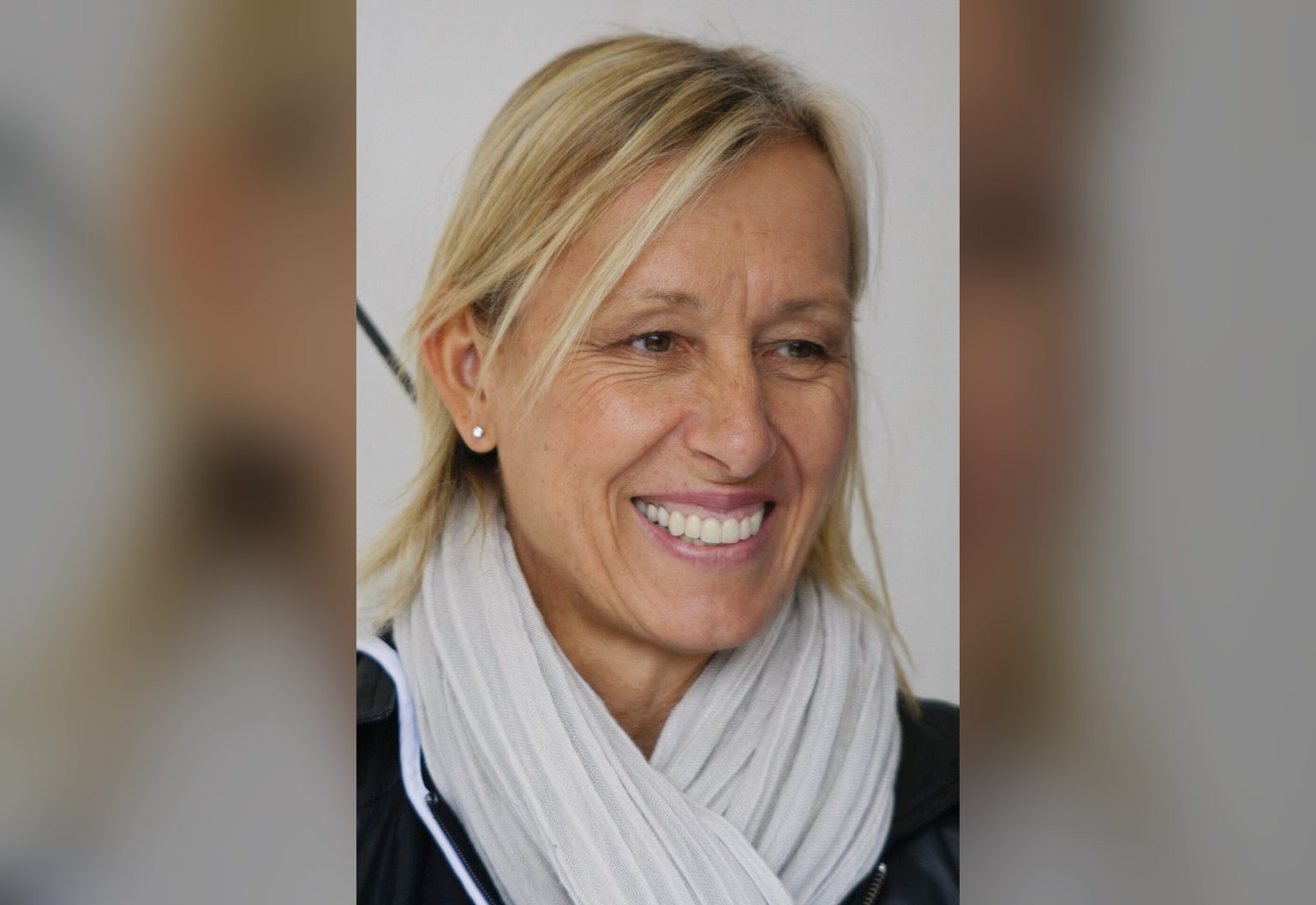
Photo: Andrew Campbell, CC BY 2.0, via Wikimedia Commons