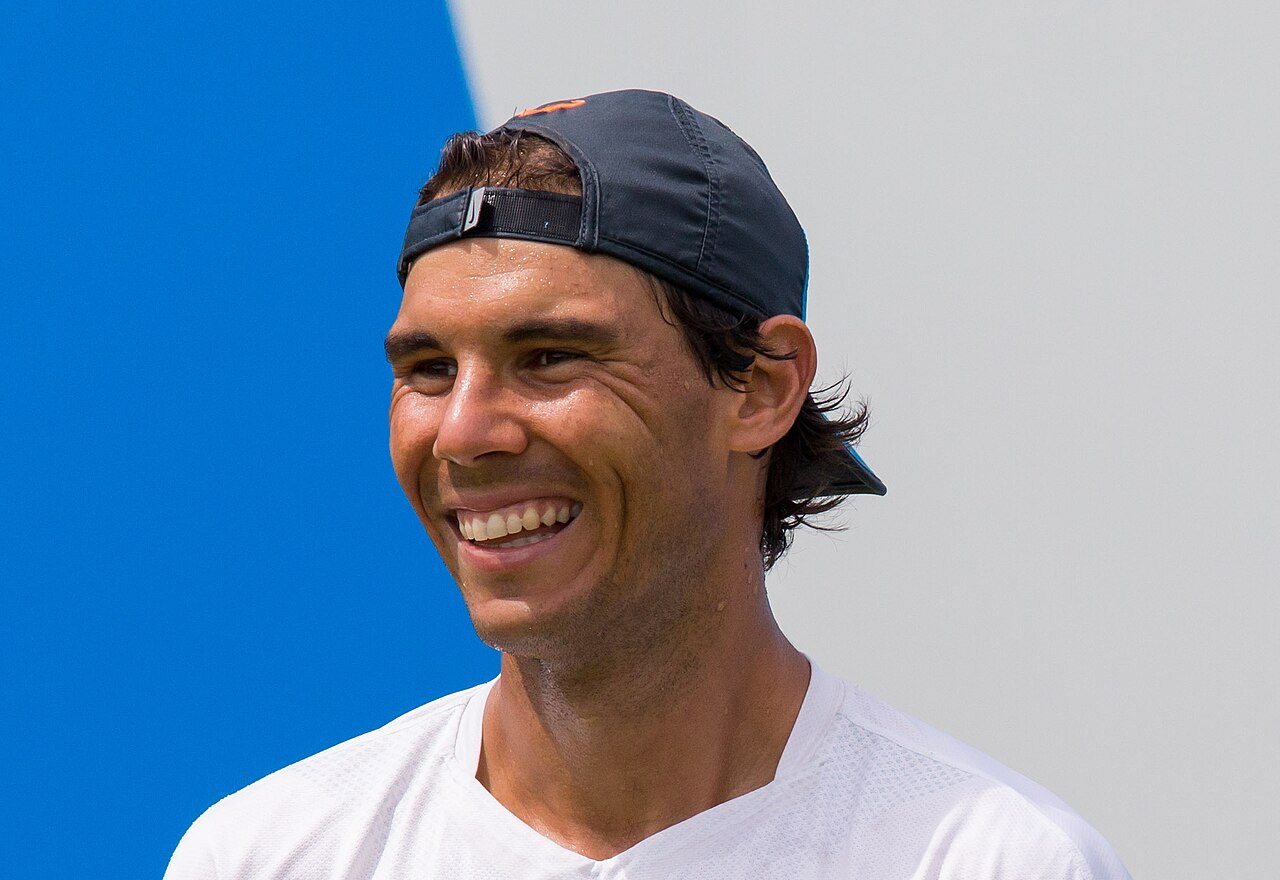
Fourteen times, Rafael Nadal walked off Court Philippe-Chatrier as the champion. That number still looks unreal, even in a sport used to big records. By the time he stepped away in November 2024, the man from Mallorca had won 22 Grand Slam singles titles, 92 ATP singles titles, Olympic gold in singles and doubles, and built a career that stretched far beyond clay.
From Manacor to the tour
Rafael Nadal Parera was born on June 3, 1986, in Manacor, Mallorca. Sport was everywhere around him. His uncle Miguel Ángel Nadal played professional football for Barcelona and Spain, while another uncle, Toni Nadal, became the coach who shaped his tennis from early childhood.
That partnership with Toni defined the first chapter of his career. Nadal was naturally right-handed, but he was encouraged to play left-handed, a choice that later gave his forehand its awkward, high-bouncing weight. Off court, he still wrote with his right hand, one of those small details that followed him throughout his career.
As a boy, he played football and tennis, and by some accounts he preferred football for a time. Tennis won out quickly. He developed on the courts of Mallorca, away from the usual academy conveyor belt, and his progress was obvious early. In 2001, he helped Spain win the Junior Davis Cup. The next year, he reached the Wimbledon boys’ singles semifinals, a useful early clue that his game would travel.
He turned professional in 2001. On April 29, 2002, still only 15, he beat Ramón Delgado in Mallorca to become one of the youngest players to win an ATP match in the Open Era.
A teenage breakthrough
The rise did not take long. In 2003, Nadal reached the third round at Wimbledon on his debut there, an impressive result for a teenager more closely associated with clay. Injuries interrupted him early too, a theme that would return often, but they did not stop his momentum.
His first ATP singles title came in August 2004 in Sopot, where he beat José Acasuso in the final. Later that year, he helped Spain win the Davis Cup, defeating Andy Roddick in the final rubber of the tie against the United States. He was still a teenager, but already trusted on a big stage.
Then came the season that changed everything. In 2005, Nadal won 11 singles titles and announced himself as a force almost everywhere, but especially on clay. At Roland Garros, on his tournament debut, he beat Mariano Puerta in four sets to win the French Open. He was 19. No player had ever looked more immediately at home in Paris.
Roland Garros became his court
The record at the French Open is the headline number of Nadal’s career: titles in 2005, 2006, 2007, 2008, 2010, 2011, 2012, 2013, 2014, 2017, 2018, 2019, 2020 and 2022. Fourteen championships at one major is unmatched in men’s or women’s singles.
The dominance was not limited to Paris. On clay, he put together an 81-match winning streak between 2005 and 2007, the longest single-surface run in the Open Era. Opponents knew what was coming and still struggled to stop it: the heavy topspin forehand, the scrambling defense, the ability to turn a neutral rally into a physical test, and the refusal to let points end easily.
That is why the label stuck. “King of Clay” was not marketing. It was simply the most convenient shorthand for a body of results the sport had never seen.
Still, calling him only a clay-court player misses too much. Nadal kept adding range to his game, especially on grass and hard courts, until he had one of the most complete résumés in tennis history.
Federer, Wimbledon and the move to No. 1
Some of Nadal’s most important early losses came against Roger Federer. He reached the Wimbledon final in 2006 and 2007 and lost both times to the Swiss. Those defeats mattered because they framed the rivalry and showed how quickly Nadal was expanding beyond clay.
In 2008, he broke through. First came another French Open title, this time with a lopsided final win over Federer. Then came Wimbledon, where Nadal beat Federer in a five-set final that stretched into near darkness and became one of the defining matches of the era. A few weeks later, he won Olympic singles gold in Beijing and, in August, rose to world No. 1 for the first time.
That season completed his climb from teenage prodigy to the top-ranked player in the world. He would spend 209 weeks at No. 1 across his career.
Building a 22-Slam career
Nadal won his first Australian Open in 2009, beating Federer in a five-set final in Melbourne. It was another sign that his game had become truly all-surface.
Then came 2010, one of the pivotal years of his career. He won the French Open, Wimbledon and the US Open, completing the career Grand Slam. Because he had already won Olympic singles gold, he also became one of the few men to complete a career Golden Slam in singles. He was the youngest man in the Open Era to finish the career Slam.
The major titles kept coming. He won the US Open again in 2013, 2017 and 2019. He added a second Wimbledon title in 2010 and, after years of physical setbacks and close calls in Melbourne, a second Australian Open in 2022 with a comeback win over Daniil Medvedev from two sets down.
That left him with 22 Grand Slam singles titles at retirement:
– Australian Open: 2009, 2022
– French Open: 2005-2008, 2010-2014, 2017-2020, 2022
– Wimbledon: 2008, 2010
– US Open: 2010, 2013, 2017, 2019
The defeats in finals help tell the story too. He lost Australian Open finals to Novak Djokovic in 2012, Stan Wawrinka in 2014, Federer in 2017 and Djokovic again in 2019. At Wimbledon, Federer beat him in the 2006 and 2007 finals, and Djokovic did the same in 2011. Nadal also finished runner-up at the US Open in 2011 against Djokovic.
Those names matter. His era was defined by the push and pull between Nadal, Federer and Djokovic, with Andy Murray close behind. Nadal’s rivalry with Federer gave the sport one contrast in styles and personalities; his rivalry with Djokovic became a long, bruising contest of endurance, tactics and nerve.
Titles, medals and the injuries that kept returning
By the end of his career, Nadal had won 92 ATP singles titles and 11 doubles titles. He also collected 36 ATP Masters 1000 titles and reached two ATP Finals championship matches, in 2010 and 2013, though that title eluded him.
In team competition, he was central to one of Spain’s strongest periods. He won the Davis Cup five times: 2004, 2008, 2009, 2011 and 2019. At the Olympics, he added doubles gold in Rio in 2016 alongside Marc López to the singles gold he had won in Beijing.
The other constant was injury. Knees, wrists, ribs, abdominal issues, and most persistently his chronic foot problem all interrupted him at different points. In 2012, knee trouble forced him out for months. In other seasons, he returned from layoffs to win majors almost immediately, which became one of the defining rhythms of his career: setback, doubt, return, trophy.
That resilience shaped how he was seen as much as the silverware did. Nadal’s matches often felt physical even before the first long rally had ended.
How Rafael Nadal played
At first glance, his game looked simple: heavy forehand, deep court position, relentless movement. In reality, it was more layered than that.
The forehand was the signature shot, especially the cross-court ball that leapt high into a right-hander’s backhand on clay. But he was also an excellent competitor on defense, a sharp passer, an underrated volleyer when he moved forward, and a much-improved server in the later stages of his career. On hard courts, he flattened the ball more. On grass, he learned to take time away and finish points faster.
He played left-handed with a two-handed backhand, and his topspin rates became part of tennis folklore. So did his routines. The bottle placement, the avoidance of stepping on lines, the precise order of movements before serving, all of it became familiar to anyone who watched him regularly. Whether those habits were ritual, routine or simply structure, they were part of the competitive identity he carried onto court.
Life away from tennis
Home remained important throughout his career. Nadal built his life in Mallorca and married María Francisca Perelló, widely known as Mery Perelló, in 2019. The couple have a son, born in 2022.
His biggest off-court project is the Rafa Nadal Academy in Manacor, which opened in 2016 and became a major part of his post-playing identity even before retirement. He also founded the Rafa Nadal Foundation in 2008 with his mother, focused on educational and social projects for vulnerable children and young people.
There were other business interests too. Nadal became linked with hospitality ventures including the ZEL brand, and in 2024 he was named an ambassador for the Saudi Tennis Federation, a move that drew criticism in some quarters.
Not every charitable claim attached to famous athletes is easy to verify, and that matters here. Nadal’s foundation work and his donation to victims of the Mallorca floods in 2018 are well documented. Some other widely repeated stories about personal donations or private acts of charity have circulated in media reports and online summaries, but where sourcing is unclear, they are better treated cautiously rather than stated as settled fact.
He published his autobiography, Rafa, in 2011. Even small details of his public image tended to stick: the fisherman’s calm off court, the intensity on it, the sense that Mallorca remained the center of gravity no matter how large the career became.
Controversies and public scrutiny
Long careers at the top rarely pass without friction. In 2016, former French minister Roselyne Bachelot repeated doping allegations about Nadal without evidence. He sued for defamation in France and won the case, later saying he would donate damages to charity. Nadal consistently denied all doping accusations made about him over the years.
There were other moments of scrutiny. During his 2022 French Open run, he said he had played with anesthetic treatment for his foot, which prompted debate about pain management in elite sport. Comments he made in 2018 about equal prize money and the broader gender pay discussion also drew criticism.
Those episodes never defined his career, but they were part of the public record around a player who spent two decades under unusual attention.
Prize money, endorsements and Rafael Nadal net worth
According to ATP figures at the time of his retirement, Nadal finished with roughly $134.9 million in career prize money. Off the court, he had long-running endorsement deals with brands including Nike, Babolat, Kia, Richard Mille and Infosys.
Any estimate of Rafael Nadal net worth should be treated as just that, an estimate. Various outlets have placed it in the broad range of around $220 million to $250 million, but such numbers are not official and can vary depending on the source.
FAQ
How many Grand Slams did Rafael Nadal win?
He won 22 Grand Slam singles titles.
Why is Rafael Nadal called the King of Clay?
Because of his extraordinary results on clay, especially his record 14 French Open titles and his 81-match clay winning streak.
When did Rafael Nadal retire?
He retired from professional tennis in November 2024.
Who is Rafael Nadal’s wife?
He is married to María Francisca Perelló, known as Mery Perelló.
Where is Rafael Nadal from?
He is from Manacor, Mallorca, Spain.
Did Rafael Nadal win Olympic gold?
Yes. He won singles gold in Beijing in 2008 and doubles gold in Rio in 2016 with Marc López.
Photo: Diliff, CC BY 3.0, via Wikimedia Commons