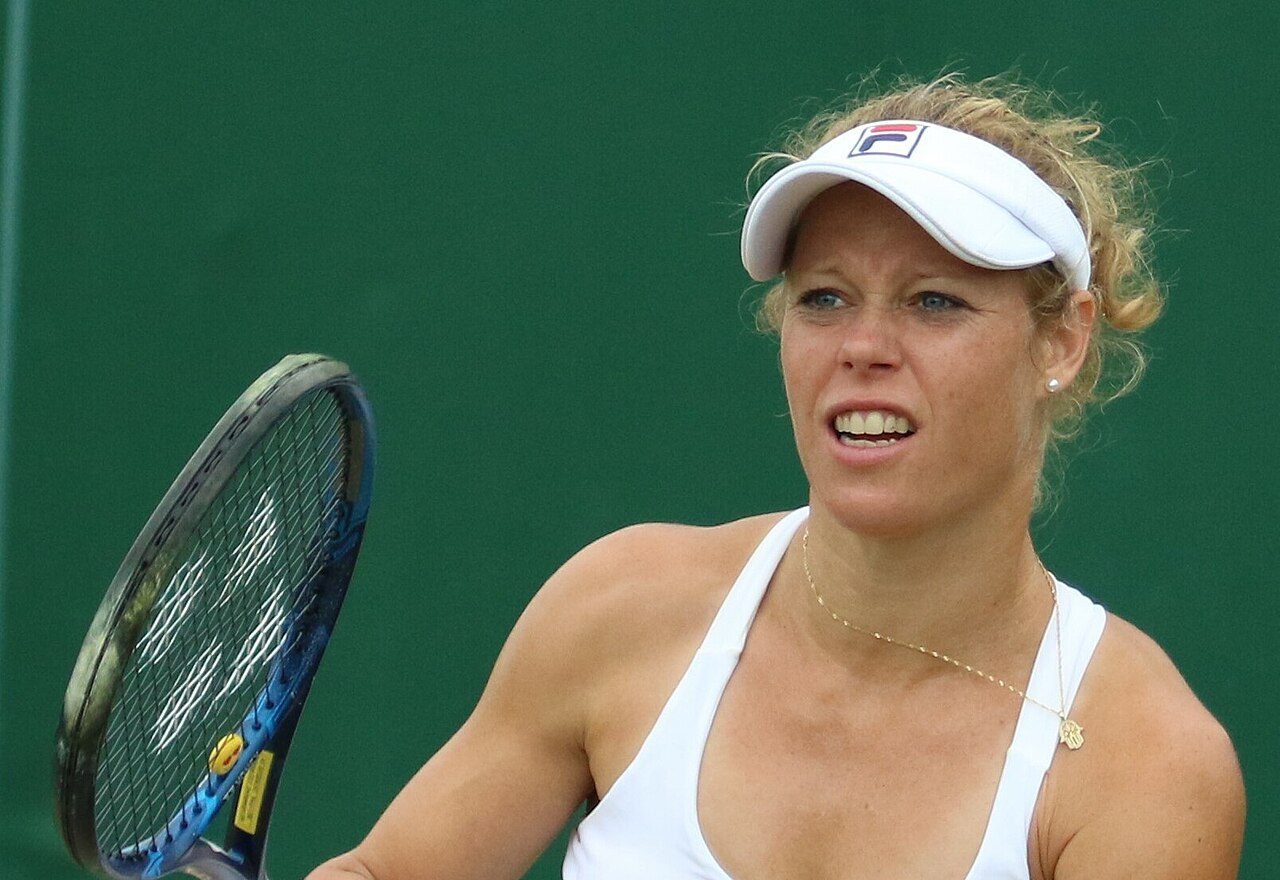
At Wimbledon in 2025, Laura Siegemund had world No. 1 Aryna Sabalenka a set down and scrambling for answers. Slices stayed low, drop shots dragged the Belarusian forward, and rallies rarely settled into a comfortable rhythm. Sabalenka eventually won their quarterfinal 4-6, 6-2, 6-4, but the 37-year-old German had made her work for it.
For Siegemund, it was another late-arriving milestone. Her career has unfolded in stages: junior success, years working through the lower levels, a psychology degree, a singles breakthrough in her late twenties and Grand Slam titles in two doubles formats. The route has been anything but straightforward.
A childhood across three countries
Laura Natalie Siegemund was born on March 4, 1988, in Filderstadt, near Stuttgart. Her father’s engineering work took the family abroad: she spent part of her childhood in Riyadh, Saudi Arabia, and later lived in Jakarta, Indonesia.
Tennis began at three, introduced by her family. Steffi Graf was her childhood idol, and in 2000 she won the Junior Orange Bowl’s prestigious 12-and-under competition, becoming the first German girl since Graf to claim that title.
It was an encouraging start, not a guarantee of a fast professional rise. Siegemund turned professional in 2006 but spent years building her career away from the biggest courts. Her first WTA main-draw singles victory did not arrive until Båstad in 2014.
By then, she was also pursuing a life beyond tennis. Studying psychology at the University of Hagen gave her a demanding parallel project during seasons when the sporting rewards were less certain. She completed her bachelor’s degree in 2016-the same year her results began to change the scale of her career.
The breakthrough came on clay
Stuttgart’s indoor clay courts provided the first major signal that spring.
Coming through qualifying at the 2016 Porsche Tennis Grand Prix, Siegemund beat Simona Halep, Roberta Vinci and Agnieszka Radwańska to reach the final. All three were top-10 players. Angelique Kerber stopped her in the title match, but the qualifier had shown she could unsettle elite opposition repeatedly, not merely produce one surprise.
Her first WTA singles title followed in Båstad that July, with victory over Kateřina Siniaková in the final. She then reached the quarterfinals of the Rio Olympics, losing to eventual gold medallist Monica Puig.
On August 29, 2016, she reached No. 27, her career-high singles ranking. Within a fortnight, she had a Grand Slam trophy too.
Partnering Croatia’s Mate Pavić, she won the US Open mixed doubles title by beating Coco Vandeweghe and Rajeev Ram in the final. A season that had begun with her still seeking a first tour singles title ended with success across three distinct settings: the WTA circuit, the Olympics and a major championship.
Stuttgart joy, then a serious setback
A year after her run from qualifying, Siegemund returned to the Stuttgart final and went one better.
Her 2017 campaign included wins over Svetlana Kuznetsova, Karolína Plíšková and Halep before a three-set final against Kristina Mladenovic. Siegemund won 6-1, 2-6, 7-6, taking the deciding tiebreak in front of a home crowd.
It remains one of the defining singles performances of her career. Clay rewarded her willingness to change height, spin and direction, while the familiar surroundings added an emotional edge.
The momentum did not last. The following month, she tore the anterior cruciate ligament in her right knee during a match in Nuremberg. Surgery and rehabilitation ended her season and interrupted the strongest stretch of her singles career.
Her eventual return was not simply a restoration of what had come before. Doubles increasingly became a major part of her working life, though she continued to pursue singles. At the rescheduled 2020 French Open, she reached her first Grand Slam singles quarterfinal, losing to Petra Kvitová.
A second career at the net
Only weeks before that Paris run, Siegemund had won the 2020 US Open women’s doubles title with Vera Zvonareva. They defeated Nicole Melichar and Xu Yifan in straight sets in the final.
The partnership suited her. Doubles gave greater prominence to her anticipation, touch and willingness to move forward, rather than leaving those skills as occasional variations in a baseline contest.
More substantial results followed. Siegemund and Zvonareva won Miami in 2022, then reached the 2023 US Open final, where Gabriela Dabrowski and Erin Routliffe beat them.
They finished that season by winning the WTA Finals in Cancún, defeating Nicole Melichar-Martinez and Ellen Perez in the championship match. For Siegemund, it was another significant title earned well beyond the age at which tennis careers are often expected to peak.
She reached No. 4 in the doubles rankings on January 29, 2024, more than seven years after setting her singles best.
That June brought a third Grand Slam title. Alongside Édouard Roger-Vasselin, she won the French Open mixed doubles championship, beating Desirae Krawczyk and Neal Skupski in the final. Her three major titles now covered women’s doubles and mixed doubles, on both hard courts and clay.
She also contributed to Germany’s title-winning United Cup campaign in 2024, adding a team success to a career already spread across several disciplines.
Wimbledon offered another singles chapter
The doubles trophies might have suggested where her biggest opportunities lay. Wimbledon in 2025 complicated that picture.
Siegemund defeated Australian Open champion Madison Keys in the third round, then beat Solana Sierra to reach the quarterfinals. At 37, she had produced her best Wimbledon singles result.
Against Sabalenka, her methods were especially clear. Rather than trying to trade power from the baseline, she interrupted the exchanges: a slice, a shorter ball, a change of direction, an invitation to come forward under awkward circumstances.
She led by a set and later by a break in the decider before the top seed recovered. The defeat was narrow enough to sting, but the run added a grass-court quarterfinal to a singles record previously defined most strongly by clay.
There is no single rivalry that explains her career. Instead, matches against players such as Halep, Keys and Sabalenka show the recurring contest within it: established power and rhythm against an opponent determined to deny both.
Variety with a competitive edge
At 1.68 metres, Siegemund does not build her game around an overwhelming serve. The right-hander, who uses a two-handed backhand, needs other ways to take control.
She can attack from the baseline, but the more revealing passages often come when she changes the terms of a rally. Backhand slices stay low. Drop shots punish opponents who retreat. At the net, quick hands and an instinct for positioning help explain her doubles results.
That variety can irritate opponents, particularly when they want a predictable hitting pattern. It also demands judgment: an attempted change of pace must disrupt the other player without surrendering control.
Her tennis is tactical without being passive. The aim is still to apply pressure, just not always through speed.
Psychology, home life and a shared working partnership
The psychology degree is more than an unusual detail on a player biography. Completing it while competing professionally required a second commitment, one that existed independently of rankings and match results.
It would be too neat to attribute every tactical decision to her studies. Still, education forms a substantial part of her story, especially because she finished the qualification during her breakthrough season rather than after retirement.
Siegemund has also spoken publicly about Antonio Zucca as both her coach and partner, crediting his support and coaching with helping her career. Their relationship is therefore a publicly acknowledged part of her life, not a matter of speculation.
Her background stretches from childhood years in Saudi Arabia and Indonesia to an adult life closely connected with the Stuttgart area. The home tournament carries particular weight for that reason: the trophy she won there belongs to the same story as the young girl who first picked up a racket nearby.
FAQ
How many Grand Slam titles has Laura Siegemund won?
She has won three: US Open mixed doubles in 2016, US Open women’s doubles in 2020 and French Open mixed doubles in 2024.
What are her highest rankings?
She reached No. 27 in singles on August 29, 2016, and No. 4 in doubles on January 29, 2024.
Who is her coach and partner?
Siegemund has publicly identified Antonio Zucca as both her coach and romantic partner.
What did she study?
She completed a bachelor’s degree in psychology at the University of Hagen in 2016.
What is her best Wimbledon singles result?
She reached the quarterfinals in 2025, aged 37, before losing to Aryna Sabalenka in three sets.
Where was she born?
She was born in Filderstadt, Germany, on March 4, 1988.
Photo: si.robi, CC BY-SA 2.0, via Wikimedia Commons