Two sets down in an empty Arthur Ashe Stadium, Dominic Thiem looked finished. Instead, he stayed there long enough to turn the 2020 US Open final into the defining match of his career, beating Alexander Zverev in five sets for the only Grand Slam title of his career. It was a fitting peak for a player whose tennis had always been built on endurance, force and nerve.
Before that night in New York, Thiem had already spent years establishing himself as one of the toughest men’s players of his era to beat from the baseline. He rose first on clay, where his heavy topspin and one-handed backhand could stand up to the best, then broadened his game into a threat on hard courts and indoors as well. At his best, he was not simply a specialist. He was a complete contender.
A tennis upbringing in Austria
Thiem was born on September 3, 1993, in Wiener Neustadt, Austria, and grew up in a family where tennis was part of daily life. His parents, Wolfgang and Karin Thiem, both worked as coaches, so the sport was around him from the beginning. Wolfgang coached him early, and when Dominic was still a child he began working with Günter Bresnik, the coach who would shape most of his development.
One technical decision became central to the player he would become. As a boy, he switched from a two-handed backhand to a one-hander, a risky move in modern men’s tennis but one that gave his game its most distinctive shot. Later, that stroke would help define the Dominic Thiem tennis style: explosive from the baseline, full-bodied through the ball, and capable of changing direction with pace.
His junior career suggested serious promise. He climbed to No. 2 in the junior rankings, reached the boys’ singles final at the French Open in 2011, and won the Orange Bowl that same year. Those results placed him among the most closely watched young players in Europe.
There were bumps along the way. A major growth spurt in his teens reportedly brought physical complications, a reminder that even elite prospects do not develop in a straight line. But the broader pattern was clear: Austria had another major talent coming through.
Early steps on tour
Thiem turned professional in 2011, and one of the more memorable early moments came in Vienna in 2011, when he beat Thomas Muster for his first ATP-level match win. Muster, a former US Open and French Open champion, was 44 at the time. The image was hard to miss: one Austrian generation handing over to another.
Even then, the outlines of his game were obvious. He hit hard off both wings, served big, and looked most comfortable dictating from the back of the court. Clay suited him naturally, but the assumption that he would remain only a clay-court player did not last.
His first ATP title arrived in Nice in 2015, where he beat Leonardo Mayer in the final. It was an important step rather than a sudden explosion, but it moved him out of the prospect category and into the group of players expected to matter at the biggest events.
From clay threat to all-surface contender
The next few seasons were the years in which Thiem became a fixture near the top of the ATP Tour. He won titles steadily, especially on clay, and built a reputation as one of the few players who could genuinely trouble Rafael Nadal on that surface. Thiem beat Nadal four times on clay, an unusually strong record against the player who dominated Roland Garros for so long.
That did not mean his success stopped there. He also developed into a dangerous hard-court player, especially as his serve and return improved and his confidence in shorter points grew. In 2019, he won Indian Wells, beating Roger Federer in the final for the biggest title of his career outside the majors. Later that season he reached the final of the ATP Finals, losing to Stefanos Tsitsipas, and he made the final again in 2020, this time losing to Daniil Medvedev.
Those runs mattered because they showed how far he had moved beyond the early label of clay specialist. By then, Dominic Thiem ranking discussions were no longer about potential. He had already reached world No. 3 on March 2, 2020, the highest position of his career.
His coaching story also shifted during this rise. Bresnik had been a long-term presence from Thiem’s childhood into 2019. Nicolás Massú then joined and played a key role in the most successful stretch of his career, including the US Open title. Later coaching partnerships included Benjamin Ebrahimzadeh and, in the final phase of his career, Mate Delić.
The Grand Slam near-misses
Before he lifted a major trophy, Thiem had to absorb several painful losses on the biggest stages. He reached his first Grand Slam final at the French Open in 2018 and lost to Nadal. He returned to the Roland Garros final in 2019 and again ran into Nadal. Then came the Australian Open final in 2020, where Novak Djokovic beat him in five sets.
Those defeats did not make him a tragic figure; they established the level he had reached. He was no longer chasing a breakthrough quarterfinal or semifinal. He was regularly deep in majors, facing the best players in the sport with a real chance to win.
That context is what gave the Dominic Thiem US Open run its weight later in 2020. He arrived in New York as one of the leading contenders, but he still had to prove he could finish a major.
The night in New York
The 2020 US Open final was messy, tense and physically draining. It was also historic. Thiem recovered from two sets down to beat Zverev 2-6, 4-6, 6-4, 6-3, 7-6(6), becoming the first man in the Open Era to come back from two sets down in a US Open final.
With that win, he became the first man born in the 1990s to win a Grand Slam singles title. He also became the first Austrian man to win the US Open singles title. For a player who had spent years knocking at the door, it was less a surprise than a release.
The title remains the centerpiece of the Dominic Thiem Grand Slam record: one major, after three earlier runner-up finishes.
It also left him with another notable distinction. He is the most recent men’s Grand Slam singles champion with a one-handed backhand.
Injury and the difficult final chapter
The turn in his career came in 2021. During the grass-court season, Thiem suffered a serious right wrist injury at the Mallorca Championships. It forced him out for the rest of the season and changed the shape of everything that followed.
For many players, a wrist problem is disruptive. For Thiem, whose game depended on violent acceleration through the ball and trust in long, heavy exchanges, it was especially costly. The forehand lost some of its old weight. The backhand, one of the great signatures in the men’s game, no longer came as freely. Results became harder to string together.
He returned to the tour and kept working, but the comeback never fully restored the player who had been a regular in major finals and the top three. There were flashes, solid wins, and stretches where the old timing seemed close. Still, the larger pattern held.
In May 2024, Thiem announced that he would retire at the end of the season, citing the lasting effects of the wrist injury. He played the final months of his career with that decision already public and officially retired after the Vienna Open in October 2024.
He finished with 17 ATP singles titles, no doubles titles, a career-high ranking of No. 3, and more than $30 million in prize money. In Davis Cup competition, he posted a 10-6 record for Austria.
How he played
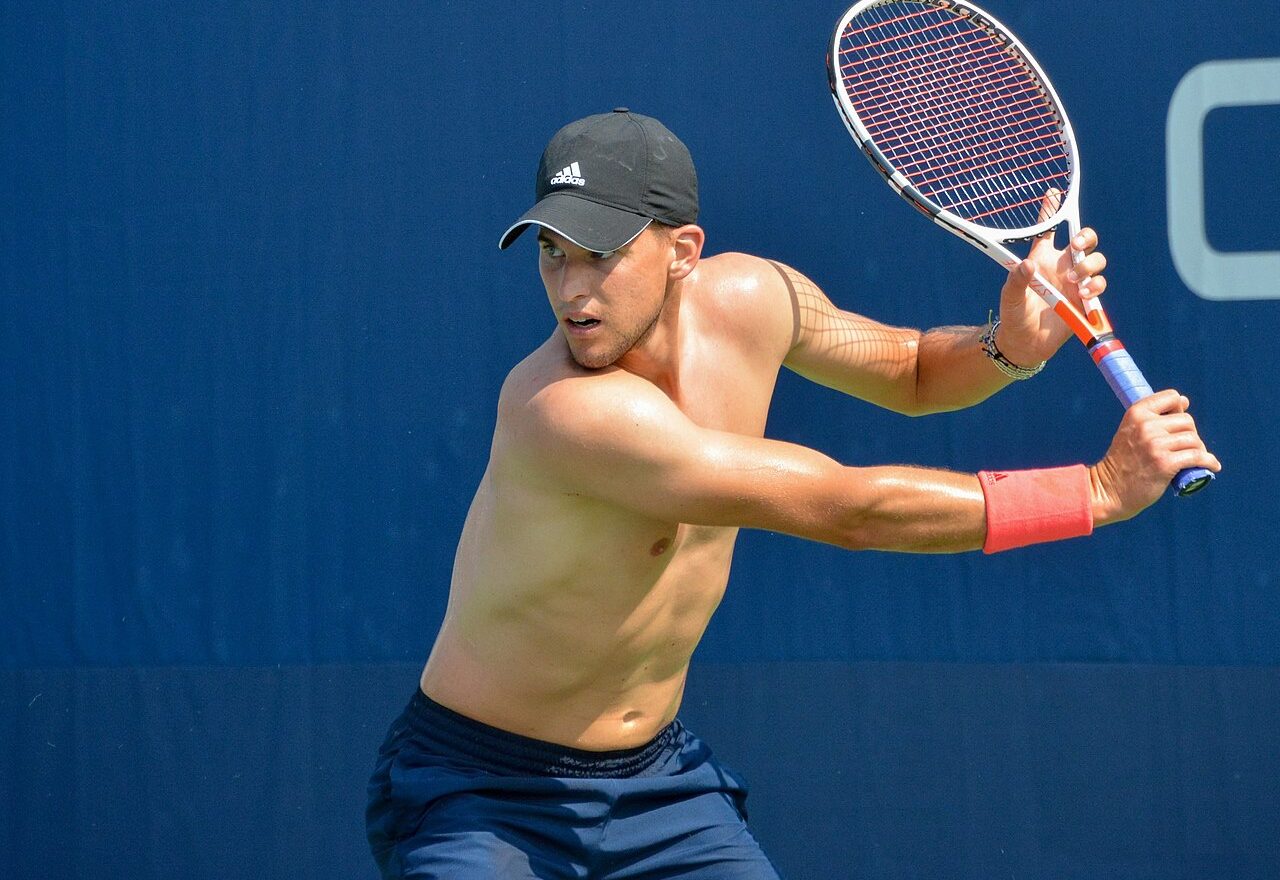
At his best, Thiem was one of the heaviest ball-strikers in men’s tennis. He played right-handed, used a one-handed backhand, and did most of his damage from the baseline. His forehand kicked high and hard, especially on clay, and his backhand could be driven flat or rolled with shape depending on the rally.
The one-hander drew attention because it looked unusual in an era dominated by two-handed backhands, but it was not just aesthetic. It was a practical weapon. He could defend with slice, attack crosscourt, or change direction down the line with real force.
His serve was another important part of his game, and on quicker courts it helped him shorten points more than he sometimes got credit for. He also tended to handle pressure well, which showed up in many tight matches and tie-breaks over the course of his best seasons.
Off court: family, business and life beyond tennis
Away from competition, Thiem’s life remained closely tied to family. His younger brother, Moritz Thiem, also played professionally, and Dominic often spoke about the stability his family gave him through the demands of tour life. He has been associated with Lichtenwörth in Austria as his home base.
He also built interests outside tennis. Publicly reported business ventures linked to him have included Thiem Energy, Thiem View and Thiem Academy Burgenland, all presented with a sustainability angle. He was also involved commercially with the protein bar brand Neo.
Environmental causes were a visible part of his public image. He has supported projects and campaigns connected to 4ocean, WWF, Adidas x Parley, bee protection initiatives and the Wings for Life World Run. He also founded 1. TFC Matzendorf, a charity football team.
Some of the lighter details around him helped round out the picture. Thiem has long been known as a football fan and has publicly supported Chelsea. A family anecdote often repeated in Austrian media holds that his mother, Karin, got a tattoo for each title he won.
As for endorsements, he worked with brands including Babolat, Adidas, Rolex, Kia, Tecnogym, Red Bull and Bank Austria, among others. Estimates of Dominic Thiem net worth have varied widely in media reports, so it is safer to say only that he earned more than $30 million in official prize money, with additional income from sponsorships and business interests.
FAQ
What Grand Slam did Dominic Thiem win?
He won the 2020 US Open, beating Alexander Zverev in five sets in the final.
What was Dominic Thiem’s highest ranking?
His career-high ATP ranking was world No. 3, reached on March 2, 2020.
How many ATP titles did Dominic Thiem win?
He won 17 ATP singles titles.
When did Dominic Thiem retire?
He retired from professional tennis in October 2024 after the Vienna Open.
What was Dominic Thiem known for?
He was known for his heavy baseline game, his one-handed backhand, and his 2020 US Open title.
Who coached Dominic Thiem?
He was coached early by his father Wolfgang Thiem, then for many years by Günter Bresnik, later by Nicolás Massú, and in the final phase of his career by Benjamin Ebrahimzadeh and Mate Delić.
Photo: Carine06 from UK, CC BY-SA 2.0, via Wikimedia Commons