Twenty-four major singles titles is the headline number, but it only hints at the scale of Novak Djokovic’s career. For well over a decade, the Serbian has been the man opponents had to solve: the best returner many of them ever faced, a relentless defender who could turn defense into attack in a single step, and a champion whose biggest matches often came against Roger Federer, Rafael Nadal and Andy Murray.
From Belgrade courts to the pro tour
Djokovic was born on May 22, 1987, in Belgrade, then part of Yugoslavia. Tennis entered his life early. He picked up a racket as a child, and by the age of six he had caught the eye of coach Jelena Genčić, who became one of the first important figures in his development.
The family’s commitment was serious and costly. His parents, Dijana and Srđan Djokovic, backed his training through financially difficult years, and he later spent time at the Nikola Pilić academy in Germany, a crucial step for a talented junior trying to become an international prospect rather than simply a local standout.
As a junior, he rose high in the European age-group rankings, but his climb into the professional game was not instant. He turned pro in 2003, still a teenager, and began the usual hard road through Futures and Challenger events. In 2004 he earned his first ATP-level win in Davis Cup, and in 2005 he made his Grand Slam debut at the Australian Open.
Even then, the outlines of the player were visible. He moved exceptionally well, returned serve with unusual depth and balance, and looked comfortable extending rallies until opponents overplayed.
The breakthrough years
His first ATP title came in 2006 at Amersfoort, and the following season was the one that changed his status. In 2007, Djokovic won Masters titles in Miami and Montreal, beat top players regularly, and reached his first Grand Slam final at the US Open. Roger Federer stopped him there, but the message was clear: a new contender had arrived.
The first major title followed quickly. At the 2008 Australian Open, Djokovic beat Jo-Wilfried Tsonga in the final to win his maiden Grand Slam singles crown. Later that year he also took the bronze medal in singles at the Beijing Olympics.
By then, men’s tennis had a new shape. Federer and Nadal were already established at the top, and Djokovic was no longer chasing from a distance. He was part of the central story.
2011: the season that changed everything
Some careers turn on one season. Djokovic’s turned on 2011.
He began that year on a stunning run, piling up wins, beating Nadal repeatedly in big finals, and carrying his form from hard courts to clay and grass. By July he had reached world No. 1 for the first time. By the end of the season he had won three Grand Slam titles, the Australian Open, Wimbledon and the US Open, along with five Masters 1000 titles.
That campaign moved him from major champion to the defining force of the tour. It also sharpened the rivalries that came to define the era. Against Nadal, matches often became physical and tactical marathons. Against Federer, the tension was different: shorter points at times, more pressure on serve, and a constant battle over who could take time away first. Murray, meanwhile, was another frequent presence deep in the biggest events.
The phrase Big Three became standard shorthand in those years, and Djokovic’s place in that group was earned through results rather than mythology.
Building the Djokovic record
The most striking thing about Djokovic’s résumé is not just the number of titles, but how completely they are spread across the sport’s biggest stages.
He has won the Australian Open 10 times: 2008, 2011, 2012, 2013, 2015, 2016, 2019, 2020, 2021 and 2023. At Roland Garros, he won in 2016, 2021 and 2023. He collected Wimbledon titles in 2011, 2014, 2015, 2018, 2019, 2021 and 2022. At the US Open, he won in 2011, 2015, 2018 and 2023.
That total gives Novak Djokovic 24 Grand Slam singles titles, the men’s record.
There were painful losses along the way too, and they matter because they show how often he kept putting himself in position. He lost major finals at the 2007 US Open, the 2010 US Open, the 2012 French Open, the 2012 US Open, the 2013 Wimbledon Championships, the 2013 US Open, the 2014 French Open, the 2015 French Open, the 2016 US Open, the 2020 French Open, the 2021 US Open and the 2023 Wimbledon Championships. Those defeats came against Federer, Nadal, Murray, Stan Wawrinka, Daniil Medvedev and Carlos Alcaraz, a list that says plenty about the level of opposition at the end of his runs.
One of the landmark moments came in Paris in 2016. By winning the French Open, Djokovic completed the career Grand Slam. He also held all four major titles at once across 2015-16, a rare feat in any era and one that underlined how fully his game traveled across surfaces.
Then there is the Masters 1000 collection. Djokovic became the first player to win all nine events, and he has completed that set more than once. His ATP Finals record is equally strong, with seven titles.
Setbacks, surgery and the return
The career did not move in a straight line. In 2017 his level dipped, and an elbow problem became too serious to ignore. He eventually had surgery in early 2018, a significant interruption for a player whose precision on serve, return and backhand timing is so central to his game.
The comeback was swift. That summer he won Wimbledon, beating Kevin Anderson in the final, and a few months later he won the US Open. It was a reminder that his edge had never depended on one shot alone. If the movement returned and the timing settled, the whole machine could start working again.
Another off-court episode followed in 2022, when Djokovic was deported from Australia after a visa dispute linked to the country’s COVID-19 entry rules. It became one of the most heavily covered controversies of his career, largely because it kept him out of the tournament he had dominated more than any other.
He answered with more tennis. In 2023 he won the Australian Open, Roland Garros and the US Open, adding another three-major season to a career already full of them.
The Olympic gold that had been missing
For all the trophies, one prize had long remained out of reach: Olympic singles gold.
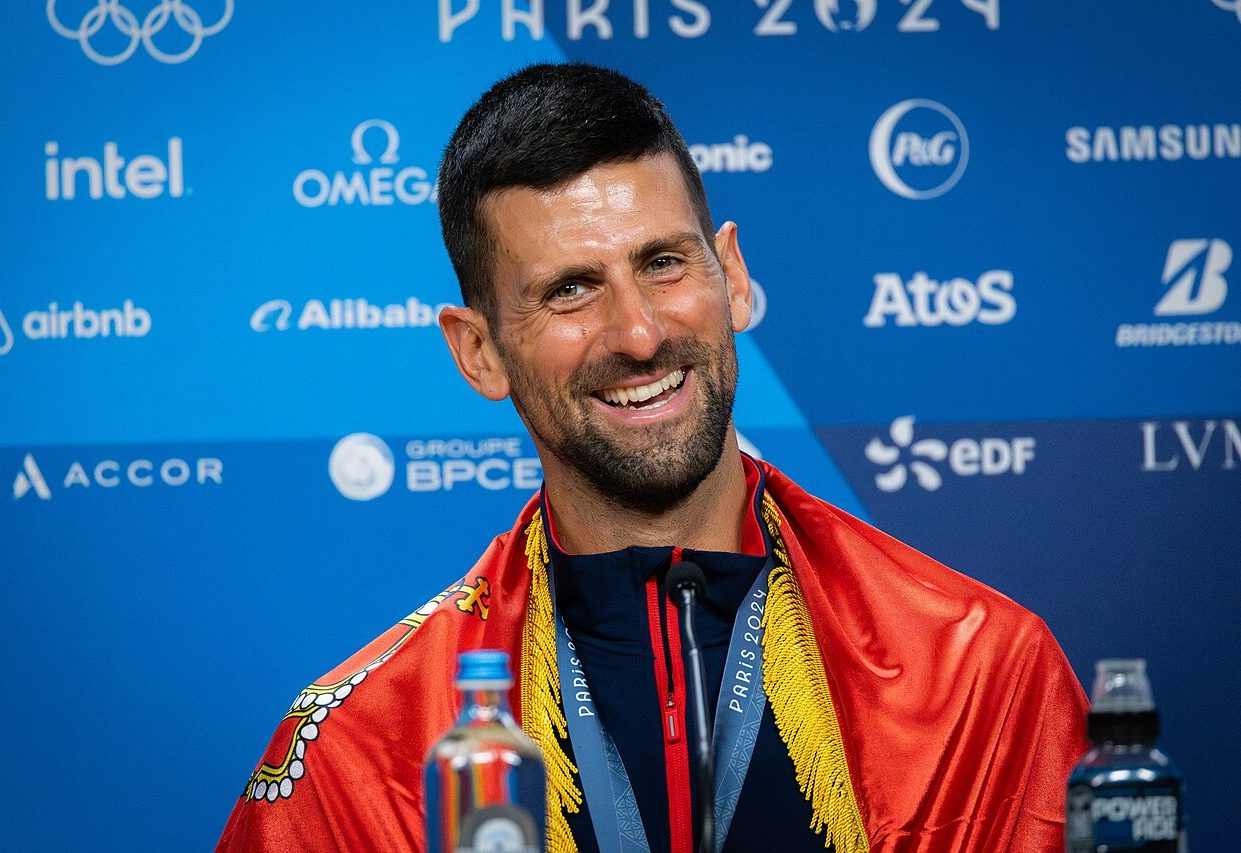
Djokovic had won bronze in Beijing in 2008, but the gold medal eluded him through several Games. He finally completed that part of the story in Paris, winning the 2024 Olympic singles title. It was one of the clearest examples of his longevity. The player who had first made his mark in the mid-2000s was still good enough, disciplined enough and physically sharp enough to take the sport’s biggest prizes nearly two decades later.
He also owns one of the most important ranking records in the men’s game: 428 weeks at world No. 1. He first reached the top spot in 2011 and finished year-end No. 1 a record eight times.
Why his game has lasted
Djokovic plays right-handed with a two-handed backhand, but that basic description barely captures what makes him difficult to beat.
His return of serve is the foundation. He gets the ball back deep, neutralizes big servers, and immediately puts rallies on his terms. From there, his movement does the rest. At his peak he slid into corners on hard courts as if they were clay, absorbed pace without losing balance, and redirected the ball with almost no wasted motion.
He has often been described as a counterpuncher, which is true, but incomplete. He can defend for hours, yet he is also an aggressive baseliner when the opening appears. His backhand down the line is one of the cleanest change-of-direction shots of his era, and his serve, especially in later phases of his career, became more efficient and more reliable under pressure.
That is why the Novak Djokovic playing style has translated so well to every major surface. Hard courts reward his return and elasticity. Grass rewards his balance and compact strokes. Clay rewards his patience and physical resilience.
Life away from the baseline
Off the court, Djokovic has long balanced a very public career with a relatively stable family life. He married Jelena Ristić in 2014, and they have two children.
His charitable work has been a consistent part of his public profile. The Novak Djokovic Foundation, established in 2007, focuses on early childhood education, especially in Serbia.
Business interests have expanded over time as well. Some are well documented, including endorsement deals and investments. Other reported links should be treated more carefully. Djokovic has been publicly connected to ventures in wellness, sports business and biotechnology; where ownership stakes or advisory roles have been reported by companies or major outlets, they can be stated with confidence, but broader claims about private investments are best described as reported rather than definitive unless officially confirmed.
He has also remained a significant figure in tennis politics and player representation, including serving as president of the ATP Player Council in 2016.
FAQ
How many Grand Slam titles does Novak Djokovic have?
Novak Djokovic has won 24 Grand Slam singles titles, the most by any man in tennis.
How many weeks was Novak Djokovic world No. 1?
He spent a record 428 weeks at world No. 1.
Did Novak Djokovic win Olympic gold?
Yes. He won the Olympic singles gold medal in Paris in 2024.
What is Novak Djokovic’s playing style?
He is an elite returner and all-court baseliner known for defense, flexibility, depth off both wings and tactical control.
Who is Novak Djokovic’s wife?
He is married to Jelena Ristić, now Jelena Djokovic.
What does the Novak Djokovic Foundation do?
The foundation focuses on early childhood education, with much of its work centered on Serbia.
Photo: Andymiah, CC BY-SA 4.0, via Wikimedia Commons