Eight major singles titles are only part of the Jimmy Connors story. The fuller picture is 109 tour-level singles titles, a record 1,274 match wins in the Open Era, and a career that stretched from the early 1970s into the mid-1990s without ever becoming quiet.
Jimmy Connors: the making of a fighter
James Scott Connors was born on September 2, 1952, in East St. Louis, Illinois, and raised just across the river in Belleville. Tennis was not a hobby in the family; it was the family business. His mother, Gloria Connors, taught him from early childhood and remained one of the strongest influences on his game. A detail often repeated around his upbringing says plenty about the atmosphere he came from: while pregnant, Gloria helped clear space for a court. Whether told as family lore or hard fact, it fits the world Connors grew up in, one built around tennis, work, and repetition.
He was on court young, and he improved quickly. As a junior, he won the Junior Orange Bowl in the 12-and-under and 14-and-under divisions, then moved into college tennis at UCLA. In 1971, he won the NCAA singles title, a sign that his game was already too sharp and too disruptive for most players his age.
Another key figure arrived in 1968, when Pancho Segura began working with him. Segura helped refine what would become one of the most recognizable styles in men’s tennis: taking the ball early, flattening out groundstrokes, and turning the return of serve into an attack.
Turning pro and breaking through
Connors turned professional in 1972, and the rise was quick. He won his first top-level singles title that year in Jacksonville, then followed with more titles as his schedule expanded. He was already different from many of his peers. He did not fit neatly into tennis politics, and he often clashed with the sport’s power structure. Early in his career, he chose not to join the ATP, a decision that fed his outsider image and set the tone for years of friction with officials and fellow players.
By 1973, he had won the U.S. Pro Singles title. By 1974, he was no longer an emerging name. He was the man everyone had to deal with.
On July 29, 1974, Connors reached world No. 1. He stayed there for 160 consecutive weeks and spent 268 weeks in total at the top, a measure of how firmly he controlled men’s tennis during his peak years.
1974: the season that changed everything
Some seasons define a career. Connors’ 1974 campaign did more than that.
He won the Australian Open, Wimbledon, and the US Open, losing only four matches all year. The one major missing from that sweep was the French Open, and not because he was beaten there. He was barred from playing Roland Garros because of his involvement with World Team Tennis. Connors responded by filing an antitrust lawsuit against the ATP, the International Lawn Tennis Federation, and officials including Arthur Ashe; he later dropped it.
That episode mattered because it captured the contradictions that followed him throughout his career. He was brilliant, relentless, and hugely successful, but also argumentative and often at war with the institutions around him.
Even without a French Open title, he was no non-factor on clay. He reached the semifinals at Roland Garros four times, in 1979, 1980, 1984, and 1985.
The years at the top
From the mid-1970s into the early 1980s, Connors kept winning at a rate few players have matched. His eight Grand Slam singles titles came at three majors: the Australian Open in 1974, Wimbledon in 1974 and 1982, and the US Open in 1974, 1976, 1978, 1982, and 1983.
That list also says something about his durability. He won majors eight years apart, from his first in 1974 to his last at the 1983 US Open, where he beat Ivan Lendl in the final. He reached seven other major singles finals as well, including losses to Ken Rosewall, Arthur Ashe, Bjorn Borg, John McEnroe, and Ivan Lendl.
Away from the Slams, the title count kept piling up. Connors won the year-end Masters in 1977, beating Bjorn Borg in the final. He also claimed the WCT Finals in 1977 and 1980. By the time he finished, his 109 singles titles stood as the Open Era record, along with 16 doubles titles.
Rivalries that gave the era its edge
Connors did not build his record in a soft period. He did it while sharing the sport with several all-time greats, and his rivalries helped define the mood of men’s tennis in that era.
Against Bjorn Borg, he went 8-15 in their tour-level meetings. Their contrast was obvious: Borg, cool and controlled; Connors, noisy and confrontational. They split their four Grand Slam final meetings 2-2, which says plenty about how evenly matched they could be on the biggest stages.
His rivalry with John McEnroe had a different texture. McEnroe brought his own volatility, and the two Americans often seemed to be competing for the same emotional space. McEnroe finished ahead 20-14 in their head-to-head, but Connors beat him in the 1982 Wimbledon final, one of the biggest wins of his later prime.
Then there was Ivan Lendl, the player who became central to the next phase of Connors’ career. Lendl led their overall series 22-13, but Connors won both of their Grand Slam final meetings, at the 1982 and 1983 US Opens. Those victories mattered. By then, Connors was no longer the young disruptor. He was the established champion trying to hold off the next wave.
His relationship with Arthur Ashe was also complicated, sharpened by both personal tension and the legal dispute around the French Open ban. Connors rarely moved through the sport without friction.
New York, noise, and a second act
No tournament suited him quite like the US Open. Connors won it five times, and he remains the only man to have won the title on three different surfaces: grass, clay, and hard court. That is one of the clearest markers of his adaptability. However fixed his public image became, his game was more flexible than people sometimes remember.
Then came the run that revived him for a new generation.
In 1991, at 39 and after wrist problems that had threatened to end his career, Connors made an improbable charge to the US Open semifinals. He beat Patrick McEnroe, Aaron Krickstein, and Paul Haarhuis along the way, with the five-set win over Krickstein becoming one of the enduring matches of that tournament’s history. The atmosphere around that run was part tennis, part theatre. Connors leaned into it, fed off it, and nearly carried himself all the way to another final before losing to Jim Courier in the semis.
He kept playing for several more years and officially retired in 1996.
How Jimmy Connors played
Connors was listed at 5 ft 10 in (1.78 m), left-handed, with a two-handed backhand that became one of his signatures. At a time when much of men’s tennis still revolved around serve-and-volley patterns, he brought a different kind of pressure. He hugged the baseline, took the ball on the rise, redirected pace early, and made the return of serve one of the most dangerous shots in the match.
His best surfaces were hard court, grass, and carpet, though he was too good a competitor to be limited to one setting. What separated him, beyond the strokes, was the feeling that every point had to be contested on his terms. He played fast, flat, and with visible defiance.
That edge also came with baggage. Connors was fined at times during his career and drew criticism for on-court behavior. At Wimbledon in 1977, he was booed after skipping the traditional Parade of Champions. He was not interested in being universally liked, and he rarely pretended otherwise.
Bud Collins gave him the nickname “the Belleville Basher,” and it stuck because it fit: the ball-striking, the tempo, the noise, the force of personality.
Davis Cup and the team dynamic
Connors did represent the United States in Davis Cup, though not with the same regularity as some of his peers. He made his Davis Cup debut in 1975 and was part of American title-winning teams in 1976, 1981, and 1984, though he did not play in the 1976 Challenge Round final. His singles wins were important in the 1981 campaign, when the United States beat Argentina in the final.
Even there, the independent streak never disappeared. In his autobiography and in comments from others, including John McEnroe, there are accounts of Connors keeping some distance from team routines. That should be treated as reported recollection rather than settled fact in every detail, but it fits the broader pattern of a player who preferred operating by his own rules.
Off court: family, business, and the public image
Away from tennis, Connors married former Playboy Playmate of the Year Patti McGuire in 1979, and they have two children. He has long been associated with Santa Barbara, California.
His private life drew heavy attention during his playing days, especially during his relationship with Chris Evert in the mid-1970s. The pair were once engaged, but the relationship ended before marriage. Beyond that, personal claims that have circulated over the years are best handled cautiously unless they come from named, published sources.
Connors later moved into several post-playing roles. He wrote a memoir, The Outsider, worked in television, and spent time coaching. Most notably, he had a short coaching partnership with Andy Roddick in 2006 and later worked briefly with Maria Sharapova in 2013.
Commercially, he was one of the most marketable players of his era. Over the years, he was linked with brands including Wilson, Slazenger, Adidas, Nike, Canon, and American Express, though endorsement rosters changed over time and were not all concurrent. His official career prize money totaled $8,641,040, a large figure for his era, even if it looks modest beside modern earnings. Estimates of Jimmy Connors net worth vary widely across celebrity-finance sites and are not reliably verifiable, so they are better treated as speculation than hard fact.
FAQ
How many Grand Slams did Jimmy Connors win?
He won 8 major singles titles: 5 US Opens, 2 Wimbledons, and 1 Australian Open.
When was Jimmy Connors world No. 1?
He first reached No. 1 on July 29, 1974, and spent 268 weeks there in total.
Did Jimmy Connors win the French Open?
No. He never won Roland Garros, though he reached the semifinals four times.
When did Jimmy Connors retire?
He retired from professional tennis in 1996.
Who coached Jimmy Connors?
His mother, Gloria Connors, shaped his early game, and Pancho Segura became his most influential later coach.
What is Jimmy Connors known for?
He is known for his aggressive baseline style, two-handed backhand, fierce return game, 109 singles titles, and Open Era record for match wins.
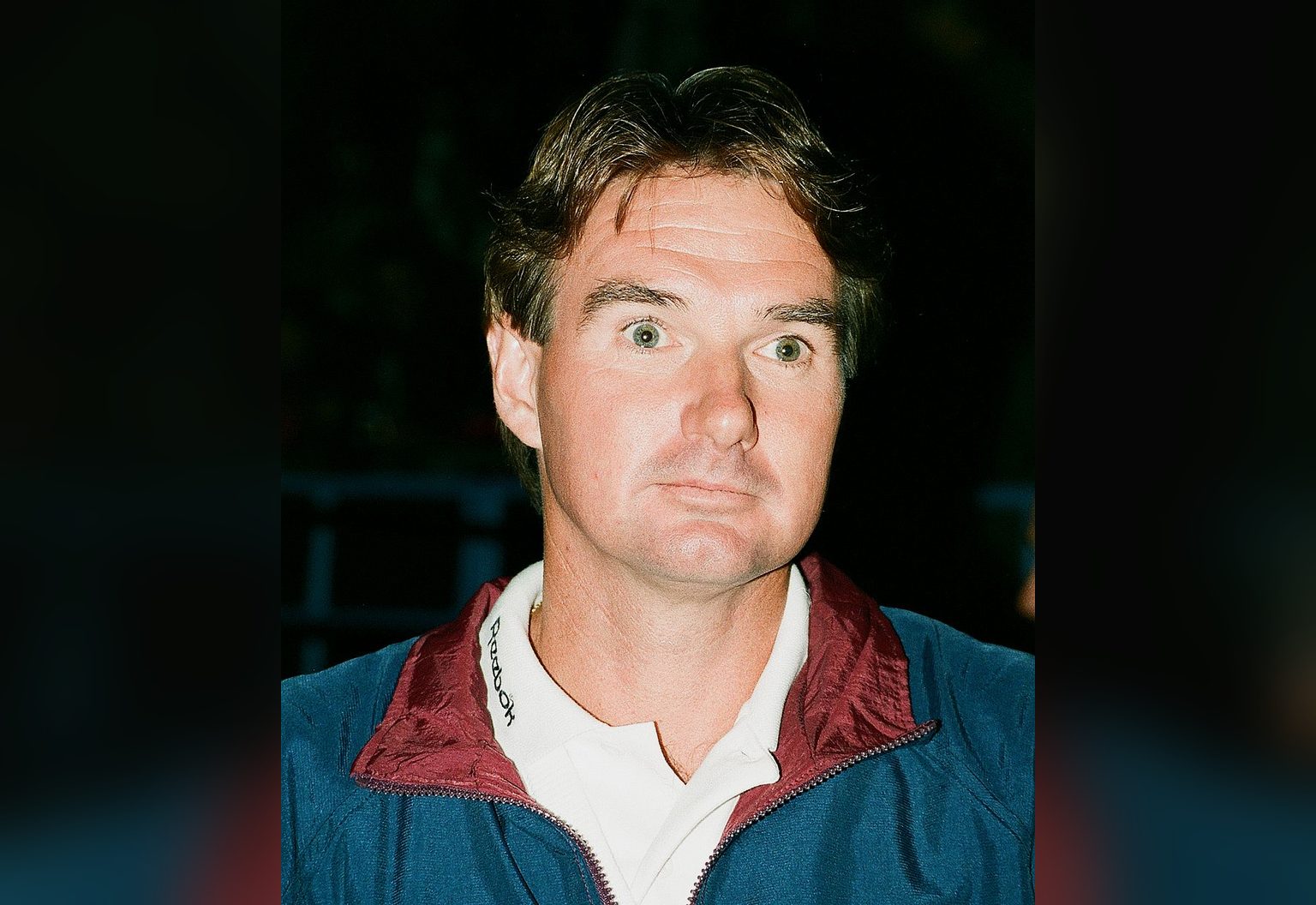
Photo: John Mathew Smith & www.celebrity-photos.com from Laurel…, CC BY-SA 2.0, via Wikimedia Commons