Twenty major singles titles, 310 weeks at world No. 1 and 237 of them in one uninterrupted run: the numbers explain why Roger Federer sits so high in tennis history. They do not quite capture how he played. For more than two decades, the man from Basel made elite tennis look strangely calm, building points with precision, gliding through rallies and carrying a one-handed backhand deep into an era shaped by heavier topspin and baseline power.
Born on August 8, 1981, in Basel, Federer grew up with Swiss and South African citizenship through his parents, Robert Federer and Lynette Federer. Long before the polished public figure took shape, he was known in junior tennis as a gifted, fiery talent. He admired Boris Becker, loved competition and, by his own account, had to learn how to manage his emotions on court before the rest of his game could fully flourish.
Basel beginnings and the making of a prospect
Federer started playing young and quickly stood out. Early coaching came from Adolf Kacovsky, but the most important formative influence was Peter Carter, the Australian coach who began working with him when Federer was around 10. Carter helped refine the technique, but just as importantly, he was part of the effort to turn a brilliant but combustible junior into a player who could survive the demands of the tour.
A key step came in the mid-1990s when Federer moved into the Swiss National Tennis Center in Ecublens. That shift took him from local promise to full-time development track. The results followed. In 1998, he won the Wimbledon boys’ singles title, captured the Orange Bowl and finished the year as the ITF junior world champion. He also made his ATP debut that season, the first glimpse of a professional career that would soon move very fast.
The Sampras win and the first big breakthrough
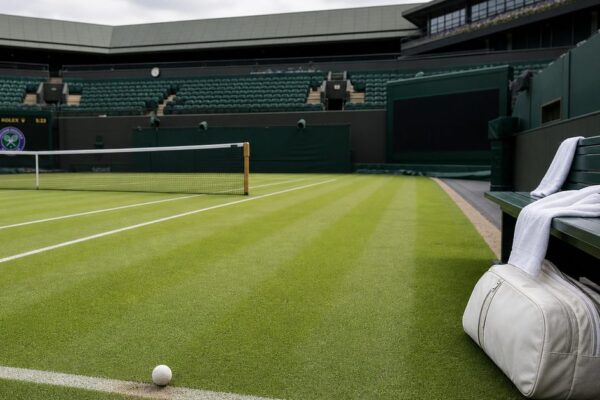
For a wider audience, the first unforgettable Federer moment arrived at Wimbledon in 2001. On Centre Court, still only a teenager, he beat seven-time champion Pete Sampras in five sets in the fourth round. Sampras had not lost at Wimbledon since 1996. Federer did not go on to win the title that year, but the match changed the conversation around him. He was no longer just a stylish prospect from Switzerland. He was a player who could unsettle the established order on the sport’s biggest stage.
The full breakthrough came two summers later. At Wimbledon in 2003, Federer won his first Grand Slam title by beating Mark Philippoussis in the final. It was the start of the most dominant stretch of his career. In February 2004, he rose to world No. 1 for the first time, and he stayed there week after week until the run reached a record 237 consecutive weeks.
The years when he owned the tour
From 2004 through 2007, Federer set the pace almost everywhere. He won the Australian Open in 2004, 2006 and 2007, then added later titles there in 2010, 2017 and 2018. At the US Open, he took five straight crowns from 2004 through 2008, a run of hard-court control that remains one of the defining sequences of the Open Era.
Wimbledon became his signature stage. He won there in 2003, 2004, 2005, 2006 and 2007, then again in 2009, 2012 and 2017, giving him a men’s record eight singles titles at the tournament. The lone missing major was Roland Garros, where Rafael Nadal repeatedly blocked his path. Federer lost French Open finals to Nadal in 2006, 2007 and 2008, then finally completed the career Grand Slam in 2009, beating Robin Soderling in the final after Nadal’s earlier exit opened the draw.
That 2009 title mattered beyond the trophy itself. It confirmed that Federer was not simply a grass-court artist or hard-court master. He had won all four majors, joining a very small group of men to complete the set in singles during the Open Era.
Rivalries that gave the era its shape
No Federer profile makes sense without the rivals who sharpened his career. The most famous contrast came against Nadal: Federer’s fluid attack against Nadal’s left-handed spin and relentless physicality. Their head-to-head finished 24-16 in Nadal’s favor. Nadal denied him repeatedly in Paris and beat him in two of the most painful finals of Federer’s career, the 2008 Wimbledon final and the 2009 Australian Open final.
The 2008 Wimbledon final still stands as one of the sport’s landmark matches. Federer had owned the tournament for five straight years, but Nadal beat him in five sets in fading light, ending that streak and shifting the balance of the rivalry. A few months later, Federer lost again to Nadal in Melbourne, an emotional defeat that showed how much those matches had come to mean.
Against Novak Djokovic, the numbers were also close enough to stay tense across many seasons, with Djokovic finishing ahead 27-23. Their rivalry stretched from Federer’s peak into his later years and included several major final losses for the Swiss, notably at Wimbledon in 2014, 2015 and 2019, and at the US Open in 2015. The 2019 Wimbledon final was especially brutal: Federer held two championship points on his serve before Djokovic escaped in a fifth-set tiebreak.
Andy Murray belonged to the same era too, though the matchup never carried quite the same symbolic weight. Murray beat Federer in the 2012 Olympic final to win singles gold, while Federer answered weeks later by defeating Murray in the Wimbledon final for his seventh title there.
More than majors: titles, medals and team success
The Grand Slams frame the story, but they were only part of it. Federer finished with 103 ATP singles titles, second only to Jimmy Connors in the Open Era, plus eight tour-level doubles titles. He won 28 Masters 1000 titles and six year-end championships, taking the ATP Finals in 2003, 2004, 2006, 2007, 2010 and 2011.
His career also had the pieces that often escape even great singles players. At the 2008 Beijing Olympics, he won doubles gold with Stan Wawrinka. Four years later in London, he took singles silver after losing the final to Murray. In 2014, he helped Switzerland win the Davis Cup, another milestone on a resume that had already become unusually complete.
The style that made him instantly recognizable
Some champions are remembered mainly for results. Federer is one of the few whose movement and shot-making became part of the memory as much as the scorelines. He played right-handed, with a one-handed backhand, and built an all-court game that could shift shape depending on the opponent and surface. He could shorten points with serve and forehand, absorb pace from the baseline, chip returns, move forward and volley cleanly.
Grass often brought out the clearest version of his tennis, but hard courts were nearly as productive, and his 2009 French Open title removed any doubt about his range. The elegance was real, yet it sometimes obscured the work underneath. Federer did not arrive on tour as a finished, serene champion. He had to learn patience, point construction and emotional control. That development was one of the central stories of his career.
Loss, adjustment and a late-career revival
Peter Carter’s death in a car accident in 2002 left a lasting mark on Federer. He has often spoken about Carter’s importance, and many around him saw that loss as part of the process that pushed him toward greater maturity.
Years later, when injuries began to interrupt the rhythm that had once seemed automatic, Federer found another version of himself. A knee problem and surgery disrupted his schedule, but the comeback in 2017 became one of the most striking late chapters in modern tennis. He returned to win the Australian Open in 2017, beating Nadal in a five-set final, then won Wimbledon later that year without dropping a set. In 2018, he added one more Australian Open title.
Those victories did not erase the passing of time, but they gave his career a new shape. Federer was no longer the week-by-week ruler of the tour. He was an older champion adjusting his schedule, shortening his seasons and choosing his moments carefully.
His final professional event came at the Laver Cup in September 2022. Federer retired after playing doubles alongside Nadal, an ending that felt fitting for a career so closely tied to the rivalries that defined its era.
Life off the court: family, foundation and business
Away from competition, Federer built one of the broadest public profiles in sport without saying much more than he needed to. He married Mirka Federer, formerly Mirka Vavrinec, whom he met on the tennis tour. They have four children: two sets of twins. Family life remained mostly private, though it was a steady part of his public image throughout his later career.
His charitable work became a major strand of that life. The Roger Federer Foundation, established in 2003, supports early childhood education projects in southern Africa and Switzerland. He was also appointed a UNICEF Goodwill Ambassador.
Business interests grew alongside the tennis career and expanded further afterward. Federer has an ownership stake in the Swiss running brand On and has been involved in product design there. He also co-founded Team8, the management company that helped launch the Laver Cup. He has been linked through publicly reported investments and partnerships to projects beyond tennis, including eyewear and food-tech ventures. Estimates of Roger Federer net worth vary by outlet, and such figures are necessarily approximate, but published reports have long placed him among the wealthiest athletes in the world because of endorsements and business holdings as much as prize money.
For readers searching basic details, the essentials remain straightforward: Roger Federer age is often a common query, as are Roger Federer nationality, Roger Federer wife and Roger Federer children. The outline is clear enough. He was born in Basel, holds Swiss and South African citizenship, is married to Mirka, and is a father of four.
The smaller incidents in a very long career
A career this long was never entirely free of flashpoints. Federer’s record was comparatively clean, but there were moments of frustration and poor judgment. He was fined during the 2009 US Open final for audible obscenity, and earlier in his career he made comments about Djokovic’s physical issues that drew criticism. He also faced debate in 2021 when he withdrew from Roland Garros after the third round to protect his body for the grass season. That decision was public and confirmed; the criticism around it was opinion, not misconduct.
What stands out more, though, is the broader arc. Federer began as a teenager with obvious gifts and a volatile streak. He ended as a player known almost as much for composure and sportsmanship as for titles, winning the ATP’s Stefan Edberg Sportsmanship Award 13 times.
FAQ
How many Grand Slam singles titles did Roger Federer win?
He won 20.
When did Roger Federer retire?
He retired in September 2022, with his final event at the Laver Cup.
What is Roger Federer’s nationality?
He is Swiss and also holds South African citizenship.
Who is Roger Federer’s wife?
He is married to Mirka Federer, formerly Mirka Vavrinec.
Did Roger Federer win all four Grand Slams?
Yes. He completed the career Grand Slam by winning the French Open in 2009.
What is the Roger Federer Foundation?
It is his charitable foundation, focused on early childhood education in southern Africa and Switzerland.