Six straight finals in one summer turned Daniil Medvedev from a difficult opponent into a central figure on the ATP Tour. By the time that run ended at the 2019 US Open, where he pushed Rafael Nadal to five sets in the final, the outline of his career was clear: hard-court excellence, unusual tactics, and a style that could make elite players look rushed and short of ideas.
Born in Moscow on February 11, 1996, Medvedev did not come through the junior ranks as the obvious future star of his generation. He was good, certainly, but not dominant. That matters because his rise on the professional tour was built less on teenage hype than on steady development, tactical clarity and a game that became more effective the longer points and matches went.
He started tennis at six after his mother, Olga, saw an advertisement for lessons. His father, Sergey, also played a major role in steering him into the sport. Early coach Ekaterina Kryuchkova helped lay the technical base, but even then Medvedev did not look like a conventional prodigy. He was tall, thin, cerebral, and already inclined toward problem-solving.
Away from the court, that analytical streak showed up elsewhere. He studied subjects including physics and mathematics, speaks Russian, English and French, and later built much of his career in France. Those details fit the player he became: thoughtful, adaptable and often a little unconventional.
From Moscow to France
As a junior, Medvedev won several titles and reached a career-high of No. 13 in the ITF junior rankings. Useful credentials, but not the kind that guarantee a fast track. The more important step came when he moved to France and trained in Antibes, where his game and professional habits began to sharpen.
He turned professional in 2014, and the climb was gradual. There was no instant breakthrough, no rush of big ATP results. Instead, he spent those early years building ranking points, learning the week-to-week demands of the tour and refining a style that did not always look smooth but was becoming increasingly hard to attack.
His first ATP singles title arrived in Sydney in 2018. Two more followed that season, in Winston-Salem and Tokyo, and suddenly the patient build had become a proper breakthrough. He finished the year inside the top 20, no longer a curiosity but a player with real weight on hard courts.
The season that changed everything
Momentum arrived in full in 2019. Medvedev made six consecutive finals across Washington, Montreal, Cincinnati, the US Open, St. Petersburg and Shanghai, an extraordinary stretch in the middle of the season. He won in Cincinnati and Shanghai at Masters 1000 level, added the title in St. Petersburg, and climbed into the top 10 for the first time.
The biggest match of that run came in New York. In the 2019 US Open final, he lost to Nadal 7-5, 6-3, 5-7, 4-6, 6-4, but the defeat changed his standing anyway. He had shown he could absorb pace, extend rallies and keep asking tactical questions deep into a major final. On hard courts especially, he was becoming one of the most uncomfortable matchups in men’s tennis.
That discomfort comes from the way he plays. Medvedev is officially a right-hander with a two-handed backhand, but labels like baseliner or counterpuncher only tell part of the story. He returns from very deep behind the baseline, redirects the ball flat off both wings, serves big, and seems happy to make opponents hit one extra shot until their patterns start to break down. For a player standing 1.98 metres tall, he moves exceptionally well, and his backhand is one of the cleanest control shots on tour.
Big titles, then the biggest one
In 2020, he won the ATP Finals in London, beating Diego Schwartzman, Alexander Zverev, Nadal and Dominic Thiem during the event. In the semifinal and final he defeated Nadal and Thiem back to back, and because Novak Djokovic had gone out earlier, Medvedev did not beat the top three players there, a claim sometimes repeated incorrectly. The title still mattered enormously. It was his clearest statement yet that he could win the biggest events outside the Grand Slams.
The major breakthrough came the following season. Medvedev reached the Australian Open final in early 2021 and lost to Djokovic, then produced the defining run of his career at the US Open later that year. In the final, he beat Djokovic 6-4, 6-4, 6-4 to win his first Grand Slam title and stop Djokovic’s bid for a calendar-year Grand Slam.
That victory was not a bolt from nowhere. It was the result of several seasons of hard-court excellence, a serve that gave him free points, and a return game built to drag even the best attackers into awkward territory. By then he had also won Masters titles in Cincinnati and Shanghai in 2019, Paris in 2020 and Canada in 2021, and he helped lead Russia to the ATP Cup and Davis Cup titles in 2021.
Reaching world No. 1
On February 28, 2022, Medvedev became world No. 1, the first man outside the so-called Big Four to hold the top ranking since Andy Roddick in 2004. It was a significant marker in the post-Federer-Nadal-Djokovic-Murray era, and it reflected more than one hot streak. He had built a body of results across multiple seasons, especially on hard courts, and had become one of the tour’s most consistent point collectors.
That period also carried frustration. At the 2022 Australian Open, he led Nadal by two sets in the final and still lost in five. It remains one of the most painful defeats of his career, not least because it came so close to a second major title.
A few months later, he underwent surgery for a small hernia and missed part of the spring. Even so, he returned to the top of the rankings for brief spells later in the season. His time at No. 1 did not last long in one uninterrupted run, but the achievement itself placed him in a very small group.
Learning to win on clay
For years, clay looked like the surface least suited to Medvedev’s game. His flat ball-striking, deep return position and preference for lower trajectories seemed built for hard courts, not slow, high-bouncing rallies.
Then came Rome.
In 2023, he won the Italian Open, beating Holger Rune in the final to claim his first title on clay and his sixth Masters 1000 crown. It was one of the more interesting turns in his career because it showed adaptation rather than reinvention. He did not suddenly become a classic clay-court player. He simply found ways to make his patterns work there too.
That same season he also won in Miami and reached another US Open final, where Djokovic beat him in straight sets. The result underlined a familiar truth about Medvedev’s career: he has been a regular presence in the late rounds of the biggest hard-court events, even if turning those runs into multiple major titles has proved difficult.
In early 2024, he made yet another Grand Slam final at the Australian Open. This time he came back from two sets down in both the semifinal and quarterfinal during the tournament, only to lose the final to Jannik Sinner after leading by two sets. It was another reminder of both his resilience and the fine margins at the top of the sport.
Why his game works
Few top players look less textbook and get more out of it. Medvedev’s strokes can appear rushed or improvised, his court position can seem extreme, and yet the effect is deeply structured. He gives opponents unusual pictures: space where they do not want it, pace coming back flatter than expected, and rallies that keep stretching until impatience takes over.
His serve is a major weapon, not just for speed but for placement. His backhand is the anchor. His return position, often far behind the baseline, buys him time and invites risk from the server. Once rallies settle, he is excellent at changing direction without overplaying.
That is why the phrase Daniil Medvedev playing style comes up so often in tennis discussions. It is distinctive enough to be recognizable in a few points and effective enough to have carried him to the top of the game.
Life away from the tour
Off court, Medvedev has generally kept his private life relatively contained. He married Daria Chernyshkova in 2018, and they have children together. The family has been based in Monte Carlo, a common home base for ATP players.
His coaching partnership with Gilles Cervara has been one of the most important constants of his career. Cervara has worked with him since his rise toward the top tier of the tour, helping shape both the tactical discipline and the emotional control that became central to his best seasons.
There are also a few biographical details that circulate around him and need careful framing. Medvedev has said he once considered representing Kazakhstan because of support issues in Russian tennis, but he never made that switch. Claims about military-service ineligibility have appeared in media reports, though such private medical details are best treated cautiously unless directly confirmed by the player.
Commercially, he has been associated with brands including Lacoste and Tecnifibre, and his earnings place him among the most successful players of his generation. Exact Daniil Medvedev net worth figures vary by outlet and are estimates rather than verified public totals, so they should be read with caution. Career prize money, by contrast, is documented through official tour records.
The shape of his career
Medvedev’s story is not the usual one of a junior phenomenon who simply kept winning at a higher level. It is the story of a player who built himself into a problem the sport could not easily solve. He became a US Open champion, a former world No. 1, an ATP Finals winner and a regular contender at the biggest hard-court tournaments in the world.
And he did it while looking, at times, like nobody else.
FAQ
How many Grand Slams has Daniil Medvedev won?
One. He won the 2021 US Open.
What is Daniil Medvedev’s highest ranking?
His career-high is world No. 1, first reached on February 28, 2022.
Who is Daniil Medvedev’s coach?
His long-time coach is Gilles Cervara.
Where does Daniil Medvedev live?
He has been based in Monte Carlo, Monaco.
What is Daniil Medvedev’s best surface?
Hard courts have produced his biggest results, including his US Open title and most of his Masters success.
Did Daniil Medvedev win a big title on clay?
Yes. He won the Italian Open in Rome in 2023, his first clay-court title and a Masters 1000 win.
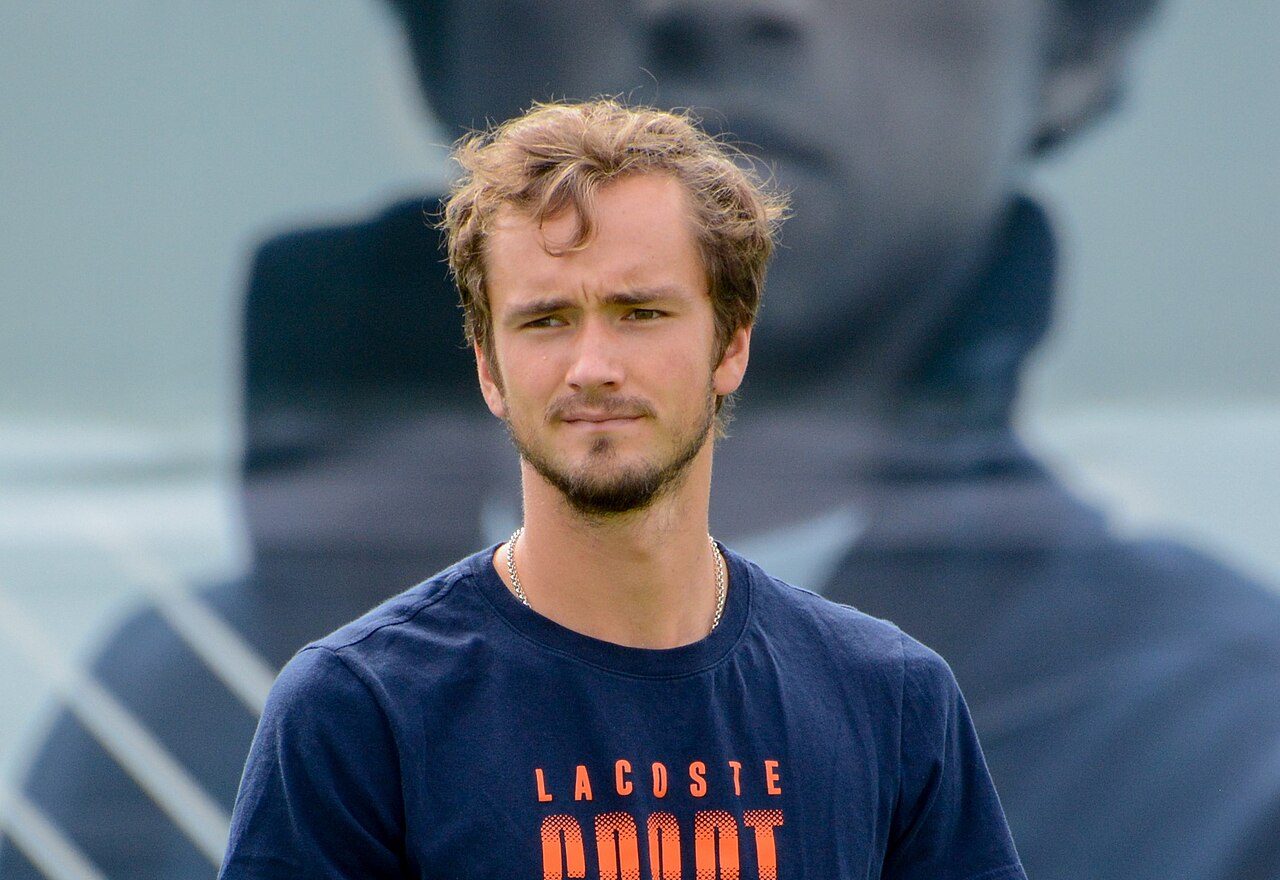
Photo: Carine06, CC BY-SA 2.0, via Wikimedia Commons