Fourteen Grand Slam singles titles, seven Wimbledons, and a US Open farewell that doubled as the last match of his career: Pete Sampras built one of the cleanest winning records of the Open Era without ever needing much noise around him.
Pete Sampras: the making of a champion
Born Petros Sampras in Washington, D.C., on August 12, 1971, he grew up in a family of Greek heritage and moved with his parents to California as a child. One of the familiar stories from his early years is also one of the most revealing: at 3, he found a tennis racket in the basement and began hitting balls for hours. It sounds simple, but it fits the player he became, self-contained, repetitive, and deeply comfortable with the lonely mechanics of improvement.
His first major guide was Peter Fischer, a pediatrician and keen amateur player who coached him through his formative years. At the Jack Kramer Club in Southern California, Sampras developed the foundations of the game that would later define him. Fischer made one especially important call when Sampras was a teenager: he encouraged him to switch from a two-handed backhand to a one-hander.
That change did not make life easier right away. A one-handed backhand asks for timing, balance, and nerve, especially from a young player facing heavy pace. But it gave Sampras more reach, more variety, and a smoother transition to the net. In hindsight, it was one of the decisions that helped turn him into the classic attacking player of his era.
As a junior, he was highly regarded without being treated as a sure thing. He reached the final of the 1988 U.S. Open boys’ singles event and turned professional that same year, still only 16.
A fast rise on the ATP Tour
The first steps on the ATP Tour were solid rather than spectacular. Sampras finished his debut season inside the top 100, a sign that he was adjusting quickly to the professional game even before the big results arrived.
Then came the leap. In 1990, he won his first top-level singles title in Philadelphia, and a few months later he changed the shape of his career at the US Open. He beat Thomas Muster, Ivan Lendl, John McEnroe, and Andre Agassi on the way to the title, a run that looked bold at the time and even stronger in retrospect. In the final, he defeated Agassi in straight sets.
That victory made him the youngest men’s singles champion in US Open history, at 19 years and 28 days. More than the age record, it announced his identity as a player. Sampras was not interested in wearing opponents down from the baseline. He wanted to take the match away from them, with a heavy first serve, a biting second serve, crisp first volleys, and the confidence to keep attacking when the score tightened.
From major winner to world No. 1
Winning one Slam can launch a career. Staying at the top is a different test, and the early 1990s were when Sampras proved he could do that too.
He won the year-end ATP Tour World Championships in 1991, then helped the United States win the Davis Cup in 1992. That same season, he reached the US Open final again, losing to Stefan Edberg, one of only four defeats he took in major finals. The others came against Andre Agassi at the 1995 Australian Open, Marat Safin at the 2000 US Open, and Lleyton Hewitt at the 2001 US Open.
On April 12, 1993, he rose to world No. 1 for the first time. He would spend 286 weeks there and finish six straight seasons as the year-end No. 1 from 1993 through 1998, a record in men’s tennis at the time. Those numbers matter because they explain what his era felt like: not a brief peak, but a long hold on the top of the sport.
Wimbledon became his stage
Some champions are linked to one tournament by accident. With Sampras, the fit was exact.
He won Wimbledon seven times: 1993, 1994, 1995, 1997, 1998, 1999, and 2000. He never lost a final there. On Centre Court, his game seemed stripped to its essentials. The serve set the tone, the first volley finished the point, and the pressure that rattled others often sharpened him.
There is a small irony in that story. Early in his career, Sampras did not love grass. He found the surface awkward and, by his own account, unfair. But under coach Tim Gullikson, he learned how to use it fully. Once he trusted his movement and patterns on grass, Wimbledon became the clearest expression of his tennis.
His Grand Slam record also shows both range and one stubborn gap. He won the Australian Open twice, in 1994 and 1997. He won the US Open five times, in 1990, 1993, 1995, 1996, and 2002. At Roland Garros, though, he never found the same comfort. His best run in Paris ended in the semifinals in 1996.
That missing French Open title is part of the Pete Sampras story, but it does not shrink the larger body of work. He retired with 14 major singles titles, the most by any man at the time.
Tim Gullikson, Paul Annacone, and a rare public moment
Sampras was often described as private, even guarded, and that made his bond with coach Tim Gullikson especially noticeable. Gullikson worked with him from 1992 to 1995, helping refine not just the tactics but also the calm structure around his game.
At the 1995 Australian Open, Gullikson left the tournament because of health concerns and was later diagnosed with brain cancer. During his quarterfinal against Jim Courier, Sampras became emotional on court after hearing shouted support for his coach from the crowd. It remains one of the most human moments of his career: a player known for control suddenly unable, and unwilling, to hide what he was feeling.
After Gullikson, Sampras worked with Paul Annacone, another important figure in the most successful stretch of his later career.
The Agassi rivalry and the changing game around him
If one rivalry gave the 1990s its sharpest contrast, it was Sampras against Andre Agassi. Their styles were different, their personalities even more so. Sampras was reserved, efficient, and most dangerous when points stayed short. Agassi was expressive, electric off the ground, and built to take time away from opponents from the baseline.
Sampras led their head-to-head 20-14, and many of their biggest meetings came on the sport’s biggest stages, including the US Open final in 1990 and the Wimbledon final in 1999. The matchup worked because it was not just about ranking points or trophies. It looked like a contest between two versions of elite tennis.
As the game gradually slowed and baseline power became more central, Sampras had to work harder for the same edge. He remained a threat, but by the start of the new decade, younger players were pushing through. Hewitt beat him in the 2001 US Open final. Safin had already done the same a year earlier.
And then came one last turn.
The perfect ending at the US Open
His final major title arrived in the most unlikely way: after a title drought and with questions growing louder about whether his best days were behind him.
At the 2002 US Open, Sampras put together one last classic run. He beat Greg Rusedski, Tommy Haas, Andy Roddick, Sjeng Schalken, and then Agassi in the final, winning in four sets. It was his fifth US Open title and his 14th Grand Slam singles crown.
He did not play another tour match after that victory.
Sampras officially announced his retirement on August 25, 2003. It gave his career an unusually neat final chapter: the last match was a Grand Slam final, and the last image was a champion walking away with a major trophy. In 2007, he was inducted into the International Tennis Hall of Fame.
Pete Sampras playing style: serve first, pressure always
Any look at Pete Sampras playing style has to begin with the serve. It was not only powerful; it was disguised, varied, and relentlessly accurate. He could hit flat, slice wide, or kick the second serve high enough to start the point on his terms. On big points, he often trusted the serve more, not less.
From there, everything connected. He moved forward naturally, volleyed with soft hands, and used his athleticism to make difficult forecourt positions look routine. His overhead was among the safest shots in the game, and his running forehand could be explosive when rallies stretched.
The one-handed backhand was not the heaviest shot in men’s tennis, but it was better than some early critics allowed. He could drive it, chip it low, and use it as a transition shot to get to net. On grass and hard courts, that full package was devastating.
Off the court: family, business, and public life
Away from tennis, Sampras has kept a lower profile than many stars of his generation. He married actor Bridgette Wilson in September 2000, and they have two sons, Christian Charles and Ryan Nikolaos. The family has long been associated with Southern California, including Lake Sherwood.
Some reports about his business life are harder to verify cleanly than his tennis record, so they need careful wording. He has been linked in published reports to real estate holdings and private investments, and various outlets have estimated Pete Sampras net worth figures in the high eight or low nine figures. Those estimates are not official, and they vary by source. His career prize money on the ATP Tour totaled $43,280,489.
He has also been associated over the years with brands including Wilson, Nike, Sergio Tacchini, Pizza Hut, Dannon, American Express, Pepsi, and Rolex.
More recently, Sampras appeared in promotional work for Kalshi, a prediction-market company. That drew attention because tennis has become increasingly sensitive about gambling-related partnerships and integrity rules. In his case, the discussion centered on the broader optics of the sport rather than on any issue from his playing career.
Legacy without exaggeration
Sampras finished with 64 ATP singles titles, five year-end championships, two Davis Cup-winning campaigns with the United States, and a long run as the standard on fast courts. He was not the loudest star of his generation, and he did not try to be. What he offered instead was a very hard thing to sustain in elite sport: clarity.
He knew how he wanted to play, he trusted it under pressure, and for much of the 1990s almost nobody could stop it often enough.
FAQ
How many Grand Slams did Pete Sampras win?
Pete Sampras won 14 Grand Slam singles titles.
When did Pete Sampras retire?
He announced his retirement on August 25, 2003. His last professional match was the 2002 US Open final.
Did Pete Sampras ever win the French Open?
No. His best result at Roland Garros was reaching the semifinals in 1996.
Who was Pete Sampras’s biggest rival?
Andre Agassi was his defining rival. Sampras led their head-to-head 20-14.
What was Pete Sampras’s playing style?
He played attacking all-court tennis built around a dominant serve, first-strike patterns, and frequent net play.
What is Pete Sampras net worth?
Published estimates vary, and no official figure has been confirmed. His ATP career prize money totaled $43,280,489.
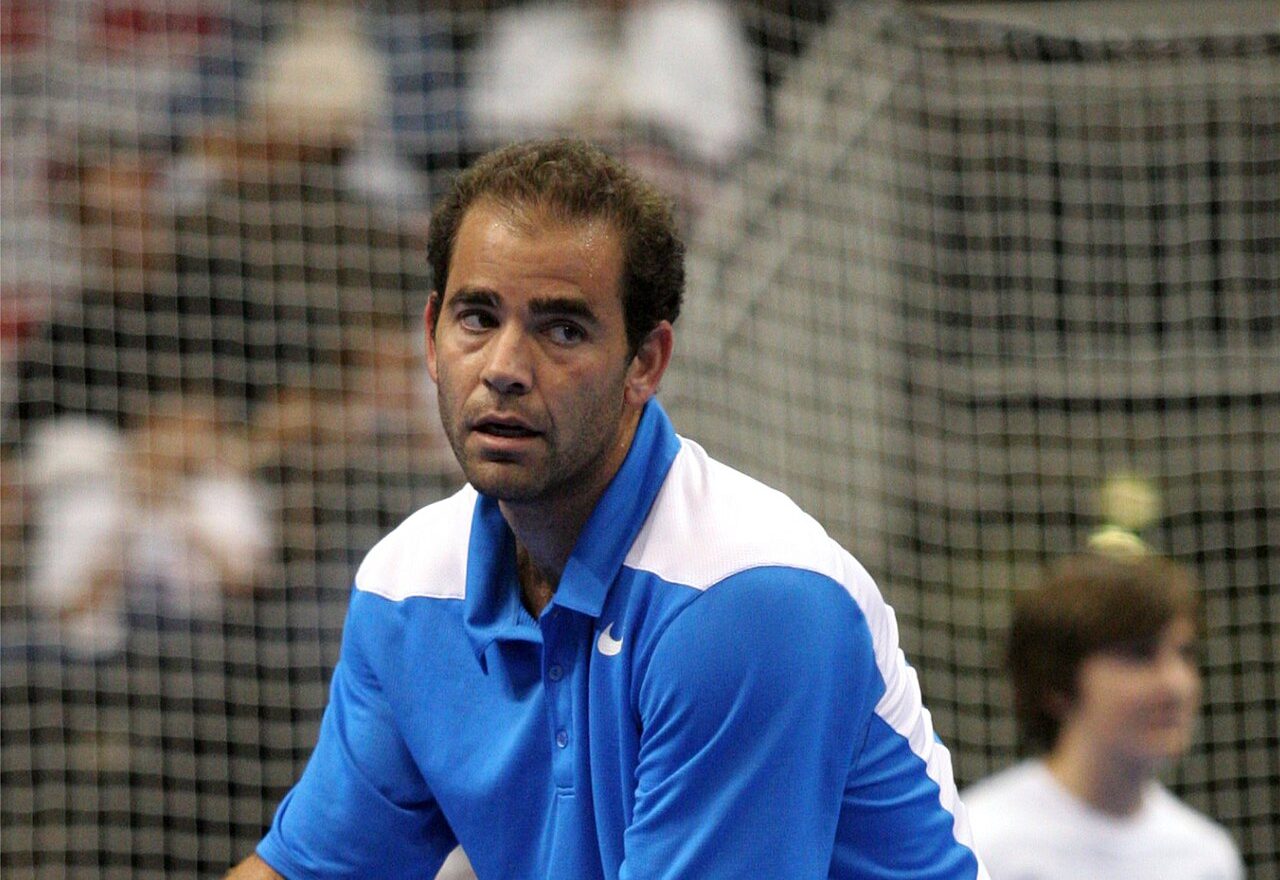
Photo: Craig ONeal, CC BY-SA 2.0, via Wikimedia Commons