At 13, Jannik Sinner left the mountains of South Tyrol for a tennis academy on the Ligurian coast. It was the kind of move that tends to define a career long before the trophies arrive. In his case, it led from a childhood split between skis and rackets to the top of men’s tennis, where he became the first Italian man to reach world No. 1 and built a résumé that already includes multiple Grand Slam titles.
A South Tyrolean start, with skis still in the picture
Sinner was born on August 16, 2001, in Innichen, San Candido in Italian, in the northern region of South Tyrol. The setting matters. This is a part of Italy where German is widely spoken, and German is his native language. His parents, Hanspeter Sinner and Siglinde Rauchegger, worked at a ski lodge, and for a while it looked entirely plausible that their son’s best sporting future might be on snow rather than on a tennis court.
As a boy, he was a strong junior skier and won a national title in giant slalom at a young age. He also admired Bode Miller, which fits neatly with that first version of his sporting life: tall, fearless, and drawn to speed. Tennis, though, kept reappearing. He briefly stepped away from it as a child, then returned, first under coach Heribert Mayr and later in a much more serious setting.
The decisive break came in his early teens, when he moved to Bordighera to train with Riccardo Piatti. That choice separated him from a normal childhood and, in some ways, from a normal tennis path too. Sinner did not build his name through the junior Grand Slams. He played none of them. By the time much of the tennis world noticed him, he was already moving through the professional ranks.
A fast rise without the usual junior fanfare
His pro debut came in 2018, and the climb was quick enough to stand out even in a sport that is always searching for the next young contender.
The first real jolt arrived in 2019. Sinner won the Next Gen ATP Finals in Milan, finished the season inside the top 100, and was named ATP Newcomer of the Year. For a teenager with no junior Slam résumé, it was a sharp introduction. He did not look like a player learning the level; he looked like one accelerating through it.
That momentum carried into 2020, when he won his first ATP title in Sofia. The title made him the youngest ATP singles champion since 2008, and it pushed him into the top 50. More importantly, it showed the outlines of the player he would become: calm between points, clean off both wings, and able to take time away from opponents without seeming rushed himself.
In 2021, he moved from promising to established. He won four ATP titles, reached his first Masters 1000 final in Miami, and in November became the first man born in the 2000s to break into the ATP top 10. By then, the conversation around him had changed. He was no longer being discussed as a project. He was already part of the sport’s main tier.
The breakthrough into the biggest titles
The next leap came in 2023, and it was the season that made his ceiling look different. Sinner won his first Masters 1000 title in Canada and then helped Italy win the Davis Cup. Those were not just good results; they were the kind that shift a player’s place in the sport. He was beating the best more often, going deeper in the biggest events, and carrying himself like someone who expected to stay there.
Then came 2024, the year his career changed shape.
He won the Australian Open, his first Grand Slam title, and later added the US Open. In between, he rose to world No. 1 on June 10, becoming the first Italian man to top the ATP rankings. He also won the ATP Finals, capping a season in which he was not merely consistent but dominant across the calendar’s biggest stages.
The Australian Open title carried extra historical weight. No Italian man had won a major singles title since Adriano Panatta at Roland Garros in 1976. Sinner ended that wait on hard courts in Melbourne, then confirmed it was no one-off by winning another major in New York.
Expanding the range: grass-court champion and clay contender
If 2024 established him as a hard-court major winner, 2025 broadened the picture.
He defended his Australian Open title, won Wimbledon, reached the French Open final, and also made the US Open final. He defended his ATP Finals crown as well. The two major finals he lost that season, at Roland Garros and the US Open, both came against Carlos Alcaraz, a detail that says as much about the era as it does about Sinner himself. Their rivalry had become central to the men’s game.
Wimbledon mattered for another reason. Sinner had long looked suited to grass because of his ball-striking and ability to take the ball early, but winning there confirmed that his game translated fully across surfaces. He was no longer a hard-court specialist with range. He was a complete top player.
Rivalry, setbacks and the harder parts of the timeline
Every leading player ends up measured at the majors, and Sinner’s record there quickly became one of the anchors of his standing. Australian Open titles in 2024 and 2025, the 2024 US Open, and Wimbledon crowns in 2025 and 2026 gave him five Grand Slam singles titles before the middle of his twenties.
The one major still missing from that run was the French Open, though he came close with a runner-up finish in 2025. Alcaraz beat him in that final and again in the 2025 US Open final, underlining how narrow the margins were at the top. Their meetings became one of the defining contests of the period: different styles, similar ambition, and very little separating them on the biggest stages.
Not every interruption came from an opponent. Sinner withdrew from the Paris Olympics in 2024 because of illness.
A more serious episode followed when he accepted a three-month suspension in early 2025 after two positive doping tests from 2024. The official finding from the International Tennis Integrity Agency was that he bore no fault or negligence, but the case remains part of his career record and cannot be skipped over in any factual account of his rise.
What makes Jannik Sinner so effective
At 1.91 meters, he looks like a modern power player, and in some ways he is. But that description is too narrow.
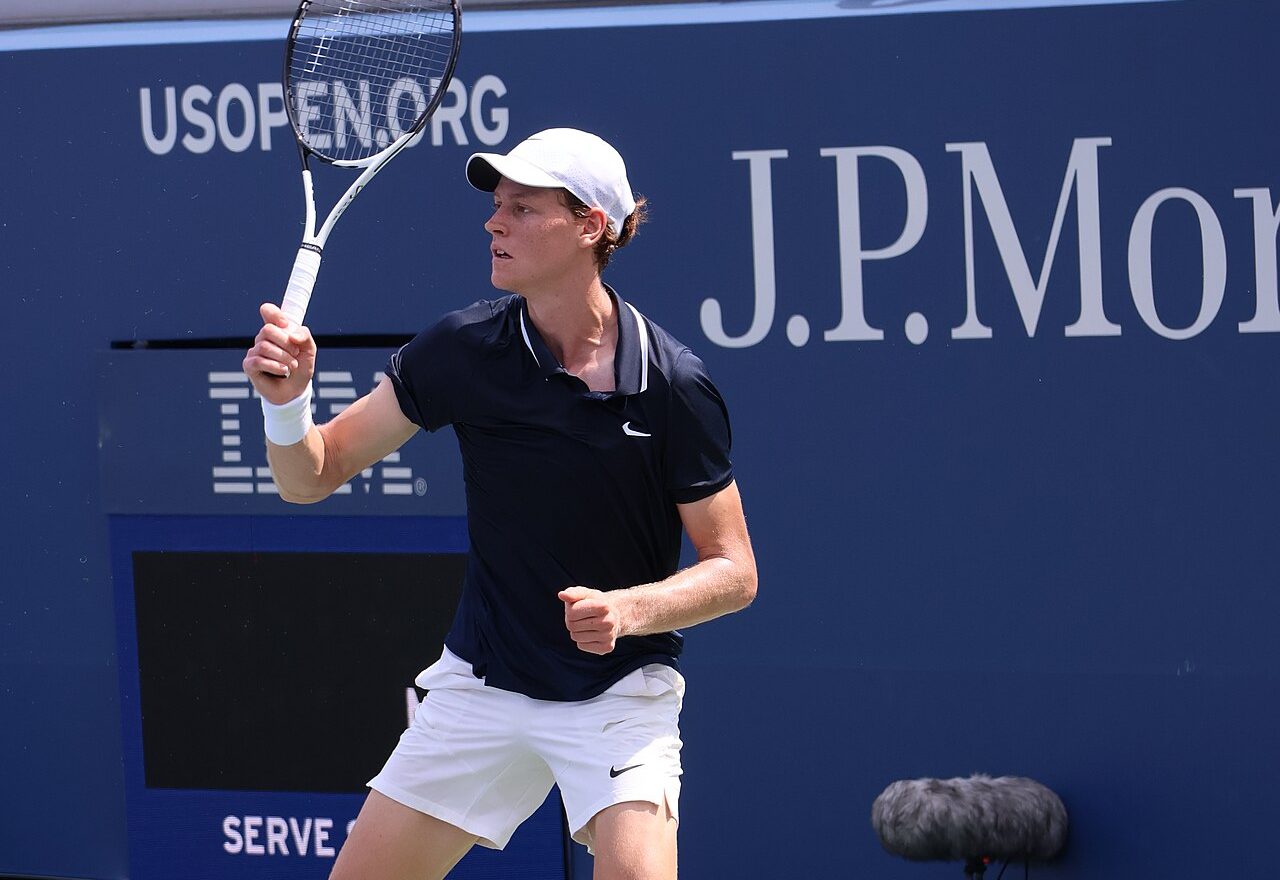
Sinner is an aggressive baseliner whose game is built on pace, timing and repeatability. He hits hard off both sides, especially when he can step inside the baseline and redirect the ball early. His two-handed backhand is one of the cleanest shots in men’s tennis, not just because of the speed it produces but because of how reliably he can use it under pressure. He can flatten it out, change direction, and take control of rallies without needing a spectacular wind-up.
What separates him from many other big hitters is how well the rest of the game supports the power. He moves exceptionally well for his height, defends without drifting too far back, and keeps a strikingly even emotional temperature during matches. That combination, force, balance, and discipline, is why his tennis has held up on clay, grass and hard courts alike.
He plays right-handed with a two-handed backhand, but the more useful description is that he plays with very little wasted motion. Points often look simpler when he is in control than they really are.
The team around him
As his results grew, so did the stability of his coaching setup. Simone Vagnozzi became his coach in early 2022, and Darren Cahill joined later that year as co-coach. It proved an important partnership during the stretch in which Sinner moved from top-10 player to major champion and world No. 1.
His wider team has also included fitness coach Umberto Ferrara and physiotherapist Alejandro Resnicoff. In a sport where progress can be fragile, that continuity has mattered.
Off court: family, language, endorsements and public curiosity
Away from tournaments, Sinner has remained closely associated with his South Tyrolean roots. He grew up in a multilingual corner of Italy, speaks German as his first language, and still carries some of the reserve often associated with that background. He is not one of the tour’s loudest personalities, but that has never hurt his profile. If anything, the contrast between his quiet manner off court and the force of his tennis has made him more distinctive.
His family includes his parents and his older adopted brother, Mark. He has also been based in Monte Carlo, a common home base for elite players on the ATP Tour.
Commercially, his rise has been matched by a broad endorsement portfolio, including Nike, Head, Gucci, Lavazza, Rolex and several Italian brands. Reports on his off-court earnings have been substantial. According to reporting cited by AP, sponsor income has reportedly reached around $27 million annually. As with all such figures, exact totals can vary by source and timing.
There has also been predictable interest in his private life. Some outlets have reported that he dated fellow player Anna Kalinskaya, and other reports have linked him to model Laila Hasanovic. Those claims should be treated as reported private-life coverage rather than confirmed statements from Sinner unless he addresses them publicly himself.
A career already heavy with milestones
The numbers alone tell a large part of the story. Sinner became world No. 1 in June 2024, won multiple Grand Slam singles titles across hard courts and grass, claimed major team success with Italy in the Davis Cup, and established himself as one of the central figures of his generation.
But the more interesting part is how he got there. Not through junior celebrity. Not through noise. A skier from South Tyrol chose tennis, left home young, learned quickly, and built a game sturdy enough for every surface and every stage.
FAQ
How old is Jannik Sinner?
He was born on August 16, 2001.
What is Jannik Sinner’s nationality?
He is Italian, from South Tyrol in northern Italy.
Has Jannik Sinner been world No. 1?
Yes. He first reached world No. 1 on June 10, 2024.
How many Grand Slam titles has Jannik Sinner won?
He has won multiple Grand Slam singles titles, including the Australian Open, US Open and Wimbledon.
Who coaches Jannik Sinner?
His coaching team has included Simone Vagnozzi and Darren Cahill.
What is Jannik Sinner’s playing style?
He is an aggressive baseliner known for powerful groundstrokes, strong movement and a standout two-handed backhand.
Photo: Hameltion, CC BY-SA 4.0, via Wikimedia Commons