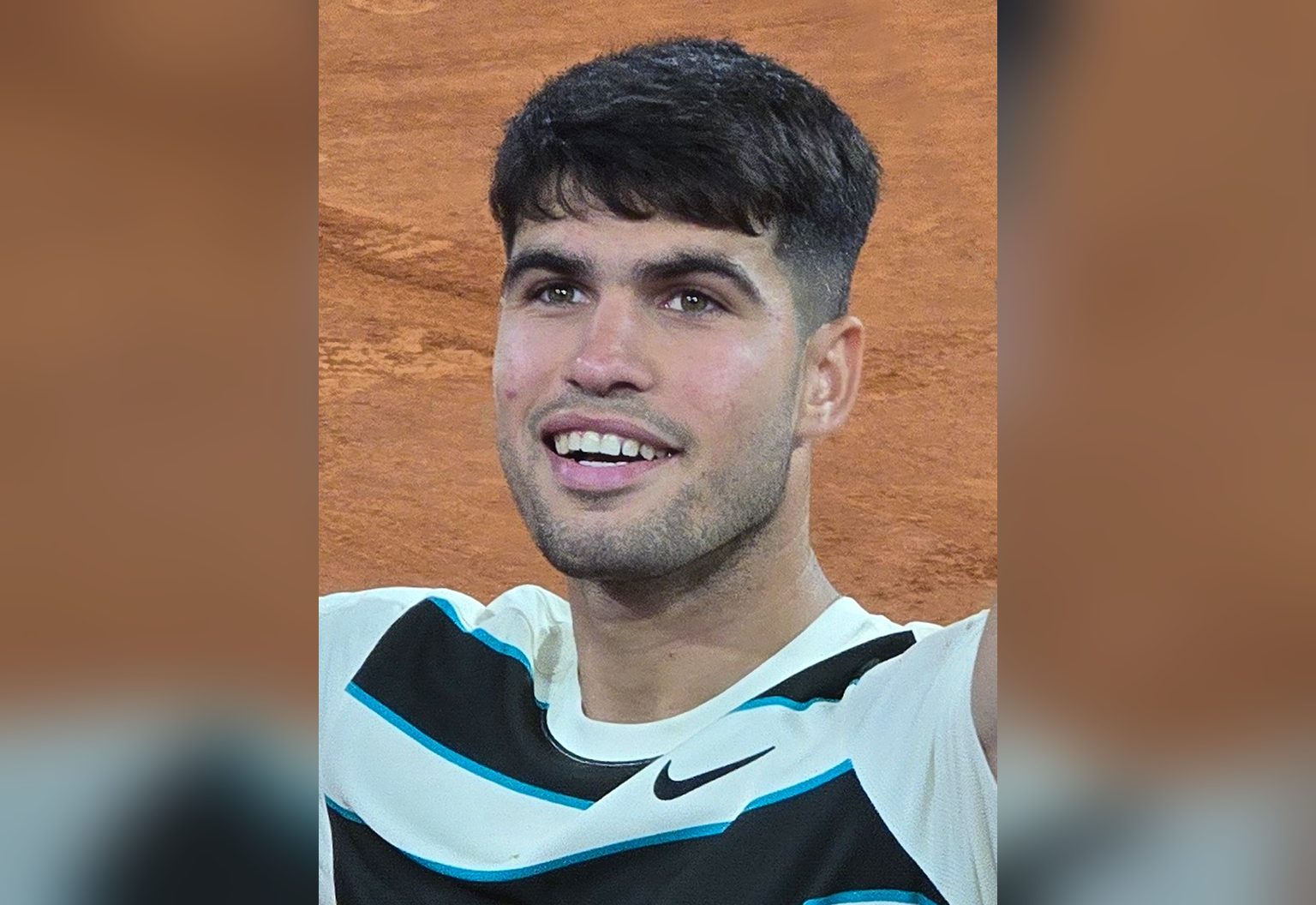
A US Open title at 19 tends to change the way a player is discussed. In Carlos Alcaraz’s case, it changed the sport’s timeline. By the time he lifted that trophy in New York, the teenager from El Palmar had already gone from local prodigy to the youngest man to reach world No. 1 in the Open Era.
From El Palmar to Ferrero’s academy
Alcaraz was born on May 5, 2003, in El Palmar, Murcia, in southeast Spain. Tennis was part of the family routine early. His father, Carlos Alcaraz González, worked at the Real Sociedad Club de Campo de Murcia as a coach and administrator, and that made the courts feel less like a special destination than an extension of home. His mother is Virginia Garfia Escandón, and he grew up with three brothers: Álvaro, Sergio and Jaime.
That background matters because his rise did not begin with a sudden discovery. He was on court from the age of four, learning in a setting where the sport was already woven into family life. His grandfather had also helped establish that connection by being the first in the family to join the local club.
As a boy, he quickly became one of Spain’s standout juniors. He won the under-12 Rafa Nadal Tour Masters in 2015, added the under-14 title in 2016 and took the Babolat Cup in 2017. At 14, he made one of the first major decisions of his tennis life and moved to the Equelite Juan Carlos Ferrero Sport Academy in Villena. It was a serious step: away from home, into a high-performance environment, under the eye of a former world No. 1 who understood exactly what top-level tennis demands.
In 2019, he reached the quarter-finals of the Wimbledon boys’ singles event. He did not build a long junior résumé because the professional game arrived quickly.
The first pro steps and a fast breakthrough
Alcaraz made his professional debut in 2018 on the ITF circuit. The first ATP-level marker came in 2020 at the Rio Open, where he won his first main-draw match and became the first player born in 2003 to win a tour-level match.
Even then, the appeal was obvious. He was not simply winning points with speed or youth. He already played with unusual variety: heavy forehands, sudden changes of pace, a willingness to move forward and a drop shot he was happy to use under pressure rather than save for show.
The real breakthrough arrived in 2021. He won his first ATP title in Umag, becoming the youngest tour-level champion since Kei Nishikori in 2008. A few weeks later at the US Open, he produced the run that introduced him to a much wider audience. He beat Stefanos Tsitsipas in a five-set thriller, reached the quarter-finals and then retired against Félix Auger-Aliassime because of injury.
That New York run mattered beyond the result. It showed how his game translated to the biggest stage: explosive but not reckless, inventive without drifting into low-percentage tennis.
2022: the leap to the top
Some players spend years circling the top before they break through. Alcaraz did it in one surge.
In 2022, he won ATP Masters 1000 titles in Miami and Madrid, the latter on home soil and against elite opposition. Then came the US Open. He beat Casper Ruud in four sets in the final to win his first Grand Slam title and, on September 12, rose to world No. 1.
That ranking jump carried real historical weight. At 19 years, 4 months and 7 days, he became the youngest men’s world No. 1 in the Open Era and the first teenage male player to hold the top spot.
The season changed his status. He was no longer discussed only as a gifted young Spaniard or the next big thing. He had become the standard-bearer of the new generation, with a major title and the ranking to prove it.
Setbacks, response and titles on every surface
His rise was not perfectly smooth. Alcaraz missed the Australian Open in 2023 because of injury, an early reminder that a violent, explosive style can put stress on the body. The response, though, was immediate. He won Indian Wells, took Madrid again and then claimed Wimbledon by beating Novak Djokovic in a five-set final.
That victory said something important about the shape of his career. He was not a clay specialist with a hard-court major, or a hard-court player learning grass. He was already building a record that worked everywhere.
The point became even clearer in 2024. He won Indian Wells for a second straight year, then captured the French Open for the first time. A few weeks later, he defended his Wimbledon title. At the Paris Olympics, he added a silver medal in singles after losing the final to Djokovic.
By then, the conversation around him had shifted. The question was no longer whether he could win the biggest tournaments. It was how broadly he could dominate across surfaces and seasons.
The Alcaraz game: force, touch and improvisation
Listed at 1.83 m (6 ft 0 in), Alcaraz is a right-hander with a two-handed backhand, but those basics do not explain much on their own. What makes his tennis distinctive is the range inside the aggression.
The forehand is the headline shot, struck with heavy pace and spin, often used to take over rallies in a single blow. But the more complete picture is in the contrast. He can flatten the ball out, defend from awkward positions, sprint into attack and then feather a drop shot that changes the geometry of the point entirely. He likes the net, trusts his hands there and is comfortable improvising.
That blend is why he is often described as an all-court player rather than being tied to one surface. Hard court, clay, grass: his best tennis has traveled well because it is built on more than one pattern.
Rivalries and the shape of his era
Every leading player eventually gets measured by the opponents who keep appearing across the net. For Alcaraz, Jannik Sinner has become the defining rivalry of his generation.
Their matches have helped frame the post-Big Three landscape: two young stars, different in style and temperament, meeting deep in major events and big tournaments. Any head-to-head figure changes over time, but the broader point is stable enough. When people talk about the sport’s next era, this pairing is usually near the center of the discussion.
Djokovic, too, has been a major reference point in Alcaraz’s story, especially because of the Wimbledon final Alcaraz won and the Olympic final he lost. Those matches gave his career an added layer: not only rising among his peers, but testing himself against one of the game’s established benchmarks.
Off the court: family, home and public image
For a player with global name recognition, Alcaraz has kept a notably close tie to home. He has often been described as continuing to live in or near El Palmar with his family even as his profile grew, though living arrangements can change and should be treated as time-specific rather than permanent fact. Reports in the British press, including The Times, have also described him as single.
Family remains central to his public image. His father’s role in tennis shaped the beginning, and his older brother Álvaro has worked as a hitting partner. That family presence has stayed visible even as the tournaments, prize money and endorsements have grown.
There are a few personal details he has shared publicly that round out the picture. He has said he prefers nicknames such as Carlitos or Charly because “Carlos” sounds too serious. He also has a “CCC” tattoo, short for Cabeza, Corazón, Cojones, “Head, Heart, Guts”, a family motto linked to his grandfather.
Commercially, his endorsement portfolio has included Nike, Babolat, Rolex, BMW, Louis Vuitton, Calvin Klein and Evian, among others. Those deals have become a significant part of his off-court profile, but they have not changed the image he projects most often: a young star still strongly anchored in family life and routine rather than celebrity theater.
The coaching influence
Juan Carlos Ferrero was one of the key figures in Alcaraz’s development. Under Ferrero’s guidance, the raw athleticism and imagination were shaped into a game sturdy enough to win majors and reach No. 1.
As with many top players, coaching structures can evolve over time, and support teams are not always as fixed as a simple label suggests. Ferrero has been the central coaching influence through the most important early phase of Alcaraz’s career, while Samuel López has also been part of his team in later stages.
Why his rise landed so hard
What stands out most in the Carlos Alcaraz story is not just speed, though there has been plenty of that. It is how complete the package looked so early. He won big on hard courts, then on grass, then at Roland Garros. He reached No. 1 as a teenager. He built a style that feels modern without being one-note: power, speed, touch and nerve, all visible at once.
That is why his career has already carried unusual weight. Not because it arrived with hype, but because the results came quickly and across the full map of the sport.
FAQ
Where is Carlos Alcaraz from?
He is from El Palmar, Murcia, Spain.
How many Grand Slam titles has Carlos Alcaraz won?
He has won four singles majors: the US Open in 2022, Wimbledon in 2023 and 2024, and the French Open in 2024.
Who coached Carlos Alcaraz?
Juan Carlos Ferrero has been the defining coach of his rise, and Samuel López has also been part of his team.
What is Carlos Alcaraz’s playing style?
He plays aggressive all-court tennis, built around a heavy forehand, great speed, net play and frequent drop shots.
Who is Carlos Alcaraz’s main rival?
Jannik Sinner is widely seen as the leading rivalry of his generation, with Novak Djokovic also a major figure in some of his biggest matches.
Does Carlos Alcaraz still live with his parents?
He has often been reported to remain closely based around his family home in El Palmar, but that is best treated as a time-specific report rather than a fixed fact.
Photo: Like tears in rain, CC BY-SA 4.0, via Wikimedia Commons