
Seven Grand Slam singles titles tell only part of the story. John McEnroe made his name with soft hands, sharp angles and a left-handed serve-and-volley game that could take time away from anyone. He also did it with a temper that often spilled into public view, which is why his career still sits at the center of tennis history: brilliant, noisy and impossible to separate from the era around him.
John McEnroe’s early life and sudden arrival
John Patrick McEnroe Jr. was born on February 16, 1959, in Wiesbaden, West Germany, where his father was stationed with the U.S. Air Force. He grew up in New York and developed his game in a tennis culture that prized repetition, discipline and match toughness. As a junior, he trained through the Port Washington Tennis Academy and worked with coaches including Tony Palafox, Paul Cohen, Harry Hopman and Carlos Goffi.
His rise did not follow the usual slow build. In 1977, still an amateur, he came through qualifying at Wimbledon and reached the semifinals. That run changed his profile almost overnight. A teenager with a compact frame and unusual touch was suddenly trading blows on Centre Court with established pros. In the same season, he won the French Open boys’ singles title and captured the French Open mixed doubles crown with Mary Carillo.
College tennis barely slowed him down. At Stanford, he won the 1978 NCAA singles title and helped the school win the team championship. He turned professional that year, but by then he was already operating like a player in a hurry.
The breakthrough years on the ATP Tour
McEnroe’s first full stretch on the ATP Tour was crowded with big results. In 1978, he won the season-ending Masters Grand Prix and played on the United States Davis Cup team that lifted the trophy. More Davis Cup success followed in 1979, 1981, 1982 and 1992, and he became one of the most effective American team competitors the event has seen.
His first Grand Slam singles title came at the 1979 US Open, where he beat Vitas Gerulaitis in the final. That same year, he won the WCT Finals and added major doubles titles at Wimbledon and the US Open with Peter Fleming. Their partnership would become one of the defining doubles teams of the period: McEnroe the improviser at the front of the court, Fleming the steady complement beside him.
By early 1980, he had climbed to world No. 1 in singles. He would spend 170 weeks there. He also reached No. 1 in doubles for 269 weeks, a reminder that his all-court instincts were not a side note to his singles success but a central part of it. He remains the only man to finish a season ranked No. 1 in both singles and doubles.
Wimbledon, the US Open and the making of a champion
One of the matches most closely tied to McEnroe’s name ended in defeat. The 1980 Wimbledon final against Bjorn Borg is remembered for its tension, contrast and the famous fourth-set tiebreak that McEnroe won 18-16 before losing the match in five sets. It was the kind of loss that still enlarged a reputation. He had shown he belonged at the top.
He returned to win Wimbledon in 1981, beating Borg in the final, then added more titles there in 1983 and 1984. At the US Open, he was even more productive, winning in 1979, 1980, 1981 and 1984. For a stretch, his game looked built for the biggest stages in New York and London: quick first strikes, biting lefty serves, reflex volleys and the nerve to play on instinct.
The doubles results kept coming too. With Fleming, he won Wimbledon men’s doubles in 1979, 1981, 1983 and 1984, and the US Open men’s doubles in 1979, 1981 and 1983. McEnroe was not moonlighting in doubles; he was dominating there as well.
The 1984 season and the French Open that got away
His best season came in 1984, and the numbers still stand out. McEnroe went 82-3 in singles, a .965 winning percentage that remains one of the best Open Era seasons ever recorded. He won Wimbledon and the US Open, took the Masters Grand Prix and the WCT Finals, and for long stretches seemed to be playing a slightly faster, cleaner version of everyone else’s tennis.
The one result that still hangs over that year came in Paris. At the French Open, he led Ivan Lendl by two sets to love in the final and then lost in five. Roland Garros was the only major singles title he never won, and that match is the clearest reason why. He reached the Australian Open semifinals in 1983, but never won that event either.
His major singles final record was otherwise formidable. He won seven of his 11 Grand Slam singles finals, with losses at Wimbledon to Borg in 1980 and Jimmy Connors in 1982, at the French Open to Lendl in 1984, and at the US Open to Lendl in 1985.
Rivalries: Borg, Connors and Lendl
McEnroe’s career makes the most sense when seen through the opponents who kept meeting him in the biggest moments.
Against Borg, he finished 7-7. Their contrast was almost too neat for fiction: Borg cool and unreadable, McEnroe expressive and combustible. Yet the rivalry was not just about temperament. It was also a clash of geometry and pace, baseline pressure against net-rushing invention.
Against Connors, McEnroe held a 20-14 edge. Those matches often felt like a fight over status in American men’s tennis, with both players stubborn, confrontational and unwilling to give an inch in rhythm or attitude.
Against Lendl, he trailed 15-21. That rivalry marked a shift in the sport as much as a shift in McEnroe’s career. Lendl’s heavier baseline game, physical discipline and relentless pressure became harder to disrupt, especially after the 1984 French Open final and the 1985 US Open final.
John McEnroe tennis style: touch, angles and confrontation
Plenty of players have attacked the net. Few did it like McEnroe. His serve was not built on raw power so much as disguise and placement, especially the lefty slice that dragged opponents wide. His first volley often decided the point. His backhand, hit with one hand, could redirect pace or feather the ball short. Around the net, he seemed to see openings before other players recognized them.
He was most dangerous on grass, hard courts and carpet, where his ability to shorten points and improvise paid off quickly. What made him special was not just technique but timing. He could make a half-volley look routine and turn a defensive exchange into attack with one touch.
The other part of the package was harder to ignore. McEnroe argued with umpires, challenged calls and let frustration show. Sometimes that edge sharpened him; sometimes it distracted him. Either way, it became inseparable from his public image.
Fines, flashpoints and the line everyone remembers
The phrase most associated with him came at Wimbledon in 1981: “You cannot be serious!” It followed a line call dispute and became part of sports culture far beyond tennis. During that tournament, he was also fined for verbal abuse after calling an umpire “the pits of the world.”
There were other incidents. At the 1984 Stockholm Open, he was fined and suspended after insulting an umpire and damaging a courtside drinks tray. In 1985, Queen’s Club asked him to resign his honorary membership because of repeated offensive language. At the 1990 Australian Open, he was defaulted after a series of code violations, becoming the first player disqualified from a Grand Slam singles match in the Open Era.
Long after retirement, he drew criticism for comments made in 2017 about Serena Williams’ hypothetical ranking on the men’s tour. The remarks were widely challenged, and McEnroe later said the question had been framed in comparative terms.
Breaks, late chapters and a long afterlife in tennis
After the peak years, his career became less linear. He took a break from the tour in 1986 and another in 1987, and the dominance of the early 1980s did not fully return. Even so, he remained a dangerous player and a major presence.
He won his last Grand Slam men’s doubles title at Wimbledon in 1992, partnering Michael Stich. It was a late-career reminder that his hands had not left him. He stepped away from full-time singles that same year and effectively ended his regular tour career soon after, though he continued to make occasional appearances.
His final career totals are still striking: 77 singles titles, 78 doubles titles and one mixed doubles major, for 156 titles across singles, doubles and mixed doubles. That total includes his mixed doubles title at the 1977 French Open. He was inducted into the International Tennis Hall of Fame in 1999.
His Davis Cup record also remained substantial. McEnroe was part of five U.S. title-winning teams and set American records for Davis Cup singles wins and combined wins.
Off court: family, books, broadcasting and the academy
Away from the court, McEnroe’s life stayed public. He married actress Tatum O’Neal in 1986; they divorced in 1994. They had three children together. In 1997, he married singer Patty Smyth, and they have two daughters. Smyth also has a daughter from an earlier relationship.
He has long been based in New York and built a second career that spread well beyond commentary. He opened an art gallery, wrote memoirs, played music and became one of the most recognizable television voices in tennis. His books include You Cannot Be Serious and But Seriously.
He also stayed involved in player development. The John McEnroe Tennis Academy became one of the most visible parts of his post-playing work, alongside the Johnny Mac Tennis Project, which aims to widen access to the sport.
Some claims about his private life have circulated for years and need careful labeling. Reports and later interviews established that McEnroe used cocaine during part of his playing career; he discussed that publicly and said it did not improve his tennis. Broader stories about rehab or a specific off-court spiral during the mid-1980s have circulated online, but where they are not backed by reliable published reporting, they remain rumor rather than established fact.
FAQ
How many Grand Slam singles titles did John McEnroe win?
He won seven: three at Wimbledon and four at the US Open.
Did John McEnroe ever win the French Open?
No. He reached the final in 1984 and lost to Ivan Lendl after leading by two sets.
What was John McEnroe’s playing style?
He was a left-handed serve-and-volley player known for touch, angles, quick hands at the net and creative shot-making.
Who were John McEnroe’s biggest rivals?
Bjorn Borg, Jimmy Connors and Ivan Lendl were the central rivalries of his career.
Is John McEnroe still involved in tennis?
Yes. He has worked as a broadcaster and remains linked to the John McEnroe Tennis Academy and other tennis projects.
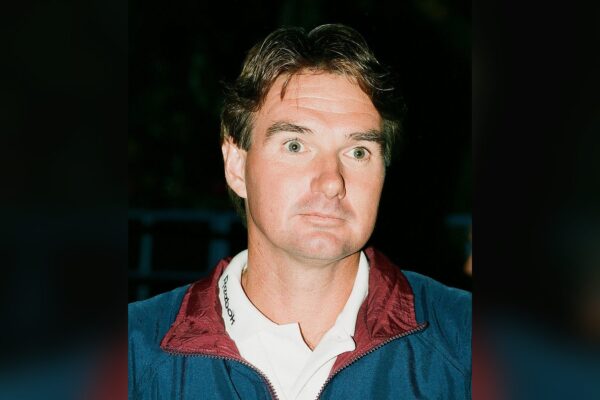
Photo: David Shankbone, CC BY 3.0, via Wikimedia Commons