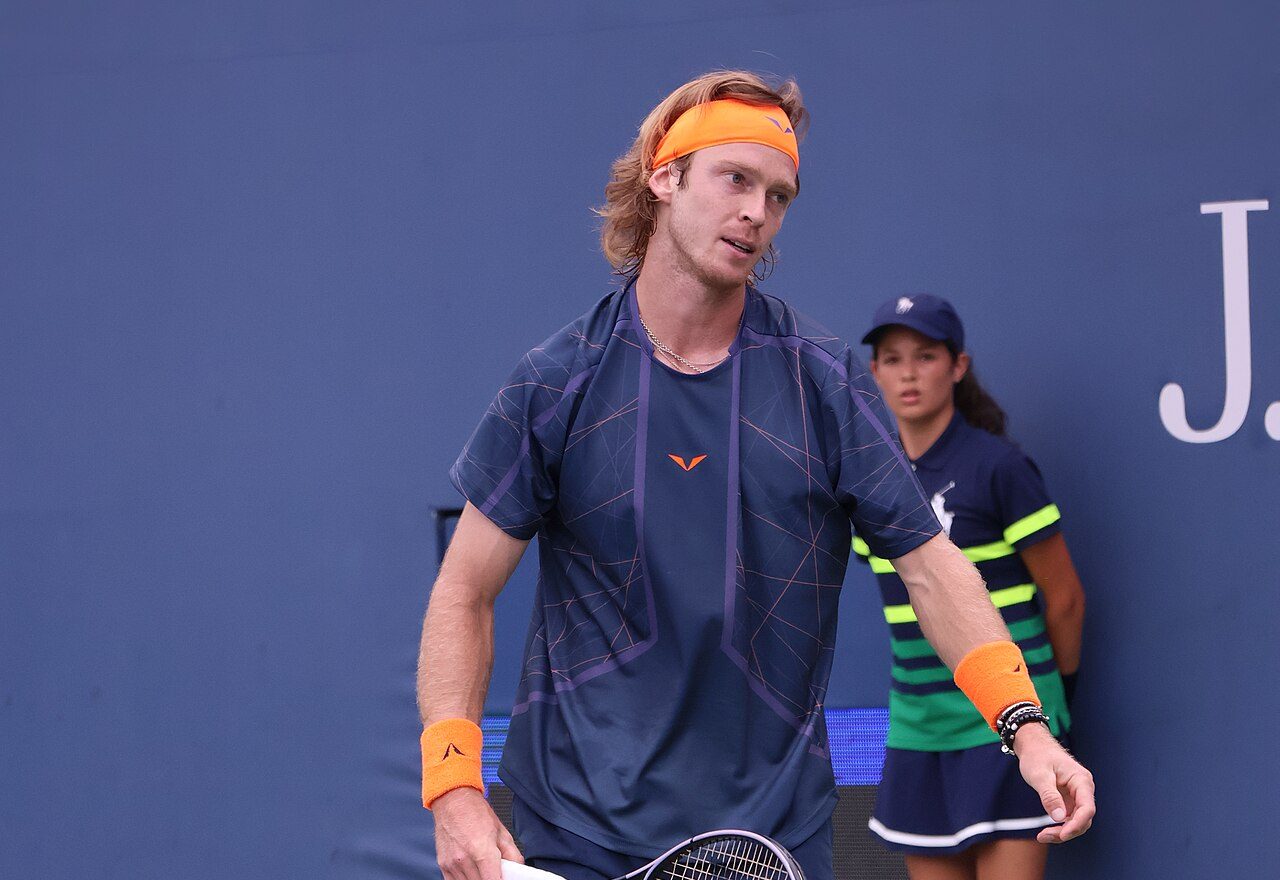
A forehand can shape a career, and few in the modern men’s game have built more around that shot than Andrey Rublev. From junior champion in Paris to Masters 1000 winner and Olympic gold medalist in mixed doubles, the Russian has spent years playing on the front foot: early contact, hard pace, little hesitation. The results have made him a constant presence near the top of the ATP Tour, even as the biggest breakthrough at Grand Slam level has remained just out of reach.
From a Moscow tennis family to junior world No. 1
Rublev was born in Moscow on October 20, 1997, into a family that already knew high-level sport. His mother, Marina Marenko, worked as a tennis coach and played a central role in his early development. His father, Andrey Rublev Sr., came from a boxing background, and his half-sister, Anna Arina Marenko, also went on to play and coach in tennis.
That background mattered. Rublev did not arrive in the sport by accident; he grew up inside its routines, expectations and travel. By his mid-teens, he was already one of the most promising juniors in the game, and 2014 became the year that pushed him into wider view.
He won the boys’ singles title at Roland Garros, took bronze in singles and silver in doubles at the Youth Olympic Games in Nanjing, and finished the season as junior world No. 1. Those results said more than “promising talent.” They showed he could handle big events, different surfaces and the pressure that comes with being one of the best players in his age group.
Early pro steps and the first real breakthrough
Rublev began playing ITF events as a teenager and made his ATP Tour main-draw debut in 2014 in Delray Beach. A year later, he picked up his first ATP doubles title in Moscow alongside Dmitry Tursunov, another early sign that he was moving beyond junior status.
Even then, the outline of his game was obvious. He wanted to dictate. He looked to take the ball early, drive opponents back and build points around a heavy forehand that could do damage crosscourt or down the line. Plenty of young hitters can produce pace for a set. Rublev’s edge was that he could repeat it.
His first major leap came in 2017. He won his first ATP singles title at Umag and then made a deeper mark at the US Open, reaching the quarterfinals. Along the way he beat Grigor Dimitrov, then ranked in the top 10, before losing to Rafael Nadal. That New York run pushed him into the top 40 and changed the conversation around him. He was no longer just a junior standout with power. He was a serious tour player.
Setbacks, then a surge into the elite
Progress was not completely linear. Injuries interrupted parts of his development, and like many aggressive players, Rublev had to learn how to manage a long season without losing the sharpness that made him dangerous in the first place.
Then came 2020, the season that established him as one of the tour’s most reliable winners outside the very top tier. He collected five ATP singles titles, in Doha, Adelaide, Hamburg, St. Petersburg and Vienna, and tied for the tour lead in match wins with 41. He also qualified for the ATP Finals for the first time and climbed to world No. 8.
That year mattered because it broadened his profile. Rublev was no longer a player who could catch fire for one week. He was stacking results across the calendar. Week after week, his intensity and first-strike tennis translated into wins.
The climb continued in 2021. He reached a career-high singles ranking of world No. 5 on September 13, 2021, and added one of the most unusual highlights of his career at the Tokyo Olympics, where he won mixed doubles gold with Anastasia Pavlyuchenkova. He was also part of the Russian team that won the Davis Cup Finals in 2021, giving him a significant team title to go with his individual success.
Quarterfinal runs, a stubborn barrier and the Masters breakthrough
For all his consistency, one statistic followed Rublev for years: repeated Grand Slam quarterfinal appearances without a semifinal. He reached the last eight at all four majors, the Australian Open, Roland Garros, Wimbledon and the US Open, which says plenty about the range of his game. But the final step into a major semifinal kept slipping away.
That tension has defined part of his career. On one hand, making major quarterfinals over and over is the mark of a top player. On the other, the inability to break through became a storyline of its own.
Away from the Slams, though, the biggest titles began to arrive. In 2022, he won three singles titles, Marseille, Dubai and Gijón, and reached the semifinals of the ATP Finals. In 2023, he claimed the biggest trophy of his singles career to that point by winning the Monte-Carlo Masters, his first Masters 1000 title. It was a fitting win on clay, a surface that suits his weight of shot and willingness to trade hard from the baseline until he gets a shorter ball to attack.
He backed that up in 2024 with another Masters 1000 crown in Madrid, beating Félix Auger-Aliassime in the final. By that stage, Rublev had turned himself into more than a dangerous regular-tour player. He had become a proven winner at the sport’s highest non-Slam level.
How Andrey Rublev plays
The basic description is simple: right-handed, two-handed backhand, aggressive baseliner. But that does not quite capture the feel of watching him.
Rublev plays with urgency. He looks to take time away from opponents, especially with his forehand, which remains the center of everything he does. It is not just a finishing shot. It is his organizing principle. He uses it to open the court, rush opponents, and keep rallies on his terms.
His backhand is flatter and more compact, often used to redirect pace rather than dominate with spin. On return games, he likes to step in and start exchanges immediately. When he is in rhythm, matches can feel compressed around him; points become shorter, the tempo rises, and opponents have less room to settle.
There is also the emotional side, impossible to separate from the tennis. Rublev’s intensity is visible, sometimes painfully so. He can be hard on himself, and his on-court frustration has often drawn attention. At the same time, that rawness is part of what makes him such a distinctive competitor. His best tennis tends to come when the aggression is controlled rather than suppressed.
Rivalries and the level he has had to clear
Rublev’s career has unfolded in a crowded era, and that has shaped how his results are judged. He has regularly run into players such as Novak Djokovic, Rafael Nadal, Daniil Medvedev and Stefanos Tsitsipas deep in tournaments, opponents who expose small tactical lapses and punish short spells of impatience.
Against that group, the challenge has often been less about shot quality than about variation, problem-solving and emotional management under pressure. Rublev has always had the pace to trouble elite opponents. The harder question in the biggest matches has been whether he can bend the pattern when Plan A stops working.
Life away from the court
Off court, Rublev has often come across as more reflective and varied than his intense match persona suggests. He has spoken about his interest in music and has released electronic tracks, citing DJs such as Martin Garrix and Alan Walker as influences. He has also shown a long-standing interest in boxing and basketball.
In business, he launched the clothing brand Rublo, with proceeds linked to charitable causes. He later expanded that side of his work through the Andrey Rublev Foundation, which supports children facing serious medical challenges. In 2024, he received the ATP’s Arthur Ashe Humanitarian Award for that work.
His endorsement portfolio has included Head, Bulgari, K-Swiss and Penhaligon’s, among others. Estimates of Andrey Rublev net worth vary by outlet, and such figures are rarely precise, so they are best treated as media estimates rather than confirmed fact.
His private life is discussed often enough online, but it should be handled carefully. Multiple outlets have reported that his partner is Anastasija Homutova, a tennis player and coach. Reports have also linked him with homes in places including Moscow, Dubai and Monaco, though athletes’ residence arrangements are not always fully public and can change over time.
The shape of his career
Rublev’s record carries an interesting split. He has been too consistent, too decorated and too durable to be described as anything less than one of the leading players of his generation. At the same time, his story still contains one obvious gap: no Grand Slam semifinal or title despite repeated chances.
That is part of what makes his career compelling. The milestones are already substantial, junior world No. 1, ATP titles across surfaces, two Masters 1000 trophies, Davis Cup success, Olympic gold in mixed doubles, and they were built with a style that is unmistakably his. Few players announce themselves so clearly from the first strike of the rally.
FAQ
How many Grand Slam titles has Andrey Rublev won?
None. He has reached Grand Slam quarterfinals at all four majors but has not won a singles major title.
What is Andrey Rublev’s career-high ranking?
His highest singles ranking is world No. 5, reached on September 13, 2021.
Has Andrey Rublev won an Olympic medal?
Yes. He won mixed doubles gold at the Tokyo Olympics with Anastasia Pavlyuchenkova.
What are Andrey Rublev’s biggest singles titles?
His biggest singles titles are the Monte-Carlo Masters in 2023 and the Madrid Open in 2024, both Masters 1000 events.
Who is Andrey Rublev’s partner?
Several media outlets have reported that his partner is Anastasija Homutova. As with all private-life reporting, that relies on public reports rather than formal confirmation in this profile.
What is Rublo?
Rublo is Rublev’s clothing brand, launched as part of his off-court business and charitable work.
Photo: Hameltion, CC BY-SA 4.0, via Wikimedia Commons