Elena Andreyevna Rybakina was born on June 17, 1999, in Moscow, Russia. Before tennis became the center of her sporting life, she also tried gymnastics and ice skating, a common path for athletic children in Russia. Tennis won out early, and by the time she was six she was already on court.
She trained at Dynamo and later at Spartak Tennis Club, two well-known Moscow bases. Her development was not especially glamorous. She worked in group settings for much of her childhood and did not immediately have the kind of one-on-one coaching structure often attached to elite prospects. Still, the shape of the future player was already there: easy power, a clean strike through the ball, and a temperament that gave very little away.
As a junior, she climbed as high as No. 3 in the world. That ranking mattered because it showed she was more than a big hitter with potential. She was already learning how to win regularly, not just impress in patches.
The early pro years and the switch to Kazakhstan
Rybakina’s first steps on the professional circuit came on the ITF circuit, where long trips, smaller events and steady accumulation usually matter more than headlines. She made her WTA main-draw debut in Moscow in 2017, and the next stage of her career turned on a decision that would shape everything that followed.
In 2018, she switched sporting nationality from Russia to Kazakhstan. The explanation was practical rather than sentimental. Kazakhstan offered the financial backing and support structure that could help a young player build a top-level career. In tennis, where travel, coaching and scheduling are expensive long before the biggest prize money arrives, that kind of support can change a career’s direction.
The move later became a frequent talking point, especially once she started winning on the biggest stages. But in competitive terms, it was simple: the switch gave her a better chance to develop.
Breakthrough season on the WTA Tour
Her first WTA title arrived in Bucharest in 2019, where she beat Patricia Maria Tig in the final. That same season, she also reached a first Premier-level final in Nanchang and pushed into the top 40 by year’s end. The rise was quick, but it did not feel accidental. Her serve was already a major weapon, and her flat groundstrokes traveled through the court in a way that rushed opponents even when they knew what was coming.
Then came 2020, the season that established her as a genuine force. Before the tour shutdown, she reached four finals in the opening months of the year, Shenzhen, Hobart, St. Petersburg and Dubai, winning in Hobart. No woman on tour made more finals in that stretch. It was one of the clearest signs that Rybakina had moved beyond promising-shotmaker status. She was becoming a week-to-week threat.
Grand Slam progress and the Wimbledon title
The deeper Slam runs followed. At the French Open in 2021, she reached her first major quarterfinal. A few weeks later, she made the semifinals at the Tokyo Olympics before finishing fourth, losing the bronze-medal match to Elina Svitolina. Those results mattered because they broadened the picture. She was not just dangerous on quick courts; she could carry her game onto clay and through the unique pressure of the Olympics.
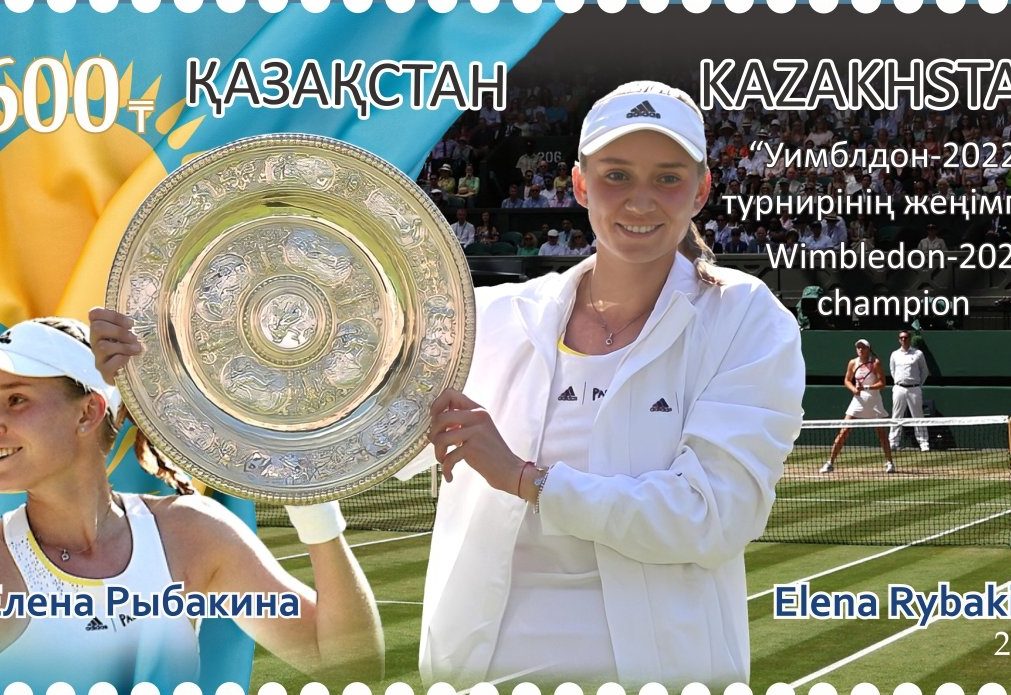
Her biggest breakthrough came at Wimbledon in 2022. Seeded 17th, she beat Ons Jabeur 3-6, 6-2, 6-2 in the final to win her first Grand Slam title. With that victory, Elena Rybakina became the first player representing Kazakhstan to win a major singles title.
The title also landed in unusual circumstances. Wimbledon had barred Russian and Belarusian players that year because of Russia’s invasion of Ukraine, so Rybakina’s win immediately triggered renewed discussion about nationality, representation and her Moscow roots. She had represented Kazakhstan since 2018, and officially that was the sporting identity attached to the title. The debate around it was real, but the tennis part was straightforward: she served brilliantly, stayed calm under pressure and played the cleaner final.
Backing it up: Australian Open final and WTA 1000 wins
One question always follows a first major title: was it the start of something larger or a perfect fortnight? Rybakina answered quickly in 2023.
At the Australian Open, she beat Iga Świątek and Victoria Azarenka on the way to the final, where she lost to Aryna Sabalenka in three sets. Even in defeat, the run was important. It confirmed that Wimbledon had not been a one-off and that her game translated perfectly to hard-court majors too.
The rest of that season strengthened the point. She won Indian Wells, beating Sabalenka in the final, and later claimed the Italian Open in Rome by defeating Anhelina Kalinina. Those were her first two WTA 1000 titles, and they came on very different surfaces. For a player often reduced to serve-plus-power shorthand, that versatility mattered.
Rybakina also rose to a career-high ranking of world No. 3 in 2023, another landmark for a player representing Kazakhstan.
Illness, interruptions and life near the top
Her next stretch on tour was less smooth. Illness and physical interruptions repeatedly broke her momentum, even as she remained one of the most dangerous players in any draw. She still reached major late rounds and stayed in the top tier of the women’s game, but the stop-start rhythm made it harder to build a full season around her best tennis.
That is part of the Elena Rybakina story too. When she is healthy and striking the ball freely, she looks capable of beating anyone. The challenge has often been staying on court often enough to let that level accumulate over months, not just matches.
Rivalry with Aryna Sabalenka
If one matchup captures her place in the modern WTA landscape, it is the one with Aryna Sabalenka. Their games share obvious traits, big serving, first-strike intent, a willingness to take control early in rallies, and that usually makes for short, high-quality exchanges with very little room to breathe.
Sabalenka beat her in the 2023 Australian Open final, but Rybakina also owns major wins in the rivalry, including the Indian Wells final that same year. Their meetings have often carried ranking implications as well as title stakes, which is usually the sign of a real top-level rivalry rather than a catchy storyline.
Playing style: power without theatre
Rybakina is often described as one of the cleanest ball-strikers on the WTA Tour, and that fits. Her serve is the foundation: flat, accurate and difficult to read, especially when she lands a high first-serve percentage. From there, she looks to take the ball early and keep points on her terms.
She is not a player built around long defensive exchanges or visible emotion. The contrast is part of what makes her distinctive. The shots are forceful; the body language is restrained. She can hit through opponents for stretches and barely change expression. That calm exterior has become one of her signatures, though it should not be mistaken for passivity. Her tennis is aggressive by design.
Hard courts suit her naturally, but the Wimbledon title and Rome trophy showed that her game travels. On grass, the serve and flat hitting stay low and skid through the court. On clay, her improved movement and willingness to redirect pace have made her more complete than early labels suggested.
Off the court: roots, residence and public debate
Away from competition, Rybakina’s background has remained part of her public profile. She was born in Moscow and later began representing Kazakhstan, a switch that has been discussed repeatedly since her rise to the top of the sport. She has spoken in practical terms about that decision, pointing to the support she received for her career.
She has also described her living situation with some dry humor. Because of the travel demands of tennis, she once said, “I don’t live anywhere, to be honest.” She has been associated with both Dubai and Kazakhstan in various official and media references.
Some claims about her citizenship and residence have been disputed and should be treated carefully. According to published reports, Russian Tennis Federation president Shamil Tarpischev said in an interview with Match TV that she lived in Moscow and held Russian citizenship, describing Kazakhstan as a “sports citizenship.” The Kazakhstan Tennis Federation publicly rejected those claims. Without official documentation made public, that remains a matter of competing public statements, not a settled fact.
There is firmer ground elsewhere. In 2023, the Kazakhstan Tennis Federation said Rybakina donated 35 million tenge to support the development of junior tennis in the country. Commercially, she has worked with brands including Yonex and Red Bull, and her success has made her one of the most marketable players in Kazakhstan sport.
FAQ
Where is Elena Rybakina from?
She was born in Moscow, Russia, and has represented Kazakhstan in international tennis since 2018.
How old is Elena Rybakina?
Elena Rybakina was born on June 17, 1999.
What Grand Slam has Elena Rybakina won?
She won Wimbledon in 2022, beating Ons Jabeur in the final.
What is Elena Rybakina’s highest ranking?
Her career-high singles ranking is world No. 3.
Why did Elena Rybakina switch to Kazakhstan?
She has said the move was driven by better support and professional opportunities for her tennis career.
What is Elena Rybakina known for on court?
She is known for her powerful serve, flat groundstrokes, aggressive baseline game and notably calm demeanor.
Photo: I. Ongarbai, Public domain, via Wikimedia Commons