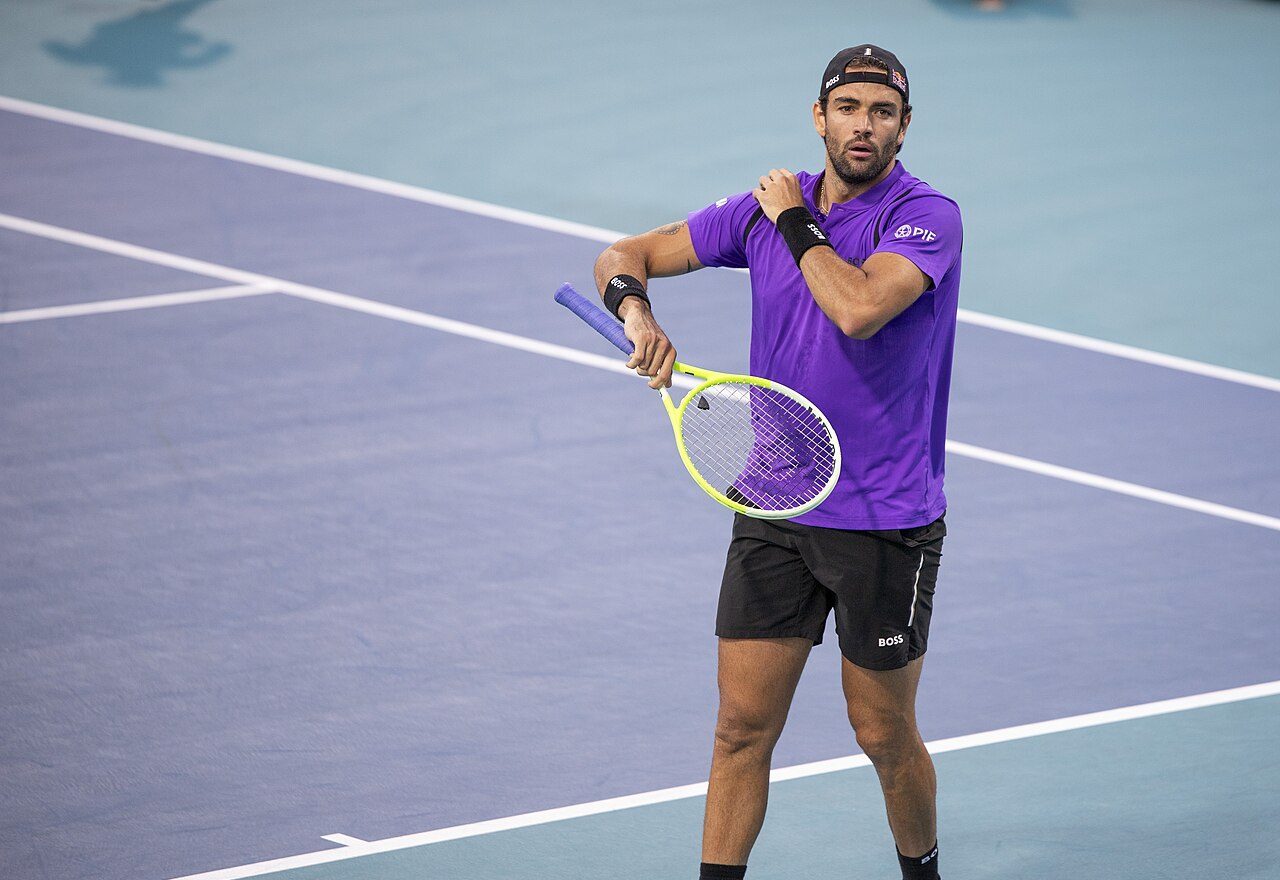
A Wimbledon final changed the scale of Matteo Berrettini’s career, but the outline was visible earlier: the huge first serve, the forehand that could end rallies in a swing, and the calm, slightly understated way he carried all of it. For a stretch, he became the clearest symbol of a new Italian men’s tennis story on the biggest stages.
From Rome to the tour
Berrettini was born in Rome on April 12, 1996, to Luca Berrettini and Claudia Bigo. Tennis was not the only sport in the picture when he was young. He also spent time with judo and swimming before settling more seriously on the game, and he has said that his younger brother Jacopo helped pull him back toward tennis when he was a child.
That family link stayed important. Jacopo also became a professional player, and the brothers have occasionally shared the court in doubles. Berrettini’s background also includes Brazilian roots through his maternal grandmother, Lucia Fogaça, who was born in Rio de Janeiro.
His development was shaped by coach Vincenzo Santopadre, who began working with him during his teenage years and remained a central figure through the rise that followed. Berrettini was not a dominant junior in the way some future stars are. He did not win a junior Grand Slam title, but he built a solid base, reached No. 52 in the junior rankings, and developed the physical, attacking game that would later define him on the ATP Tour.
The first steps: Challenger wins and an ATP title
The move into the professional ranks came in 2015. Progress was steady rather than explosive at first, with much of the early work happening away from the spotlight on Futures and Challenger courts.
A first real breakthrough arrived in 2017, when he won the ATP Challenger title in San Benedetto. It was the kind of result that matters inside the sport: not glamorous, but a sign that a player is beginning to turn promise into a weekly level.
The next season brought a bigger jump. In May 2018, Berrettini broke into the top 100. Two months later, he won his first ATP Tour singles title in Gstaad, beating Roberto Bautista Agut in the final. He also won the doubles title there with Daniele Bracciali, making it a particularly memorable week. By the end of that season, he was no longer just a prospect from Italy with a big serve. He was an established tour-level player.
The 2019 season that changed everything
His real arrival came in 2019. Berrettini won titles in Budapest and Stuttgart, showed he could threaten on different surfaces, and then made the run that altered how he was viewed across the tour.
At the US Open, he reached the semifinals, becoming the first Italian man in the Open Era to make the last four in New York. His tournament ended against Rafael Nadal, but the result carried weight well beyond one fortnight. It pushed him into the top 10 and confirmed that his game could hold up deep into a major.
That same season, he qualified for the ATP Finals in London. He did not get out of the round-robin stage, but simply being there marked another milestone. The ATP later named him Most Improved Player of the Year, a fair reflection of how quickly his status had changed.
Why grass suited him so well
Berrettini’s game has always been easy to identify. At 6 ft 5 in (1.96 m), the Italian uses his height well on serve, creating angle and pace without looking rushed. The forehand is the main finishing shot, struck with heavy weight and often used immediately after the serve. His sliced backhand is another key part of the package, especially on quicker courts, where it stays low and breaks rhythm.
That combination made grass his most natural stage. Opponents often had little time to settle into rallies, and Berrettini became one of the most dangerous players in the draw whenever the tour moved onto lawns. The nickname “The Hammer” followed naturally from that style. Another nickname, “Meatball,” has appeared in online discussion, but that is better treated as rumor than as an established label.
Wimbledon, Queen’s and a place in Italian history
The interrupted 2020 season offered limited chances to build momentum, but Berrettini returned strongly and produced the best stretch of his career in 2021.
He won Queen’s Club on his debut at the event, becoming the first Italian man to take that title. Then came Wimbledon. Berrettini played his way into the final without fuss or drama, beating Hubert Hurkacz in the semifinals to become the first Italian man to reach a Wimbledon singles final.
In the championship match, he took the opening set against Novak Djokovic before losing in four. Even in defeat, the run stood as a landmark. No Italian man had gone that far at the All England Club before him.
His summer included another major result in Madrid, where he reached the final of the Masters 1000 event before losing to Alexander Zverev. He also returned to the ATP Finals, though injury forced him to withdraw after his opening match.
Australian Open run and a career-high ranking
Berrettini carried that level into the next major season. At the Australian Open, he reached the semifinals in 2022 before losing to Nadal. Shortly after, on January 31, he climbed to a career-high ranking of world No. 6.
By then, his record across the majors had taken on broader historical significance. He became the first Italian man to reach the quarterfinals or better at all four Grand Slam tournaments: the US Open, Australian Open, French Open and Wimbledon. It was a marker of range as much as peak. He was not only a grass-court threat; he had found ways to make deep runs everywhere.
Injuries interrupt the climb
That upward line did not continue cleanly. Berrettini’s career has repeatedly been checked by physical setbacks, often just as he seemed ready to build on a strong run.
He missed the Tokyo Olympics because of a thigh injury. In 2022, he underwent surgery on his right hand, another interruption in a period when he looked capable of staying among the most dangerous players in the sport. There were more absences after that, including withdrawals linked to abdominal issues, illness and foot trouble.
Those interruptions matter when reading his record. The talent and the weapons were obvious; the harder part was staying on court long enough to build continuity.
Titles, comeback moments and Davis Cup value
Even with those stop-start seasons, Berrettini kept adding to his résumé. His ATP titles have come in clusters and on different surfaces, with grass and clay both featuring prominently. One of the more satisfying recent moments came in Marrakech, where he won the Grand Prix Hassan II after another difficult spell with injuries. It was less about the size of the event than what it represented: proof that he could still return and win after long layoffs.
He has also been an important figure for Italy in team competition. In Davis Cup ties, Berrettini gave the side experience, firepower and emotional steadiness. Italy’s modern rise in men’s tennis has had several faces, but his role in that broader story is secure.
Coaches and the search for continuity
For much of his rise, Santopadre was the constant. Their long partnership helped shape not only the mechanics of Berrettini’s game but also the measured way he approached the tour. When they split, it marked the end of a significant chapter.
Berrettini later worked with Francisco Roig, another experienced voice with a long background in elite tennis. As with many players dealing with injuries and ranking swings, his coaching setup evolved as he searched for stability and a route back toward the top end of the game.
Off court: family, relationships and life away from tennis
Away from competition, Berrettini has generally come across as relaxed and personable rather than overly curated. He has lived in Monte Carlo, a common base for top players, but Rome remains central to his identity and public image.
Family is a recurring part of his story, especially because of Jacopo’s own tennis career. Berrettini has often spoken warmly about that bond and about the role his brother played in his early sporting life.
His relationships have also drawn tabloid attention. He was in a relationship with Ajla Tomljanović, according to widely reported accounts, and was later linked to Italian television presenter Melissa Satta in a relationship reported by Italian media. Private-life details beyond that are best treated cautiously unless confirmed by the people involved.
There are a few grounded details that round out the picture. He has supported charitable causes, including a campaign connected to Tennis for Africa. He has spoken about his love of animals. And he has also addressed one of the uglier sides of modern sport, saying that his family received threats from bettors during a tournament in Paris.
Prize money and endorsements
Matteo Berrettini prize money has passed the $12 million mark on official ATP figures, a reflection of how often he has gone deep at big events even without winning a Grand Slam title. Estimates of Matteo Berrettini net worth vary by outlet and should be treated as estimates rather than hard fact.
Commercially, he has been a strong fit for sponsors: recognisable, marketable and easy to place beyond tennis audiences. His endorsement portfolio has included BOSS, Head, Asics, Red Bull, Peugeot, Colavita, Signum Pro and Capri Watch.
Matteo Berrettini FAQ
How old is Matteo Berrettini?
He was born on April 12, 1996.
What is Matteo Berrettini’s highest ranking?
His career-high singles ranking is world No. 6, reached on January 31, 2022.
Has Matteo Berrettini won a Grand Slam?
No. His best Grand Slam result is reaching the Wimbledon final in 2021.
Why is Matteo Berrettini called The Hammer?
The nickname refers to his powerful serve-and-forehand game, especially the force of his first strike.
Who has Matteo Berrettini dated?
He was previously in a relationship with Ajla Tomljanović, according to widely reported coverage, and was later reported to be dating Melissa Satta.
Where does Matteo Berrettini live?
He has lived in Monte Carlo, Monaco.
Photo: Vbrunophotog, CC BY-SA 4.0, via Wikimedia Commons