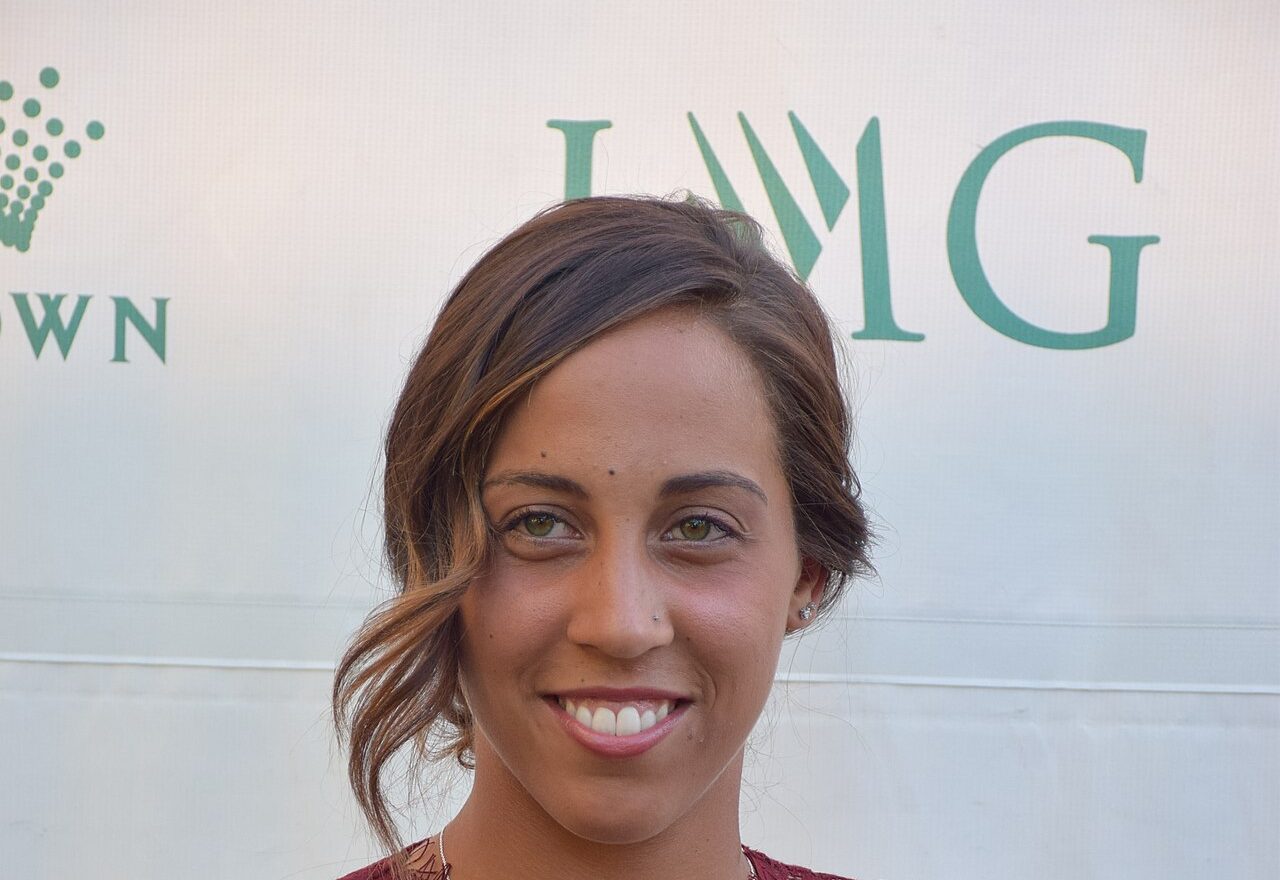
Seven years after her first Grand Slam final, Madison Keys stood on Rod Laver Arena with the trophy that had eluded her. She had beaten Aryna Sabalenka 6-3, 2-6, 7-5 to win the 2025 Australian Open, ending the defending champion’s pursuit of a third consecutive Melbourne title.
At 29, Keys became the oldest woman in the Open Era to win her first major singles title at the Australian Open. The power had always been there. This time, she brought it through the tense final games of a championship match.
A Wimbledon outfit starts the story
Born on February 17, 1995, in Rock Island, Illinois, Keys did not discover tennis through a fascination with technique. As she has often recalled, she saw Venus Williams playing Wimbledon on television and wanted a dress like hers. Her parents’ response was practical: if she wanted the outfit, she would have to play.
She grew up with parents Rick and Christine and three siblings, Sydney, Montana and Hunter. By 10, tennis had become serious enough for her to train at the Evert Tennis Academy in Boca Raton, Florida.
The transition to professional competition came quickly. In April 2009, aged 14, she won her WTA main-draw debut at Ponte Vedra Beach, beating Alla Kudryavtseva. Later that year, she beat Serena Williams 5-1 in World TeamTennis.
That was a short-format team encounter, not a tour-level singles match. Still, a teenager holding her own against Williams was difficult to overlook.
Learning to turn power into results
Keys entered the top 100 in 2013, but her first WTA singles title arrived on grass. At Eastbourne in 2014, she defeated Angelique Kerber in the final, showing how difficult her serve and groundstrokes could be to contain on a quick court.
Her first major breakthrough followed at the 2015 Australian Open. She beat Venus Williams in the quarterfinals before losing to Serena in the semifinals. The childhood connection had become a competitive reality: the player whose outfit had caught her attention was now across the net in a Grand Slam quarterfinal.
In 2016, she won Birmingham, entered the top 10 and reached the Olympic semifinals in Rio de Janeiro. The Olympics ended painfully, with defeats by Kerber and then Petra Kvitova leaving her fourth and without a medal.
Those results established her as more than an occasional threat. The next challenge was sustaining that level through the final weekend of a major.
A difficult afternoon in New York
The 2017 US Open seemed to offer the opening. Keys beat Elina Svitolina, Kaia Kanepi and CoCo Vandeweghe on her way to an all-American final against Sloane Stephens.
Both finalists had dealt with injury problems that season. Stephens had returned from a lengthy absence following foot surgery; Keys had undergone wrist surgery. Their meeting was a comeback story on both sides of the net.
The final itself was one-sided. Stephens absorbed the pace, defended intelligently and won 6-3, 6-0. Keys struggled to control her attacking game and could not find a way back into the match.
Their warm exchange afterward reflected a friendship that existed beyond the result. It also underlined the particular difficulty of that afternoon: a first major final had ended quickly, against someone who knew her well.
More deep runs followed. Keys reached the semifinals at Roland Garros and the US Open in 2018, and she was part of the American team that finished runner-up in that year’s Fed Cup, now the Billie Jean King Cup.
In 2019, she won Charleston on clay and Cincinnati on hard courts. The latter, then classified as a Premier 5 event and now part of the WTA 1000 category, was her biggest title before Melbourne.
Setbacks, another near miss and a new coach
Progress did not follow a straight line. Injuries and uneven results interrupted her momentum, although she returned to the Australian Open semifinals in 2022.
Bjorn Fratangelo became her coach in 2023. A former French Open boys’ champion and an experienced professional, he brought a player’s understanding to the job, alongside the familiarity of their relationship away from tennis.
That season brought another grass-court title at Eastbourne and another painful US Open semifinal. Against Sabalenka, Keys won the opening set 6-0 and served for the match in the second, only to lose in three sets, with both remaining sets decided by tiebreaks.
The defeat made clear how close she remained to another major final. It also gave her next meeting with Sabalenka on a Grand Slam stage an unmistakable backstory.
Melbourne, finally
Keys arrived at the 2025 Australian Open having already won the Adelaide title. She then worked through a demanding draw, beating Danielle Collins, Elena Rybakina and Svitolina before facing Iga Swiatek in the semifinals.
Against Swiatek, she saved a match point and won a deciding-set tiebreak. It was the kind of narrow escape that changes the shape of a tournament: one point from elimination, she instead earned her second major final.
Sabalenka awaited. The Belarusian had won the previous two Australian Opens and had overturned a commanding Keys lead in New York.
This time, Keys stayed with her. After taking the first set and losing the second, she continued attacking through a closely contested decider. At 6-5, she broke serve to secure her first Grand Slam title.
It was her tenth WTA singles trophy. On February 24, 2025, she reached a career-high ranking of world No. 5.
How Madison Keys plays
At 5 ft 10 in, or 1.78 metres, Keys builds her game around a strong serve and powerful groundstrokes. She plays right-handed with a two-handed backhand, but the forehand is the shot that most readily takes time away from opponents.
Her best tennis is assertive. She looks to establish control early, step into the court and finish before a rally becomes a prolonged defensive exchange.
That approach carries risk. When her timing slips, errors can arrive in clusters. The task has never been simply to hit harder, but to judge when to commit and when to leave enough margin.
Hard courts have provided her most important major results, yet titles at Eastbourne, Birmingham, Charleston and Strasbourg show that her game travels across surfaces.
Marriage, baking and life beyond the baseline
Keys and Fratangelo married in November 2024, a few months before her Australian Open victory. Their partnership combines marriage with the everyday work of practice sessions, match preparation and travel.
Away from competition, she has spoken about enjoying baking, interior design, plants and time with friends and family. She has also expressed an interest in becoming a chef after tennis-an ambition rather than an announced career plan.
Her public work includes Kindness Wins, the nonprofit she founded in 2020, and earlier involvement with FearlesslyGiRL. Both reflect her interest in supporting young people and encouraging kinder interactions, including online.
Commercially, Nike has been associated with her since her teenage years. She switched from Wilson to Yonex rackets for the 2025 season.
Online estimates of her wealth are not verified accounts of her finances. Prize money is publicly recorded; endorsement income, investments and expenses are not fully disclosed.
FAQ
When did Madison Keys win her first Grand Slam?
She won the 2025 Australian Open, defeating Aryna Sabalenka 6-3, 2-6, 7-5 in the final.
How old was she when she won in Melbourne?
She was 29. Her date of birth is February 17, 1995.
Who is Madison Keys’ husband?
She married fellow tennis professional Bjorn Fratangelo in November 2024. He began coaching her in 2023.
What is her highest singles ranking?
She first reached world No. 5 on February 24, 2025.
Did she reach a Grand Slam final before winning the Australian Open?
Yes. She reached the 2017 US Open final, losing to Sloane Stephens 6-3, 6-0.
Where is she from?
She was born in Rock Island, Illinois, and represents the United States. She moved to Florida for tennis training as a child.
Photo: Tourism Victoria from Australia, CC BY 2.0, via Wikimedia Commons