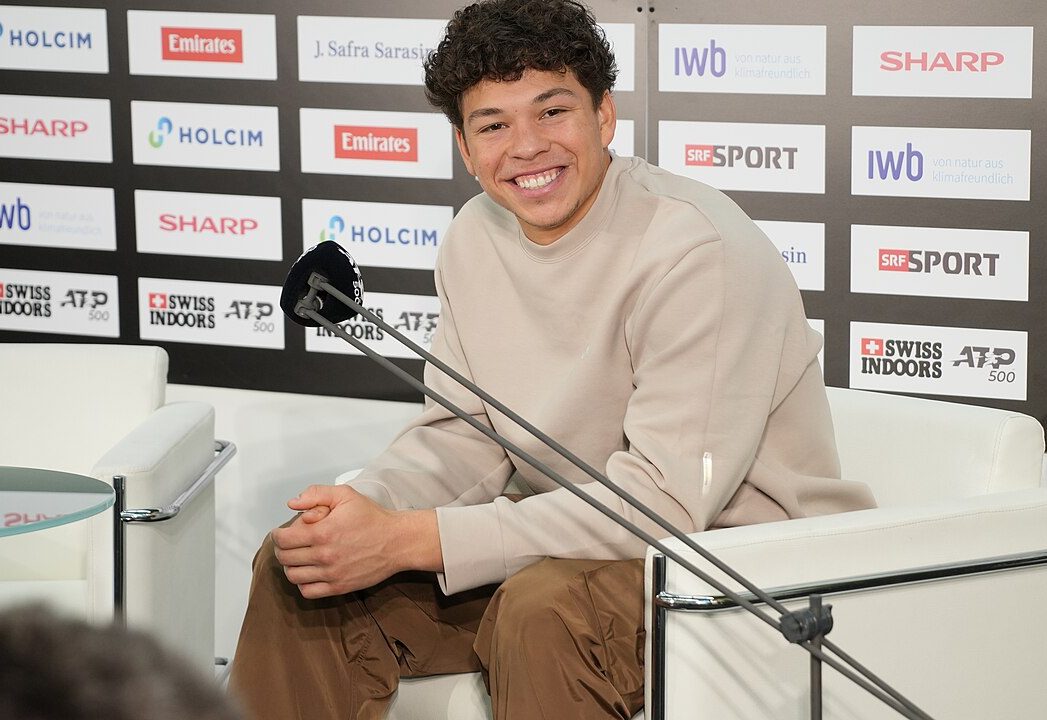
A 150 mph serve can make a crowd look up from anywhere in the stadium. What turned Ben Shelton from a viral clip into a serious ATP contender was everything that followed the serve: the nerve in big moments, the fast learning curve, and the unusual route he took through college tennis before landing near the top of the men’s game.
Ben Shelton’s start: family, football and a late tennis push
Benjamin Todd Shelton was born on October 9, 2002, in Atlanta, Georgia, and grew up in a family that knew the sport from the inside. His father, Bryan Shelton, played on the ATP Tour and later built a successful coaching career in college tennis. His mother, Lisa Witsken Shelton, was a strong junior player, and his uncle Todd Witsken was also a professional.
Even with that background, tennis was not treated as a family obligation. Shelton spent part of his childhood playing other sports, including football, where he lined up at quarterback. He did not fully commit to tennis at the very earliest age, which helps explain some of the raw athleticism and freedom in his game. When he did turn toward the sport more seriously, the progress came quickly.
That family influence remained central without becoming overbearing. Bryan Shelton would eventually coach his son, but the relationship had already been shaped by years around the game rather than a rushed push toward the tour.
Florida gave his career a different foundation
Before the ATP spotlight, there was Gainesville.
Shelton played for the University of Florida from 2020 to 2022, with his father serving as head coach of the Gators. In an era when many top prospects skip college entirely, he took a different road and made it count. In 2021, he helped Florida win the NCAA team championship. A year later, he made the leap from standout to the best player in college tennis.
In 2022, Shelton won the NCAA singles title, finished the season as the top-ranked men’s college player in the country, and collected major individual honors, including SEC Player of the Year and ITA National Player of the Year. He also studied finance, giving those Florida years a structure that many young pros never have.
His ATP Tour debut came in Atlanta in 2022, and the transition from campus tennis to the professional circuit was faster than expected. After turning pro that summer, he won three Challenger titles in a short burst, at Charlottesville, Knoxville and Champaign. It was the kind of run that changed the conversation around him. He was no longer simply a college success story with a big serve; he was clearly built for a higher level.
The 2023 breakthrough: Australia first, then New York
For many casual fans, the breakout seemed to arrive all at once at the US Open. In truth, Shelton had already announced himself months earlier.
At the start of 2023, he traveled outside the United States for the first time as a professional and reached the quarterfinals of the Australian Open. That run mattered for more than ranking points. It showed he could handle the demands of a major, adapt quickly, and win away from the environment he knew best.
By late summer, his game had become one of the stories of the American hard-court season. Then came New York. Shelton reached the semifinals of the 2023 US Open, beating Frances Tiafoe in the quarterfinals before losing to Novak Djokovic. The run pushed him into a different category. He was no longer just promising. He was suddenly part of the bigger conversation around the next wave of men’s tennis in the United States.
A few weeks later, he won his first ATP title in Tokyo, beating Aslan Karatsev in the final. That title gave the season a cleaner shape: a strong Slam in Melbourne, a major breakthrough in New York, and a first tour trophy to confirm the rise.
Building on the breakthrough
The next phase of a young player’s career is often less dramatic and more revealing. Can he back up the first big run? Can he win on different surfaces? Can he handle being expected to go deep?
Shelton answered some of those questions in 2024. He won the U.S. Men’s Clay Court Championship in Houston, his first ATP title on clay, beating Frances Tiafoe in the final. For a player so closely associated with first-strike hard-court tennis, that result mattered. It suggested his game was broadening rather than staying trapped inside one identity.
He also climbed high enough in the rankings to become the top-ranked American man for a period, another sign of how quickly he had moved from prospect to reference point within U.S. tennis.
Some summaries of his career overstate this stretch by crediting him with Masters 1000 titles in Canada. That is incorrect. Shelton did not win the Canadian Open during this period, and he has not won a Masters 1000 title. His best Masters result so far is a semifinal run, not a championship.
Grand Slam progress and the climb into the top five
If the US Open semifinal was the first loud statement, the Australian Open run that followed later in his career showed staying power. Shelton reached the semifinals in Melbourne, giving him deep runs at two different majors on two very different timelines. That is often how a contender’s profile starts to take shape: not with one magical fortnight, but with repeated appearances in the final stages of the biggest events.
His ranking rise followed that pattern. Strong results across the tour, not just at one tournament, carried him into the top 10 and then to a career-high of world No. 5. That climb was significant because it reflected a fuller player than the one who first grabbed attention with pure pace on serve.
He still does not have a Grand Slam title, but his best major results already place him among the leading American men of his generation.
How Ben Shelton plays
The obvious starting point is the serve. Shelton is left-handed, stands 6 ft 4 in (193 cm), and delivers one of the heaviest serves in men’s tennis. The radar-gun numbers get attention, but the real problem for opponents is the combination of pace, angle and kick. From the ad court in particular, he can open the court sharply and take control of the point with one swing.
But reducing him to a servebot misses the point. His forehand is explosive, he likes to play on the front foot, and he is willing to move forward and finish at the net. There is also a certain improvisational quality to his game. He can look raw in patches, then suddenly produce a sequence of shots that only a handful of players would even attempt.
His two-handed backhand has developed into a more reliable rally shot, and his movement has improved as he has spent more time on tour. The college background may have helped here. He arrived on the ATP circuit older than some blue-chip prospects, but also more physically mature and more used to match play under pressure.
Hard courts still suit him best, though the Houston title showed he can be effective on clay as well.
Rivalries, attention and the American context
Every American men’s prospect gets measured against the country’s recent history, and Shelton has not been spared that. His matches against fellow Americans, especially Frances Tiafoe, have drawn extra attention because they carry both competitive and generational weight. Their 2023 US Open quarterfinal was one of the defining all-American matches of that season.
There is also the broader contrast in his story. He did not come through as a child prodigy in the usual sense. He spent meaningful time in college tennis. He learned in public, quickly, and sometimes messily. That has made his rise feel less scripted than some of his peers’.
Off the court: family, faith and life beyond tennis
Away from matches, family remains a central part of Shelton’s story. Bryan Shelton is not just his father but also his coach, which gives the team around him an unusually personal core. His mother and extended family have deep tennis roots too, so the sport has long been part of daily life without being the only thing in it.
Shelton has said that Roger Federer was his tennis idol growing up. He also appeared in Netflix’s Break Point, which introduced him to viewers who may not follow the ATP week to week. His Christian faith has surfaced publicly as well, including in post-match remarks and speeches.
As for his personal life, his relationship with professional soccer player Trinity Rodman became public in 2025. That is established, public information rather than rumor, and it drew interest well beyond tennis because it linked two prominent American athletes.
Some of the money and lifestyle figures attached to him online should be treated more carefully. Reported net worth estimates and endorsement-income totals vary by outlet and are often speculative. It is fair to say that Shelton has built a strong sponsorship portfolio, including deals with On, Yonex, Rolex, Ralph Lauren Fragrances, Thorne, Bose and Loewe, but precise private financial estimates are less reliable unless confirmed by the player or his team.
One lighter claim has circulated in lifestyle coverage: according to EssentiallySports, his favorite car is reportedly a Mercedes-Benz AMG GT. That sits firmly in the category of reported color detail, not a verified biographical fact.
What his career already says
Shelton’s path has been unusual by modern ATP standards: a tennis family, a late serious start, a full college chapter, then a rapid jump into the top tier of the sport. The serve may be the first thing people remember, but it is not the whole story. The more important detail is how quickly he learned to win the kinds of matches that turn raw talent into a real presence on tour.
FAQ
How old is Ben Shelton?
He was born on October 9, 2002.
Who coaches Ben Shelton?
His coach is his father, Bryan Shelton.
What is Ben Shelton’s highest ranking?
His career-high singles ranking is world No. 5.
Has Ben Shelton won a Grand Slam title?
No. He has reached Grand Slam semifinals but has not won a major singles title.
Is Ben Shelton left-handed?
Yes. He plays left-handed and uses a two-handed backhand.
Did Ben Shelton play college tennis?
Yes. He played for the University of Florida and won the 2022 NCAA singles title.
Photo: Skyscraper2010, CC BY-SA 4.0, via Wikimedia Commons