At 14, Venus Williams walked onto a professional tennis court in Oakland and beat a player ranked inside the world’s top 60. It was October 1994, and she had barely played competitive junior tennis for three years. In her next match, she took a set from world No. 2 Arantxa Sánchez Vicario before losing.
The debut offered an early glimpse of what would make her difficult to contain: reach, speed and the confidence to attack established opponents. Seven Grand Slam singles titles and five Olympic medals followed, along with a career that changed both the way women’s tennis was played and how its champions were paid.
From Compton courts to a professional debut
Venus Ebony Star Williams was born on June 17, 1980, in Lynwood, California, and grew up in nearby Compton. Her parents, Richard Williams and Oracene Price, taught her and younger sister Serena on public courts.
Richard attracted much of the attention, but both parents shaped the sisters’ development. Tennis was a family project, with practice fitted around school and a childhood that would soon become unusually public.
Venus compiled an outstanding junior record in Southern California. In 1991, the family moved to Florida, where the sisters trained at Rick Macci’s academy.
Then came a departure from the usual route. Richard withdrew them from regular junior competition, citing concerns about racism and the pressures of the circuit. Training continued, but without the tournament schedule most aspiring professionals relied on.
Her first professional match, on October 31, 1994, ended in a straight-sets victory over Shaun Stafford. The defeat by Sánchez Vicario followed. Williams had lost, but she had made herself noticed.
A US Open final before her first title
At the 1997 US Open, the teenager reached the final without being seeded-the first woman to do so there in the Open Era. Martina Hingis beat her 6-0, 6-4, exposing the distance between a startling breakthrough and a finished championship game.
Williams began closing that gap. Her first WTA singles title came at Oklahoma City in 1998. That season also brought the Grand Slam Cup and two major mixed doubles titles, at the Australian Open and Wimbledon, with Justin Gimelstob.
By the summer of 2000, her serve and attacking groundstrokes were supported by greater consistency. At Wimbledon, she beat Serena in the semifinals and defending champion Lindsay Davenport in the final to claim her first major singles title.
The victories came quickly after that: the US Open, Olympic singles gold in Sydney, and Olympic doubles gold alongside Serena.
She defended both Wimbledon and the US Open in 2001, beating her sister in the latter final. Four titles from six consecutive majors made her the central figure in women’s tennis.
On February 25, 2002, she became the first African American woman to reach No. 1 in the computerized singles rankings. She held the position for a total of 11 weeks.
Serena, Wimbledon and the family rivalry
The player best equipped to challenge her had grown up on the other side of the practice net.
Venus won their first professional meeting at the 1998 Australian Open. As Serena developed, their matches became fixtures at the end of major tournaments. They contested nine Grand Slam singles finals, with Serena winning seven.
The balance shifted sharply in 2002. Venus lost the French Open, Wimbledon and US Open finals to her younger sister, followed by the 2003 Australian Open final. Serena also won their Wimbledon final that summer, when Venus was struggling with an abdominal injury.
Wimbledon nevertheless remained her most productive setting.
In 2005, she faced Davenport in a final that stretched to two hours and 45 minutes. Williams saved a championship point and won 4-6, 7-6, 9-7. It was a title earned through survival as much as power.
Two years later, seeded 23rd, she beat Marion Bartoli to become the lowest-seeded Wimbledon women’s singles champion. In 2008, she defeated Serena in the final to secure her fifth title there and seventh major singles crown.
She also won the season-ending WTA Championships in 2008. Her 49 tour-level singles titles reflect a career built on more than those successful Wimbledon fortnights.
Doubles success and a difficult diagnosis
The sisters’ rivalry never prevented them from functioning as an exceptional doubles team. They won 14 Grand Slam women’s doubles titles together without losing a major final.
Their partnership combined huge serves and groundstrokes with instinctive court coverage. Venus’s reach and willingness to close the net were particularly valuable. On June 7, 2010, she reached No. 1 in doubles, adding that ranking to her singles achievement.
Olympic doubles golds in Beijing in 2008 and London in 2012 followed their Sydney victory. At Rio in 2016, she won mixed doubles silver with Rajeev Ram, taking her medal total to five across four different Games.
Those achievements straddled a major disruption. In 2011, Williams withdrew from the US Open and disclosed that she had been diagnosed with Sjögren’s syndrome, an autoimmune condition that can cause fatigue and joint pain.
Managing her health became part of managing her career. Training, recovery and scheduling required adjustments; results were no longer simply a matter of how well she struck the ball.
Yet in 2017 she reached two more major singles finals. Serena beat her at the Australian Open, and Garbiñe Muguruza defeated her at Wimbledon. At 37, she finished that season ranked No. 5.
Later seasons brought injuries and fewer appearances, but she continued returning to competition rather than allowing that diagnosis to define the end of her story.
Power, reach and a willingness to move forward
At 6 ft 1 in, Williams could generate pace on serve that immediately put opponents under pressure. Her two-handed backhand was a dependable attacking weapon, while her long stride allowed her to retrieve balls that seemed beyond reach.
Her game was not without vulnerabilities. The forehand could become erratic, and double faults sometimes interrupted her rhythm. Opponents who absorbed her pace and made her hit an extra shot could force errors.
But describing her simply as a power player misses the movement. She could defend wide positions, recover quickly and turn a stretched rally into an attack. On grass, that combination was especially effective.
Her comfort at the net also distinguished her from many baseline contemporaries. Doubles sharpened those instincts, but she was prepared to use them in singles when an opening appeared.
Design, business and the fight over prize money
Away from tournaments, Williams pursued interests that did not depend on a scoreboard. She founded the interior design firm V Starr in 2002 and launched the activewear label EleVen in 2007. Her fashion choices on court often became a visible extension of that interest in design.
She also studied while competing, earning an associate degree in fashion design from the Art Institute of Fort Lauderdale and, in 2015, a business administration degree from Indiana University East.
Her response to Sjögren’s included adopting a largely plant-based diet. Nutrition later became a business interest through Happy Viking, the plant-based nutrition company she co-founded. Other ventures include Asutra, where she became a co-owner and chief brand officer, and a minority ownership stake in the Miami Dolphins alongside Serena.
Her most significant off-court intervention, however, concerned her own workplace.
Williams argued publicly for equal prize money at Wimbledon, including in a 2006 article for The Times. She was a prominent voice in a campaign involving players, administrators and advocates over many years.
Wimbledon announced equal prize money in 2007. That July, she won the women’s title and received the same champion’s cheque as Roger Federer. An argument she had helped carry into public view had become tournament policy.
FAQ
How many Grand Slams has Venus Williams won?
She has seven singles majors: five Wimbledon titles and two US Open titles. She also won 14 women’s doubles majors with Serena and two mixed doubles majors with Justin Gimelstob.
When did Venus Williams turn professional?
She made her professional debut on October 31, 1994, in Oakland, California, at 14.
Was Venus Williams world No. 1?
Yes. She first reached No. 1 in singles on February 25, 2002, and spent 11 weeks there in total. She also reached No. 1 in doubles in June 2010.
How many Olympic medals has she won?
Five: singles gold, three women’s doubles golds with Serena, and mixed doubles silver with Rajeev Ram.
What health condition does Venus Williams have?
She disclosed her diagnosis of Sjögren’s syndrome in 2011. It is an autoimmune condition that can cause symptoms including fatigue, dry eyes, dry mouth and joint pain.
What businesses has she been involved in?
Her ventures include V Starr, EleVen and Happy Viking. She has also held an ownership role at Asutra and a minority stake in the Miami Dolphins.
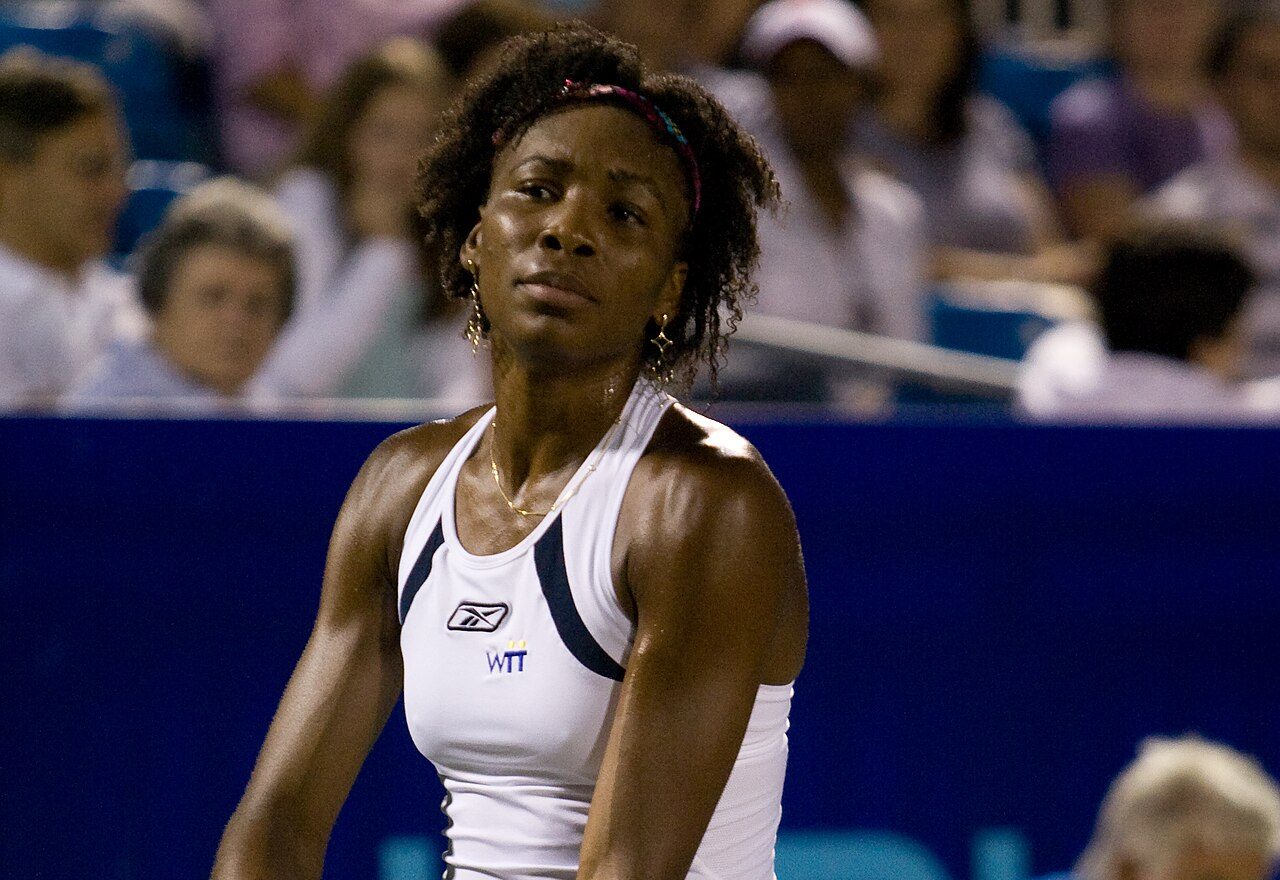
Photo: The original uploader was Nrbelex at English Wikipedia ., CC BY-SA 2.5, via Wikimedia Commons