Centre Court has a way of shrinking even seasoned players. In the summer of 2019, it became the stage for a 15-year-old qualifier who had grown up idolizing Venus and Serena Williams. Coco Gauff beat Venus in straight sets at Wimbledon, and the clip raced around the sports world. For many viewers, that was the introduction. Inside tennis, it felt more like an arrival that had been building for years.
Born Cori Dionne Gauff on March 13, 2004, in Boca Raton, Florida, she had already been a junior world No. 1 before that Wimbledon run. She was not a surprise package so much as a young player whose timeline had started unusually early and kept accelerating.
A Florida childhood built around tennis
Gauff grew up in South Florida in a family that reorganized daily life around her development. Her father, Corey Gauff, became her first coach. Her mother, Candi Gauff, took charge of homeschooling. That setup has become part of the public story around her rise, including the detail that she was still completing schoolwork during tournaments.
She started playing at six and, before long, the family was making decisions usually reserved for much older prospects. From a young age she trained with Gerard Loglo at New Generation Tennis Academy. Later, she spent time at Patrick Mouratoglou’s academy in France, an important step for a player who was still years from the main tour but already being discussed as one of the brightest talents in American tennis.
The Williams sisters were her reference point, both as champions and as proof of what was possible for a young Black American player in the sport. That is part of what made the Wimbledon match with Venus so resonant. It was not just an upset. It was a teenager beating one of the players she had watched and admired while learning the game.
Junior success came fast
The first big markers arrived in the juniors. In 2017, Gauff became the youngest US Open girls’ finalist in the tournament’s history. A year later, she won the French Open girls’ singles title and added the US Open girls’ doubles crown with Caty McNally.
By then, the broad shape of her game was already clear. She was a right-hander with a two-handed backhand, quick across the baseline, comfortable redirecting pace, and unusually composed in long exchanges for someone so young. The serve and forehand would keep evolving, but the competitive edge was there from the start.
She reached junior world No. 1 at 14, which only sharpened the attention around her next move.
From ITF stops to a Wimbledon breakthrough
Gauff began playing professional events on the ITF circuit while still in her early teens. Those tournaments rarely come with glamour, but they matter. They teach travel, repetition, awkward matchups and the day-to-day grind that junior stardom does not prepare a player for on its own.
Then came Wimbledon in 2019. She became the youngest player in the Open Era to qualify for the women’s main draw there. The win over Venus Williams turned her into a global headline, and she backed it up by reaching the fourth round before losing to Simona Halep.
That mattered. Plenty of young players produce one unforgettable match. Fewer show, in the same fortnight, that they can handle the noise that follows.
Later that season, she won her first WTA singles title in Linz. She also reached the fourth round of the US Open, where Naomi Osaka beat her in a match remembered as much for Osaka’s empathy afterward as for the tennis itself. By the end of that year, Gauff was no longer being discussed only as a junior sensation. She had become part of the tour’s present.
Learning the hard part: staying near the top
The next phase of her career was less cinematic and more revealing. Young players often break through quickly; staying in the mix is harder. Gauff had to learn how to manage expectations, sharpen her patterns and survive the weeks when the game did not feel easy.
She kept moving forward in both singles and doubles. In 2021, she reached her first Grand Slam quarterfinal in singles at the French Open. That same year, she made the US Open women’s doubles final with Caty McNally, finishing runner-up to Samantha Stosur and Zhang Shuai.
Paris became a major checkpoint in 2022. Gauff reached her first Grand Slam singles final at the French Open, where she lost to Iga Swiatek. She also made the French Open doubles final with Jessica Pegula, losing to Caroline Garcia and Kristina Mladenovic. Those defeats stung, but they also clarified where she stood. She was no longer a novelty or a feel-good story from Wimbledon. She was contending deep into the second week of majors.
That season also brought a ranking milestone in doubles: world No. 1 on August 15, 2022. It suited her skill set. Her speed, anticipation and backhand return made her dangerous at the net as well as from the baseline.
The summer when the conversation changed
Sometimes a career turns not on one title, but on a sequence that changes how a player carries herself. For Gauff, that stretch came in the North American hard-court swing of 2023.
She won Washington, then followed it by taking Cincinnati, her first WTA 1000 title. The results were important, but so was the look of her tennis. She defended with more purpose, served with more conviction and seemed more certain about when to absorb pace and when to step in.
At the US Open, all of it came together. Gauff won her first Grand Slam singles title in New York, beating Aryna Sabalenka in the final after dropping the opening set. She became the youngest American woman to win the US Open since Serena Williams in 1999.
That title did more than add a major to her résumé. It confirmed that her game, sometimes scrutinized for its technical rough edges, was already good enough to win the biggest matches in the sport.
Her hard-court record underlined the point. Gauff became the first player in the Open Era to win each of her first seven WTA hard-court finals, and later the first to win her first nine.
From contender to established champion
The next season brought more proof that the New York breakthrough was not an isolated peak. Gauff reached the Australian Open semifinals, her best run there to that point, and climbed to a career-high No. 2 in singles on June 10, 2024.
At the French Open, she added a major doubles title, winning the women’s doubles crown with Katerina Siniakova. Later in the year, she won the China Open and then the WTA Finals singles title, becoming the youngest champion at that event since Maria Sharapova in 2004.
Away from the regular tour, she also had a prominent role at the Paris Olympics, where she served as a U.S. flag bearer at the opening ceremony alongside LeBron James. In the tennis competition, she reached the third round in singles and the second round in doubles.
Her second Grand Slam singles title came at Roland Garros in 2025, when she won the French Open. By then, the shape of her career had changed again. She was no longer measured only by promise or by whether she could win one major. She had built a body of work across surfaces, formats and stages.
Rivalries that define the era
Every top player is partly defined by the opponents who keep appearing across the net. For Gauff, Iga Swiatek and Aryna Sabalenka have been central figures in that story.
Swiatek was the player who beat her in the 2022 French Open final, a match that highlighted the gap Gauff still needed to close on clay at the very highest level. Sabalenka, meanwhile, became the opponent she beat in the 2023 US Open final, the night Gauff claimed her first major singles title.
Those matches gave her career a useful tension. Against the best, she has had to find different answers: more patience on clay, cleaner first-strike tennis on hard courts, and the confidence to stay in matches that swing violently from one set to the next.
How Coco Gauff plays
At her core, Gauff is a baseliner, but that label only tells part of the story. Her movement is one of her biggest weapons. She covers the court quickly, defends without panicking and can turn a neutral rally into an attacking position in a couple of shots.
The serve has become a major source of free points when it is landing well, and her two-handed backhand is often the steadier wing in exchanges. The forehand has drawn more technical discussion over the years, but she has learned to build points around it rather than letting it define the conversation.
What separates her from many young power players is not just athleticism. It is her ability to stay emotionally present in messy matches. Gauff can win ugly, reset after a poor patch and keep asking the same physical and mental questions of an opponent until the match turns.
Hard courts have been especially productive, which fits her blend of speed, return quality and counterpunching. But the French Open title showed that her game is not confined to one surface.
Off court: family, business and public profile
The family remains a visible part of the Coco Gauff story. Corey and Candi Gauff were deeply involved in the early years, and she has often spoken about the stability that gave her. She also has two younger brothers, Codey and Cameron, and has long been associated with Delray Beach, Florida.
Off court, her profile has grown well beyond tennis. In 2024, she launched Coco Gauff Enterprises, a sign that she was beginning to shape the business side of her career more directly. She has also been reported as an investor in Unrivaled, the women’s 3-on-3 basketball league, and worked with Religion of Sports on content projects.
Her endorsement portfolio has become one of the largest in women’s sports, including deals with New Balance, Head, Rolex, Bose, Mercedes-Benz, Barilla and American Express, among others. Financial estimates about her net worth and annual earnings vary by outlet, so those figures are best treated as media estimates rather than fixed facts.
There is also a local piece to her public life. In Delray Beach, she unveiled a renovated court through the USTA’s US Open Legacy initiative, a small but fitting link between her success on the biggest stages and the community courts where many tennis stories begin.
The team around her
Elite tennis careers are often presented as solo acts, but Gauff’s has long been supported by a stable team. Jean-Christophe Faurel has been an important coaching presence since 2019. Her wider setup has included strength and conditioning coach Richard Woodroof and hitting partner Johan Tatlot. Reports in late 2025 said biomechanics expert Gavin MacMillan joined the group.
That kind of continuity matters. Gauff’s rise has happened in public, but much of the progress has come in the less visible work: refining movement patterns, managing the schedule, and adjusting a game that had to mature while the whole sport watched.
FAQ
How old is Coco Gauff?
Coco Gauff was born on March 13, 2004.
How many Grand Slam titles has Coco Gauff won?
She has won three major titles: the 2023 US Open and 2025 French Open in singles, plus the 2024 French Open in doubles with Katerina Siniakova.
What is Coco Gauff’s career-high ranking?
Her career-high singles ranking is world No. 2, reached on June 10, 2024. In doubles, she reached world No. 1 on August 15, 2022.
Where is Coco Gauff from?
She was born in Boca Raton, Florida, and is closely associated with Delray Beach, Florida.
Who is Coco Gauff’s coach?
Jean-Christophe Faurel has been a key member of her coaching setup since 2019, alongside a broader support team.
What are Coco Gauff’s biggest titles?
Her biggest singles titles include the US Open, the French Open, the Cincinnati Open, the China Open and the WTA Finals.
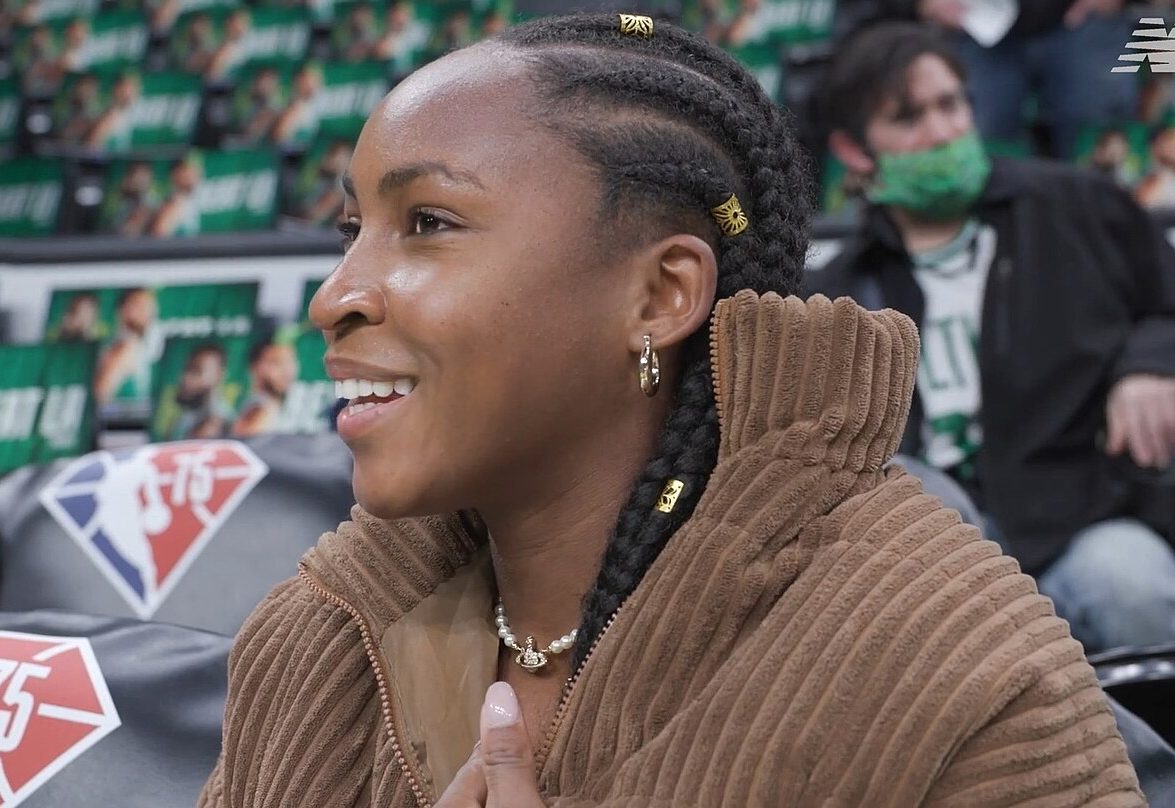
Photo: Boston Celtics, CC BY 3.0, via Wikimedia Commons