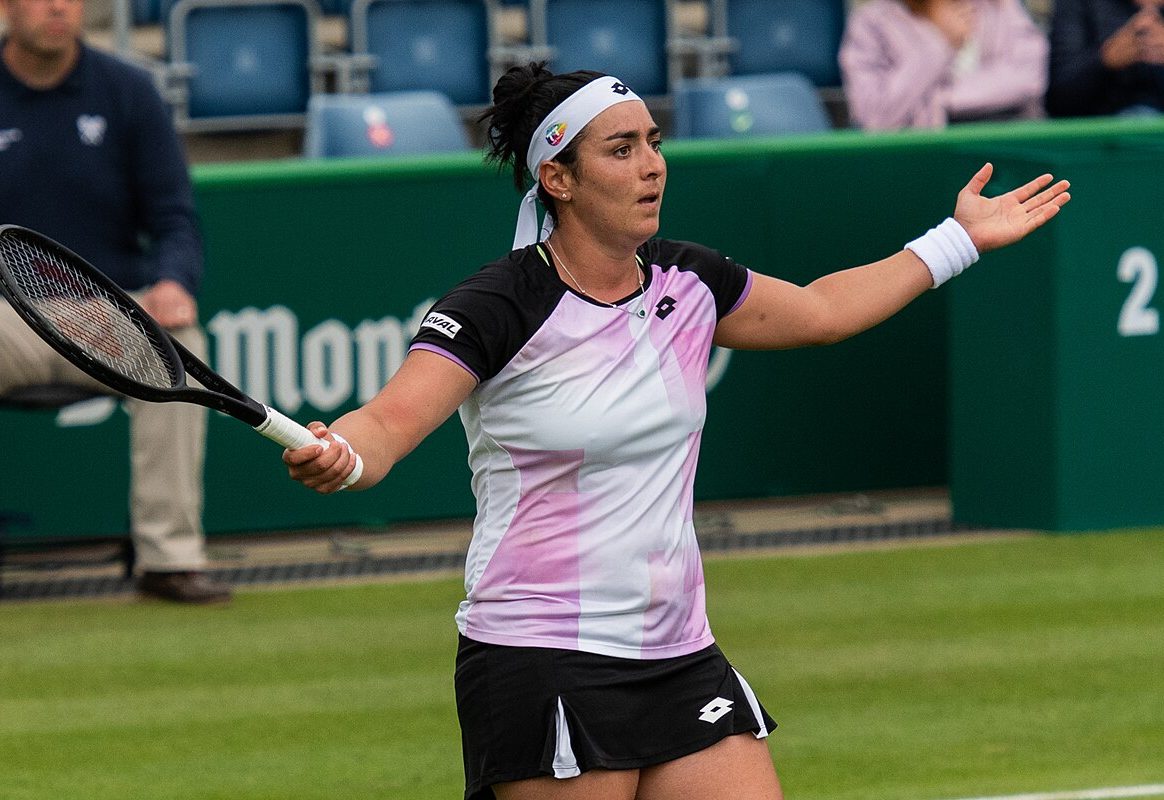
Three Grand Slam finals, one WTA 1000 title and a rise to world No. 2 tell part of the story. The fuller picture is more interesting: Ons Jabeur built one of the most distinctive careers in modern women’s tennis with touch, improvisation and a style that looked nothing like assembly-line baseline power.
From Ksar Hellal to the junior circuit
Jabeur was born on August 28, 1994, in Ksar Hellal, Tunisia, and tennis arrived early. Her mother, Samira, introduced her to the sport when she was still a small child, and by the time she was four she was already working with coach Nabil Mlika. The setting was modest rather than polished. When courts were not available at her club, she trained at nearby hotels, an early sign that her path would require flexibility long before that became the signature of her game.
She later moved to Tunis to train at Lycée Sportif El Menzah, a step that gave more structure to her development. By then, she was already competing seriously. Jabeur appeared on the ITF junior circuit as a young teenager and began playing professional events before she was old enough to drive.
Her progress did not come without interruption. In late 2010, she underwent surgery on her left wrist and missed several months. Around that setback, though, she was also making herself known at junior Grand Slam level. She reached the girls’ singles final at the French Open in 2010, losing to Elina Svitolina, then returned a year later to win the title by beating Monica Puig. That made her the first North African woman to win a junior Grand Slam singles crown. She climbed as high as No. 4 in the junior rankings.
The slow build on tour
The early professional years were not a straight sprint to the top. Jabeur spent seasons on the ITF circuit, collecting matches, learning how to manage travel and surfaces, and trying to turn flair into week-to-week results. For a player from Tunisia, there was also the added weight of being a pioneer without many obvious precedents to follow.
The first major ranking breakthrough came in 2017, when she entered the top 100 for the first time. That mattered. It changed the schedule available to her and moved her from hopeful outsider to regular presence on the main tour.
A year later, she reached her first WTA final at the Kremlin Cup in Moscow. She did not win the title, but the run showed that her game could hold up deep into big tournaments. Opponents had to deal with more than pace. Jabeur used the drop shot, changed spin and trajectory, came forward when openings appeared and kept points from settling into a rhythm.
That unpredictability helped produce her first truly global breakthrough at the 2020 Australian Open. She reached the quarterfinals in Melbourne, becoming the first Arab woman to make a Grand Slam singles quarterfinal. It was the kind of result that changes how a player is discussed. She was no longer simply talented or unusual. She was a contender capable of making history.
First title, then a leap into the elite
The next landmark came on grass. In 2021, Jabeur won the Birmingham Classic, the first WTA Tour singles title of her career and the first by an Arab woman in the Open era. It was a fitting place for that breakthrough. Her feel, disguise and willingness to use the whole court translated naturally to grass.
By then, her reputation was already clear among players and coaches. She was awkward to prepare for because she refused to play one-note tennis. But results at the biggest events still define careers, and those arrived in full during the following season.
The season that changed everything
Madrid was the spark. In the spring of 2022, Jabeur won the Madrid Open, beating Jessica Pegula in the final to claim her first WTA 1000 title. No African or Arab player had won a WTA 1000 event before her. A few weeks later, on June 27, she rose to world No. 2, the highest singles ranking achieved by an African or Arab player in the history of either the WTA or ATP rankings.
Then came the summer that fixed her place in the sport’s wider story.
At Wimbledon, she became the first Arab and African woman to reach a Grand Slam singles final in the Open era. She started the final strongly against Elena Rybakina, taking the first set, but lost in three. The defeat hurt, and she did not hide it. Still, the run mattered far beyond one match. It placed her at the center of the women’s tour.
Two months later, she reached another major final at the US Open. This time Iga Swiatek beat her in straight sets. Again, no trophy. Again, a result that underlined how far she had come. Reaching the Wimbledon and US Open finals in the same season moved her from dangerous stylist to one of the defining players of that period.
She also qualified for the WTA Finals in 2022, another marker of consistency across the full calendar rather than one hot stretch.
Another Wimbledon run, then tougher seasons
Jabeur returned to the Wimbledon final in 2023, beating Aryna Sabalenka in the semifinals before losing to Marketa Vondrousova. It was her third major final and, in some ways, the most painful one. The opportunity was there, and she knew it.
The rest of that period was less smooth. She qualified again for the WTA Finals in 2023, but injuries and uneven form began to interrupt her momentum. Physical issues, including shoulder trouble, made it harder to sustain the level that had taken her to the top of the game.
Even without a Grand Slam title, the résumé held firm. Jabeur won five WTA singles titles in total, reached three major finals and pushed the boundaries of what an Arab and African player had previously achieved in singles tennis.
More than the Slams: Olympics, team tennis and regional medals
Her Grand Slam record draws the most attention, but it is not the whole career. Jabeur represented Tunisia at three Olympic Games: London, Rio and Tokyo. She exited in the first round each time, a reminder that even top players can find the Olympics unforgiving.
In team competition, she gave Tunisia years of service in the Billie Jean King Cup, formerly the Fed Cup. Her overall record there was strong, and her singles wins placed her among the country’s most productive players in the competition.
Before the biggest WTA runs, she had already delivered medals in regional events. At the 2011 All-Africa Games in Maputo, she won singles gold and team gold, plus doubles silver. At the 2011 Pan Arab Games in Doha, she added team gold and doubles bronze. Those results now look like early chapters in a career that kept widening the map of possibility.
Why Ons Jabeur plays differently
A basic stat line says she is right-handed and hits a two-handed backhand. Watching her tells you much more.
Jabeur is an all-court player in the truest sense. The drop shot is the shot most associated with her, but it works because the rest of the game supports it. She uses slice, changes direction well, volleys comfortably and is willing to break patterns that many players repeat almost automatically. One rally might be heavy topspin and angle; the next might be short, low and full of touch.
That variety made her especially dangerous on grass, where her instincts and hands were rewarded, but she proved she could win on clay and hard courts as well. The point was never surface limitation. It was disruption. She wanted opponents to feel uncertain, and often they did.
Her nickname, “Minister of Happiness,” fit the public image: smiling, open and entertaining. On court, though, the artistry was paired with serious competitive intelligence. The fun was real, but so was the tactical sharpness.
Life away from the court
Off the court, Jabeur has generally kept a grounded profile. She married Karim Kamoun, a former fencer who has also worked as her fitness coach, in 2015. Reports have long described them as one of the more visible husband-and-wife partnerships on tour, though without much of the celebrity theater that often comes with sports fame.
She has spoken often about family. Her parents are Samira and Ridha Jabeur, and she has older siblings. She also speaks Arabic, French and English, which has helped make her one of the more accessible figures on the international circuit.
There are lighter details that round out the picture. She has been described as a football fan and has been linked in interviews to support for clubs including Juventus and Real Madrid. She has also been noted for charitable work and public outreach in Tunisia, though the scale and structure of that work are not always reported in detail.
Some private-life reporting around her family plans circulated during her playing career. Sports Illustrated reported that Jabeur and Kamoun had discussed trying for a baby if she won Wimbledon; that should be treated as reported conversation rather than established fact. More firmly documented is that she later stepped away from the tour and announced her pregnancy publicly.
What remains beyond the records is influence. Jabeur did not just win matches for herself. She expanded the imagination of the sport in her region, and she did it with a game people could recognize from a few shots alone.
FAQ
How many Grand Slam titles has Ons Jabeur won?
She has not won a Grand Slam singles title.
What is Ons Jabeur’s highest ranking?
Her career-high singles ranking is world No. 2, reached in June 2022.
How many Grand Slam finals has Ons Jabeur reached?
She reached three: Wimbledon in 2022 and 2023, and the US Open in 2022.
Is Ons Jabeur married?
Yes. She married Karim Kamoun in 2015.
What was Ons Jabeur’s first WTA title?
Her first WTA Tour singles title came at the Birmingham Classic in 2021.
What is Ons Jabeur known for as a player?
She is known for variety, touch, drop shots and an all-court style that breaks up opponents’ rhythm.
Photo: Peter Menzel, CC BY-SA 2.0, via Wikimedia Commons