Three Grand Slam titles arrived late, but they arrived against the hardest company possible. Stan Wawrinka beat Rafael Nadal in a major final once and Novak Djokovic twice, a neat summary of why his career has always stood apart from the usual numbers.
Early years in Lausanne
Born Stanislas Wawrinka in Lausanne, he grew up in a family that mixed sport, work and a slightly unconventional home life. His father, Wolfram, is German with Czech roots, and his mother, Isabelle, is Swiss. He was raised with an older brother, Jonathan, and two younger sisters, Djanaée and Naélla.
Tennis started early and, more importantly, it started seriously. Wawrinka began working with coach Dimitri Zavialoff as a child, and that partnership lasted for years, carrying him from junior promise into the professional game. By his mid-teens, the sport had already taken over enough of his life that he left regular schooling and continued through distance education.
The results came quickly. In 2003, he won the boys’ singles title at Roland Garros and climbed to No. 7 in the junior rankings. The outline of the future player was already there: comfort on clay, heavy groundstrokes, and a willingness to trade from the baseline until he found a chance to strike.
Turning pro and stepping out of Federer’s shadow
Wawrinka turned professional in 2002. The rise was steady rather than dramatic. He broke into the top 100, then the top 50, and gradually built a place on the ATP Tour as a dangerous opponent with a huge backhand and a taste for long rallies.
His first real jump into the wider tennis conversation came in 2008. That spring he reached the final of the Rome Masters, losing to Djokovic, and soon after made his top-10 debut. For a Swiss player of his generation, that mattered. Roger Federer’s presence was so large that almost every other Swiss man was discussed in relation to him. Wawrinka, though, was beginning to look like much more than a supporting act.
The same season brought one of the defining moments of his career. At the Beijing Olympics, he and Federer won the gold medal in men’s doubles for Switzerland. It remains one of the standout achievements in Swiss tennis and one of the clearest signs that Wawrinka was comfortable on the biggest stages long before he became a Grand Slam champion.
The breakthrough years
For a long time, Wawrinka was respected more than feared. He could hit through almost anyone, but the biggest titles seemed to belong to others. Then his career changed shape.
A key part of that shift came with Magnus Norman, who joined his team in 2013. The results were not instant magic, but they were significant. Wawrinka reached the semifinals of the ATP Finals in 2013 and then produced the season that changed his place in the sport.
At the 2014 Australian Open, he beat Djokovic in a bruising quarterfinal, then Tomas Berdych, then Nadal in the final to win his first major title. Nadal was dealing with a back problem during the match, but the result still demanded nerve from Wawrinka, who had to handle the occasion and finish the job. He left Melbourne not as a talented outsider, but as a Slam winner.
That same month, he rose to a career-high ranking of world No. 3. Later in the season he won the Monte-Carlo Masters, beating Federer in the final for his only Masters 1000 singles title. He also helped Switzerland win the Davis Cup, another landmark in a season that remains the fullest expression of his peak.
Three Slams, all earned the hard way
If one theme runs through any Stan Wawrinka biography, it is this: his biggest titles were never soft.
In 2015, he won Roland Garros by beating Djokovic in four sets in the final. Djokovic arrived in Paris chasing the only major missing from his collection and had been the best player in the world. Wawrinka took the match away from him with fearless hitting, especially off the backhand wing, and produced one of the finest performances of his career on clay.
A year later, he did it again at the US Open. Djokovic was world No. 1, the favorite, and the man across the net in the final. Wawrinka wore him down over four sets and claimed his third Grand Slam singles title.
That record gives his major career a very particular shape. He won the Australian Open, the French Open and the US Open, and in each final he beat the reigning world No. 1: Nadal once, Djokovic twice. He also reached another major final at Roland Garros in 2017, losing to Nadal.
There is a reason his name still comes up whenever the conversation turns to dangerous big-match players. Wawrinka was capable of going quiet for stretches of a season and then producing tennis of the highest level when the draw got difficult and the stakes rose.
Rivalries and reputation
He spent his prime in the most crowded era imaginable, sharing the tour with Federer, Nadal, Djokovic and Andy Murray. That made title runs harder, but it also sharpened his reputation. Wawrinka is one of the few men to have beaten all four of them at Grand Slam level.
His meetings with Djokovic became especially important. They played several punishing matches at the Australian Open, including the five-set classic won by Djokovic in 2013 and Wawrinka’s revenge a year later. Those contests helped redefine him. He was no longer just the man with the beautiful one-handed backhand; he was someone the very best had to survive.
The ATP Finals told a similar story. He reached the semifinals there three straight times from 2013 through 2015, proof that his best years were not built on a couple of hot weeks alone.
The Wawrinka game
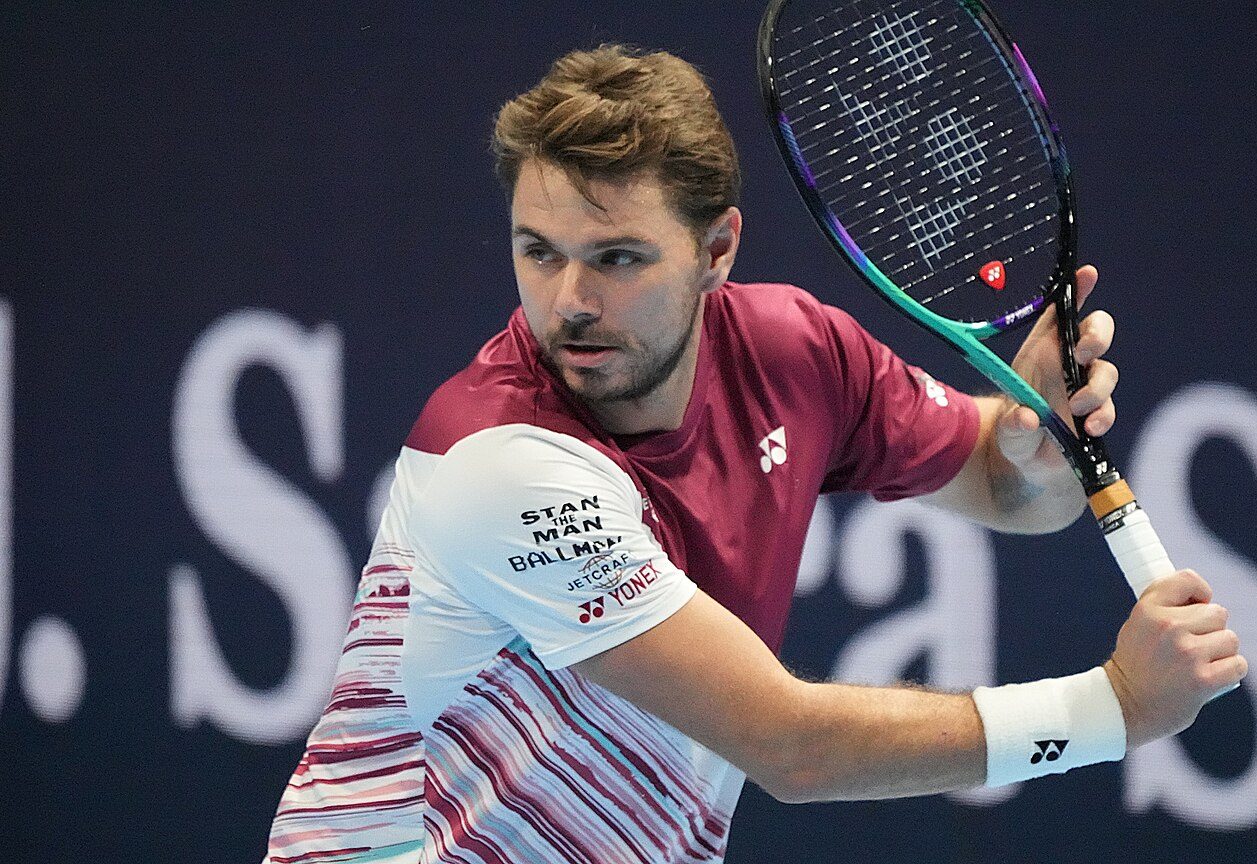
Few shots in men’s tennis have looked quite like his backhand. Hit with one hand, but with unusual weight and stability, it could flatten out a rally in an instant or open the court with angle. It was the signature stroke of the Stan Wawrinka tennis game and the shot most often linked to his highlights.
He played from the baseline, but not passively. The serve was strong, the forehand heavy, and the intent was usually clear: push the rally forward, take space away, and trust his timing under pressure. Clay may have been his favorite surface, yet his best results came across the full range of the sport, including hard courts in Melbourne and New York.
Just as important was his temperament. Wawrinka did not play safe tennis when the score tightened. He often swung harder, especially off that backhand side, and that willingness to commit made him one of the most dangerous opponents in a major draw.
Injuries, surgery and the long return
The second half of his career became a test of endurance as much as skill.
After reaching the 2017 French Open final, he was hit by serious knee problems and underwent surgery that year. The recovery was long and uneven. He later said he had doubts about whether he would return to his previous level, which was understandable given the physical toll and his age at the time.
Another major setback followed when he had foot surgery in 2021. From there, the story was less about titles and more about persistence: rebuilding ranking points, managing pain, and trying to remain competitive in a younger field.
Even in that phase, there were reminders of who he had been. At the 2023 US Open, he became the oldest man to win a singles match there since Jimmy Connors in 1992. It was not a title, but it fit the pattern of his career: resilience, timing, and a refusal to disappear quietly.
Life away from the court
Off court, Wawrinka has usually kept a relatively controlled public profile. He was married to Swiss television presenter and former model Ilham Vuilloud; they married in 2009 and later separated. They have a daughter, Alexia, born in 2010. He was also previously in a relationship with Donna Vekić, a fact widely reported during their time together.
One of the most recognizable details of his public image is the tattoo on his forearm, a Samuel Beckett line: “Ever tried. Ever failed. No matter. Try again. Fail again. Fail better.” It can sound almost too neat for an athlete whose career featured so many setbacks and returns, but in his case it fits.
There are smaller details that help round out the picture. He officially shortened his professional first name from Stanislas to Stan in the middle of his career, reflecting the name by which he had long been known. At the London Olympics opening ceremony, he served as Switzerland’s flag bearer. His mother has also been associated with work on the family’s biodynamic farm, which supports people with disabilities, a quieter part of the background behind a player better known for noise off the strings.
The shape of his career
Wawrinka never built a career on week-to-week domination. He won 16 ATP singles titles, captured one Masters 1000 crown, earned Olympic doubles gold, helped deliver a Davis Cup title for Switzerland, and collected three majors. The total is impressive; the way he did it is what makes it memorable.
He was not the most decorated player of his era, and he did not need to be. His place in the game rests on something more specific: when the match was biggest and the opponent strongest, he had the power and nerve to hit through almost anyone.
FAQ
How many Grand Slam titles did Stan Wawrinka win?
He won three singles majors: the Australian Open, Roland Garros and the US Open.
What is Stan Wawrinka’s career-high ranking?
His highest singles ranking was world No. 3, reached in January 2014.
Did Stan Wawrinka win an Olympic medal?
Yes. He won Olympic gold in men’s doubles at the 2008 Beijing Games with Roger Federer.
What is Stan Wawrinka’s best shot?
His one-handed backhand is widely regarded as the signature shot of his game.
Who coached Stan Wawrinka?
Two key coaches in his career were Dimitri Zavialoff early on and Magnus Norman during his peak years.
Photo: Skyscraper2010, CC BY-SA 4.0, via Wikimedia Commons