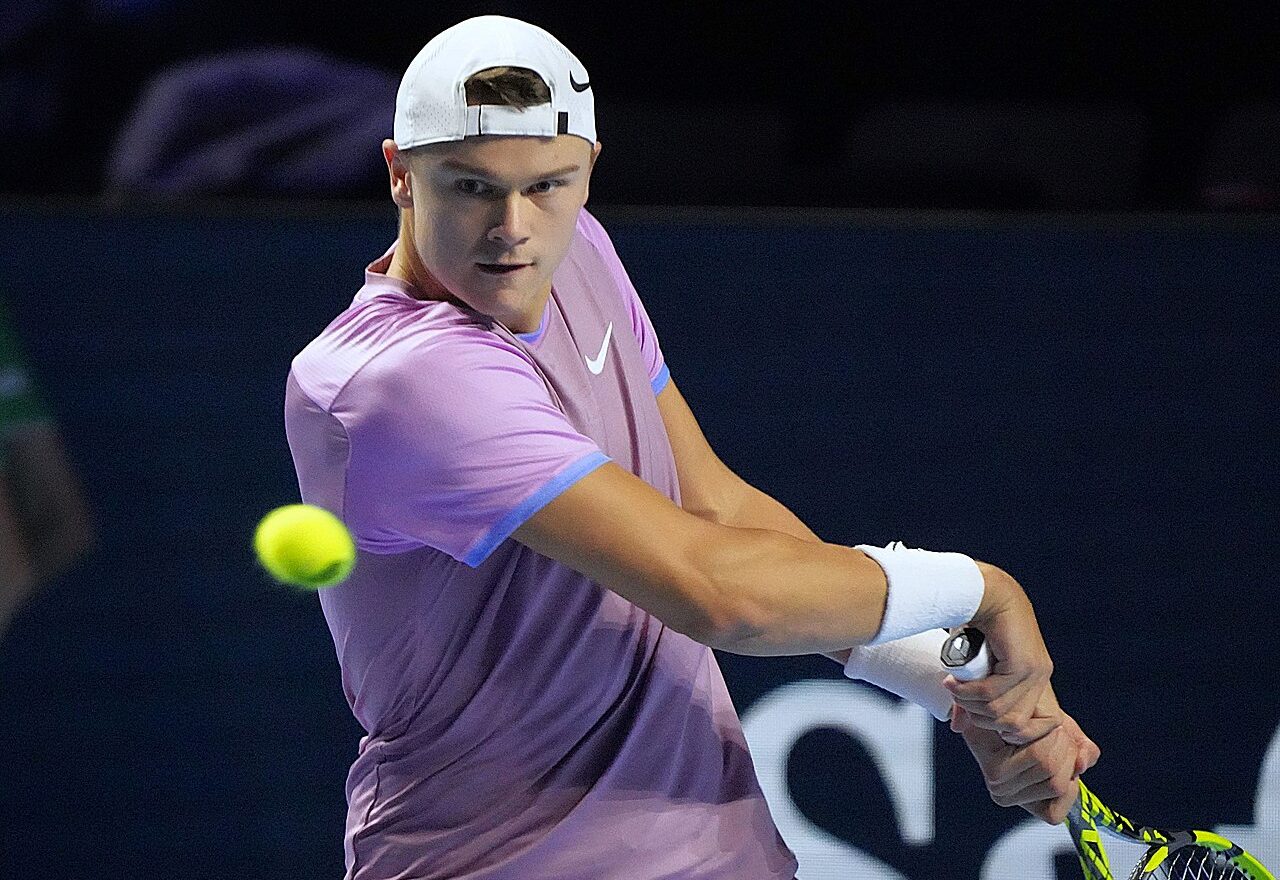
At 19, Holger Rune walked into Paris and beat five Top 10 opponents in a single week. The title run at the 2022 Paris Masters did more than put a trophy on his shelf: it announced that Denmark had a men’s player capable of troubling the very top of the sport, right now, on the biggest regular tour stages.
From Gentofte to the junior summit
Holger Vitus Nødskov Rune was born on April 29, 2003, in Gentofte, Denmark. Tennis entered the family before it became his profession. He first picked up a racket because his older sister Alma played, a small household detail that ended up shaping the direction of his life.
His parents, Aneke Rune and Anders Nødskov, were closely involved from early on. Aneke later became a visible presence as his manager, while his father has worked in business. In coaching terms, one of the key early figures was Lars Christensen, who helped guide Rune in his childhood years and would later return to his team.
By his early teens, the path was already becoming serious. In 2016, he joined the Mouratoglou Tennis Academy, with support from the Danish association Champ’Seed. The outlines of his game were clear even then: he liked to take the ball early, hit with intent from the baseline and compete with edge.
The junior results soon followed. In 2019, he won the boys’ singles title at Roland Garros, beating Toby Alex Kodat in the final. Later that year, he rose to junior world No. 1. Those are the sort of milestones that mark a player as more than a good national prospect. They do not guarantee a smooth professional rise, but they usually mean the ceiling is high.
The first steps on tour
Rune turned professional in the pandemic-affected 2020 season and wasted little time showing that his junior success could carry over. He won ITF titles that year and began climbing the lower levels of the men’s game. In July, he also appeared at Ultimate Tennis Showdown, becoming the youngest player to compete in that exhibition format at the time.
The more meaningful breakthroughs came in 2021. He made his ATP Tour debut, won a Challenger title in Biella and started collecting firsts at main-tour level. At the Chile Open in Santiago, he earned his first ATP match win and reached the quarterfinals, becoming the youngest tour-level quarterfinalist since Carlos Alcaraz in 2020.
That season also brought his Grand Slam main-draw debut. At the US Open, he came through qualifying and then pushed Novak Djokovic for a set in the first round before losing in four. Even in defeat, the match mattered. It showed how quickly he was moving from prospect to relevant opponent.
There were rougher moments too. In 2021, he was fined and defaulted at a Challenger event in Biella for audible obscenity. It was not a defining episode, but it was part of the early picture: a young player with obvious talent and a temperament still being tested in public.
Munich, Paris and a leap into the Top 10
The season that changed his status was 2022.
In the spring, Rune won his first ATP title in Munich. It was an important step, but it did not feel like the end of anything. It felt like the beginning of a faster rise. A few weeks later at Roland Garros, he reached his first Grand Slam quarterfinal, becoming the first Danish man in the Open Era to make the last eight at a major.
Then came the stretch that turned him from promising to dangerous.
Late in the season, he went on a remarkable indoor run, reaching finals in Sofia, Stockholm and Basel before arriving in Paris full of confidence. There, he won his first Masters 1000 title by beating Stan Wawrinka, Hubert Hurkacz, Andrey Rublev, Carlos Alcaraz, Félix Auger-Aliassime and Novak Djokovic in succession. The final against Djokovic ended 3-6, 6-3, 7-5.
That week delivered several historic notes at once. Rune became the youngest champion in Paris Masters history. He also became the first player to beat five Top 10 opponents at the same tournament, outside the ATP Finals, since the ranking system began. By the end of the year, he had broken into the Top 10 and the conversation around him had changed for good.
Pushing higher in 2023
If 2022 was the breakthrough, 2023 was about proving the level could hold.
Rune reached the quarterfinals again at Roland Garros and then made the last eight at Wimbledon, his best run there to date. The Wimbledon result mattered because it showed his game was not limited to clay and hard courts. His movement, return game and willingness to take the initiative translated increasingly well to grass too.
In August, he climbed to a career-high ranking of world No. 4, the highest ranking achieved by a Danish man in ATP history. That remains one of the clearest markers of how quickly he established himself near the top of the men’s game.
The year was not completely smooth. His coaching arrangements shifted several times, and the changes became a story in themselves. Aneke Rune said publicly that “ego clashes” contributed to the end of Patrick Mouratoglou’s role in the setup. That was her explanation, not outside speculation, and it reflected how closely watched Rune’s camp had already become.
Results, setbacks and the search for continuity
The next phase of his career has been less linear than the first rush upward. Rune continued to post strong results at big events, including deep runs at Masters tournaments, but the challenge became sustaining form and physical sharpness across a full season.
He recorded his 100th ATP-level win while still very young, another sign of how much ground he had covered early. Yet his seasons after the Paris breakthrough have also included interruptions, coaching resets and the normal turbulence that often follows a rapid rise.
Because some of the supplied details about later seasons are either time-sensitive or not reliably established across primary tour records, it is better not to present them as fixed fact here. That includes specific claims about injuries, rankings on future dates and endorsement additions tied to exact months unless independently confirmed by official sources. What is clear is the broader arc: Rune has already built a résumé that includes a Masters 1000 title, multiple major quarterfinals and a place among the highest-ranked players of his generation.
Grand Slams and the shape of his game
Rune has not won a Grand Slam singles title, but he has made himself a threat at majors. His best results so far are quarterfinal runs at Roland Garros and Wimbledon, with Paris standing out as the place where his heavy baseline game has often looked most natural.
His tennis is built on controlled aggression. He plays right-handed with a two-handed backhand, stands around 1.88 meters tall and likes to dictate from the baseline. The forehand can do damage when he has time, but one of the most reliable features of his game is the backhand, struck firmly and early, often down the line. He returns well, changes direction quickly and is comfortable absorbing pace before turning defense into attack.
What has always separated him from many players his age is his appetite for big points. That edge can cut both ways; emotion has occasionally spilled over. But it is also part of why he has been able to beat elite opponents so early in his career. Against top players, he rarely looks overawed. He looks engaged.
Surface-wise, clay and hard courts have brought his biggest results, though his Wimbledon quarterfinal showed that grass is no longer a clear weakness. When his movement is sharp and his shot selection disciplined, he has the tools to trouble almost anyone.
Life away from the court
Off court, Rune’s family remains central to his story. Aneke Rune has long played a major role in managing his career, and his father and sister are often mentioned when he talks about where he comes from. Alma Rune, whose early interest in tennis first drew him to the sport, later moved into modeling.
He has spoken about admiring Novak Djokovic while growing up, which makes sense when you watch the competitive side of him. Rune’s matches are rarely passive. He likes the contest, the tension and the chance to impose himself.
Rune has also built a visible commercial profile. He has been associated with brands including Nike, Babolat and Rolex, among others. As with many top athletes, estimates of his wealth vary widely depending on the outlet. Those figures should be treated as estimates, not established fact.
A few lifestyle details that circulate online deserve careful labeling. Reports about specific cars or purchases, including claims that he owns a BMW received through tournament-related arrangements, have appeared in media coverage, but unless Rune or his team has confirmed them directly, they remain reported claims rather than firm facts.
He is also widely listed as living in Monaco, a common base for ATP players, though athletes’ residences can change and are not always detailed officially.
FAQ
How old is Holger Rune?
He was born on April 29, 2003.
What is Holger Rune’s highest ranking?
His career-high ATP singles ranking is world No. 4, reached on August 21, 2023.
Has Holger Rune won a Grand Slam?
No. He has reached Grand Slam quarterfinals but has not won a major singles title.
What is Holger Rune’s biggest title?
His biggest title so far is the 2022 Paris Masters, a Masters 1000 event.
Who coached Holger Rune early in his career?
Lars Christensen was an important early coach and later returned to his team.
Where is Holger Rune from?
He is from Gentofte, Denmark.
Photo: Skyscraper2010, CC BY-SA 4.0, via Wikimedia Commons