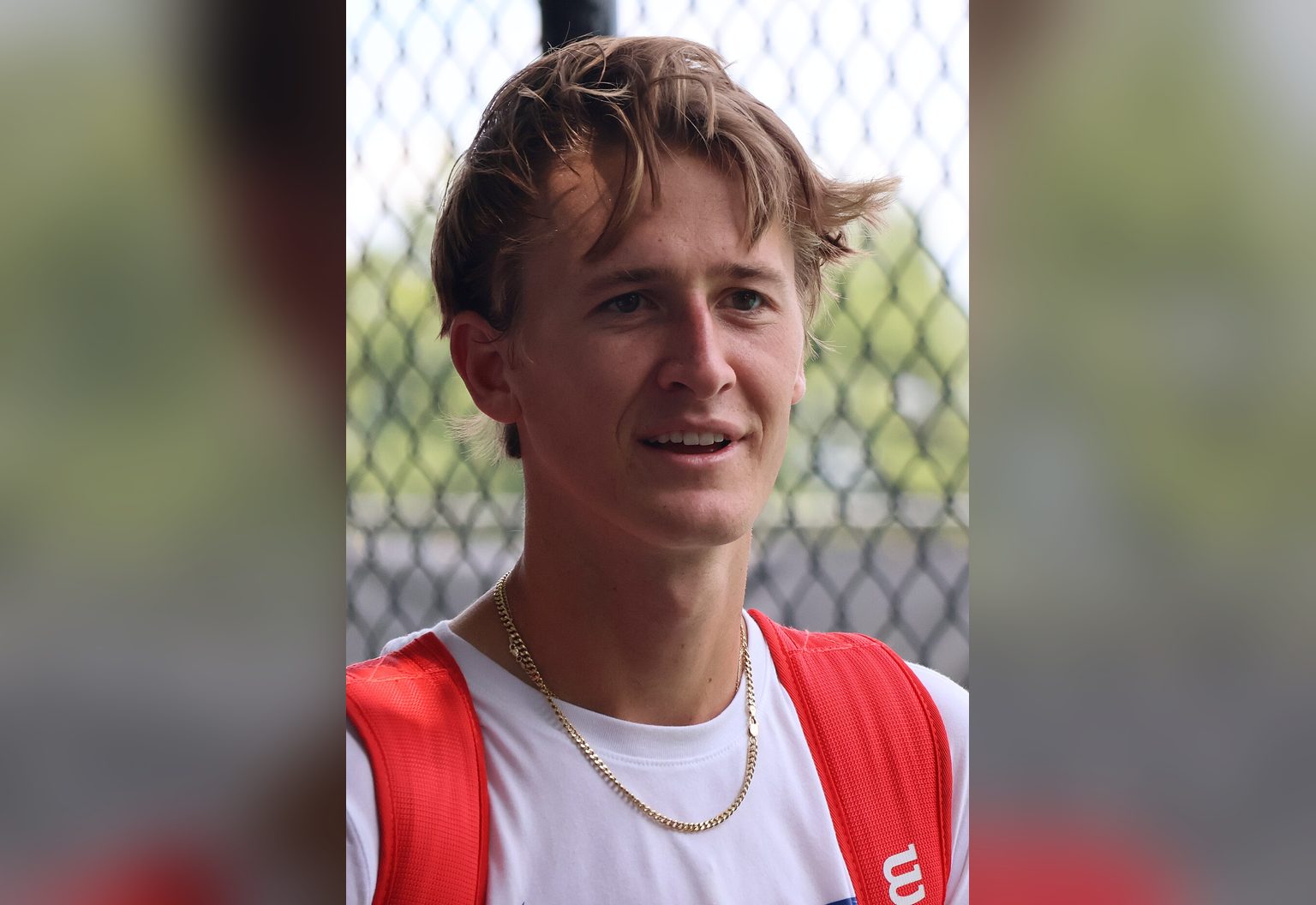
At the end of his first match against Rafael Nadal at Roland Garros, Sebastian Korda had a request: would Nadal sign his shirt? He had just lost to the player he admired enough to name his cat Rafa. The souvenir mattered, but so did the result that brought him there. At 20, the American qualifier had reached the fourth round of the French Open.
It was an early glimpse of a career that would bring three ATP singles titles, an Australian Open quarterfinal and a place inside the world’s top 15. His surname was already familiar to tennis followers. Making it his own would take longer.
A hockey childhood in a tennis family
Born on July 5, 2000, in Bradenton, Florida, Korda grew up surrounded by professional sport. His father, Petr, won the 1998 Australian Open and reached world No. 2. His mother, Regina Rajchrtová, played on the WTA Tour and reached No. 26.
Yet their son initially preferred a stick to a racket. He began playing ice hockey at three and imagined a future in the NHL. Visiting the 2009 US Open with his father helped change his mind. At nine, tennis became his focus.
Both parents helped develop his game. Growing up speaking Czech and English, the youngster known as Sebi represented the United States while retaining close ties to his parents’ Czech background.
There was plenty of sporting ambition elsewhere in the household, too. His older sisters, Jessica and Nelly, pursued professional golf rather than tennis and became LPGA Tour winners.
Melbourne provided his first major junior breakthrough. In January 2018, he beat Tseng Chun-hsin to win the Australian Open boys’ singles title, 20 years after his father’s men’s championship. He became junior world No. 1 on January 29 and turned professional that season.
Finding his feet on the ATP Tour
The transition from junior success to the senior circuit was not immediate. Korda spent time working through lower-level tournaments before making his Grand Slam main-draw debut at the 2020 US Open, where Denis Shapovalov beat him in the first round.
Roland Garros, held later that autumn, changed the scale of his career. After coming through qualifying, he won three main-draw matches before meeting Nadal in the last 16. The Spaniard won comfortably, but Korda had demonstrated that his clean ball-striking could hold up over five-set tennis.
He carried that progress into 2021. A first ATP final at Delray Beach ended in defeat to Hubert Hurkacz, followed by a quarterfinal appearance at the Miami Open.
Then came Parma. On Italian clay, he beat Marco Cecchinato 6-2, 6-4 to claim his first ATP singles title without dropping a set during the tournament.
Grass offered another test, and another encouraging answer. On his Wimbledon main-draw debut, he reached the fourth round before losing a five-set match to Karen Khachanov, 10-8 in the deciding set. It was a painful finish to a fortnight that showed he could adapt beyond hard courts.
His development also benefited from time training with Andre Agassi and Steffi Graf before the 2021 season. Their involvement added experienced voices to a career already shaped by his parents’ knowledge of the tour.
A Melbourne run interrupted
In 2022, Korda reached the Australian Open third round and rose to a then-career-high No. 30. He also made ATP finals in Gijón and Antwerp, although a second title remained out of reach.
The following January brought a stronger statement. At the 2023 Australian Open, he defeated two-time finalist Daniil Medvedev in straight sets, taking the ball early and repeatedly pushing the Russian behind the baseline.
He followed that with a five-set victory over Hurkacz, winning the deciding match tiebreak 10-7 to reach his first Grand Slam quarterfinal.
Against Khachanov, however, a wrist injury brought the run to an uncomfortable stop. Korda retired while trailing by two sets and 3-0 in the third.
The injury cost him playing time, but it did not define the whole season. In Shanghai that October, he beat Medvedev again on his way to a first Masters 1000 semifinal. He subsequently reached No. 23, another ranking milestone after a disrupted year.
Washington puts father and son on the same trophy
Korda’s next singles title arrived in Washington in 2024, more than three years after Parma.
He recovered from losing the opening set of the final to beat Flavio Cobolli 4-6, 6-2, 6-0. It was his first ATP 500 title and carried an unusually direct family connection: Petr had won the same tournament in 1992.
They became the first father and son to win the same tour-level singles event. For Sebastian, the week was also evidence that he could finish a demanding tournament rather than simply produce an eye-catching run.
On August 12, 2024, he reached a career-high singles ranking of No. 15. His earlier entry into the top 20 had already made the Kordas the first father-son pair to reach that threshold since the ATP rankings began in 1973.
There was a significant doubles result that season as well. Partnering Jordan Thompson, he won the Madrid Masters title. His doubles ranking eventually peaked at No. 46 on March 31, 2025.
Injury disruption and a return to Delray Beach
Physical setbacks continued to interrupt his momentum. A shin injury disrupted his 2025 season, and he slipped outside the singles top 50.
Delray Beach supplied a useful point of return in 2026. Five years after reaching his first ATP final there, he won the tournament for his third tour-level singles title, adding a hard-court trophy to his victories in Parma and Washington.
He also defeated world No. 1 Carlos Alcaraz at the 2026 Miami Open, another example of his ability to trouble the leading players when his timing and fitness come together.
Those wins sit alongside the less visible challenge of his career: finding enough uninterrupted court time to make strong results repeatable.
How Korda builds a point
At 6 ft 5 in, or 1.96 metres, Korda has the reach to serve effectively and cover the net. His game, though, is not built solely around height and power.
The two-handed backhand is a particularly dependable shot. He takes it early, redirects pace smoothly and can use it to change the direction of a rally without an exaggerated swing. His forehand provides attacking weight, while his willingness to move forward helps him finish points before they become prolonged baseline exchanges.
Drop shots and volleys give him alternatives when hitting harder is not the best answer. His movement is relatively fluid for such a tall player, although staying balanced under pressure remains as important as covering ground.
There is no single established rivalry that defines his career. Instead, repeated meetings with players such as Medvedev, Hurkacz and Khachanov have marked important stages of his progress.
His results also resist a narrow surface label: a first singles title on clay, a fourth-round Wimbledon debut and his deepest major run on Melbourne’s hard courts.
Life beyond the baseline
The family’s Australian Open record is an unusual conversation starter. Alongside Petr’s tennis title in 1998 and Sebastian’s junior victory in 2018, Jessica won golf’s Women’s Australian Open in 2012, followed by Nelly in 2019. Four family members have won championships carrying the Australian Open name across two sports.
Korda has spoken about enjoying drawing, offering a quieter counterpoint to tournament travel and competition. His much-reported decision to name his cat after Nadal reveals another side: before he was playing against the sport’s leading names, he was following them.
His relationship with Ivana Nedved has also attracted coverage. The couple are reported to be engaged. She is the daughter of former Czech footballer Pavel Nedvěd, giving their relationship another connection to elite sport.
Those details add personality without explaining away the tennis. His career has been shaped by family knowledge and opportunity, but also by the ordinary demands of the tour: learning to close finals, recovering from injuries and starting again after a ranking slide.
FAQ
What nationality is Sebastian Korda?
He is American and was born in Bradenton, Florida. Both of his parents are Czech, and he grew up speaking Czech and English.
Who are his parents and sisters?
His parents are former professional tennis players Petr Korda and Regina Rajchrtová. His older sisters, Jessica and Nelly, are professional golfers and LPGA Tour winners.
What is his best Grand Slam result?
His best singles result is the 2023 Australian Open quarterfinal. A wrist injury forced him to retire against Karen Khachanov.
How many ATP singles titles has he won?
He has won three: Parma in 2021, Washington in 2024 and Delray Beach in 2026. He also won the 2024 Madrid Masters doubles title with Jordan Thompson.
What is his highest ranking?
His career-high singles ranking is No. 15, achieved on August 12, 2024. In doubles, he reached No. 46 on March 31, 2025.
Who is Sebastian Korda’s partner?
His partner is Ivana Nedved. They are reported to be engaged.
Photo: Hameltion, CC BY-SA 4.0, via Wikimedia Commons