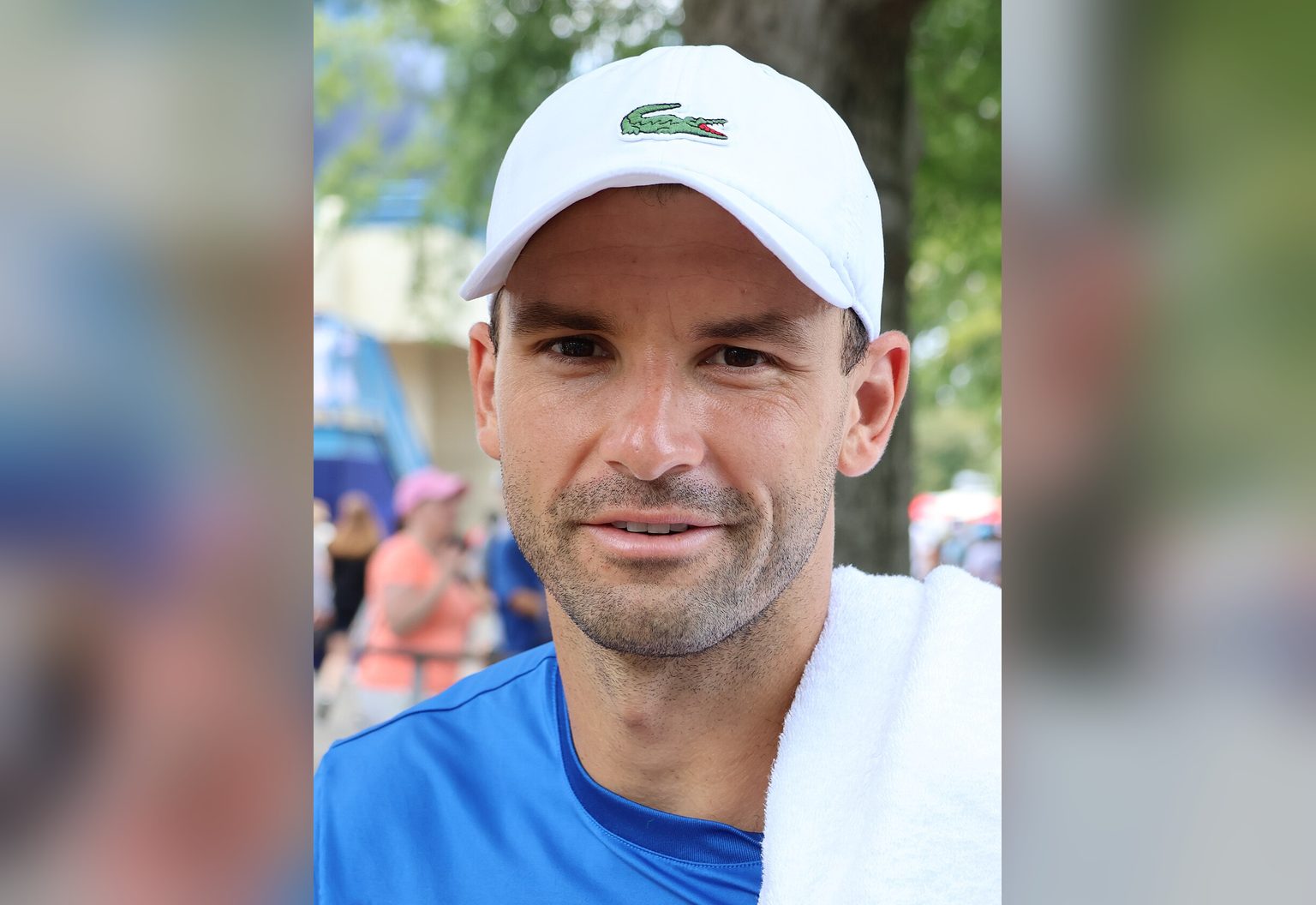
Five matches, five wins, and not a set of nerves showing when it mattered most. Grigor Dimitrov’s title run at the ATP Finals in 2017 remains the cleanest snapshot of his career: elegant tennis, big-stage composure and, for one week in London, a level few could match.
That triumph did not come out of nowhere, and it did not turn him into something he was not. Dimitrov had been known for years by then, first as a gifted junior, then as the Bulgarian with the one-handed backhand, then as the player whose style kept inviting Roger Federer comparisons. What made his story unusual was the timing. The breakthrough at the very top arrived later than many expected, and the years after it became a second act built on persistence as much as talent.
He is still the highest-ranked Bulgarian man in tennis history, having reached world No. 3 on November 20, 2017. He has never won a Grand Slam singles title, but his career has stretched well beyond the old “promise” label. It has included major semifinals, Masters success, an ATP Finals crown and a reputation as one of the tour’s most watchable all-court players.
Haskovo beginnings and a junior career that moved fast
Dimitrov was born on May 16, 1991, in Haskovo, Bulgaria, to Dimitar Dimitrov and Maria Dimitrova. Tennis was part of the family routine from the start. His father worked as a coach, his mother was a sports teacher and former volleyball player, and the sport was close enough to home that he was swinging a racket as a small child.
That background helped shape the way he would play. Rather than growing into a one-pattern baseliner, he developed touch, variety and comfort moving forward. The one-handed backhand became his signature, especially when he drove it down the line. Hard courts and grass suited him best, though his game was never built around one surface alone.
His early training began with his father before moving through bigger development systems. He spent time at the Sánchez-Casal Academy and later trained at Patrick Mouratoglou’s academy, steps that pushed him from local prospect to international junior standout.
The junior results came quickly. He won the Orange Bowl under-16 title in 2006, reached the Orange Bowl under-18 final in 2007, and then put together a major junior season in 2008 by winning the Wimbledon boys’ singles title and the US Open boys’ singles title. He finished as junior world No. 1, confirming what scouts had already noticed: this was not just a stylish player, but a serious one.
He turned professional in 2008, carrying both momentum and baggage. The momentum came from the trophies. The baggage came from the comparisons. Because of the fluid movement, compact service motion and one-handed backhand, he was quickly tagged “Baby Fed,” a nickname that followed him for years.
Learning the pro game
The first phase of his ATP career was steadier than the junior résumé had led some to expect. Dimitrov was not an instant star on the men’s tour. He had to build his ranking in steps, learn how to win against stronger and more physical opponents, and adjust to a circuit where talent alone rarely carries a player very far.
By 2011 he had broken into the top 100. By the end of 2012 he was inside the top 50. Those numbers mattered because they showed real progress, even if the rise lacked the dramatic speed people often expect from a former junior No. 1.
His first ATP singles title arrived in Stockholm in October 2013, and it was an important one beyond the ranking points. Dimitrov became the first Bulgarian man to win an ATP Tour singles title. For his country, it was a landmark moment. For him, it was proof that the transition from gifted prospect to established tour player was finally taking hold.
Wimbledon 2014 and the first real major breakthrough
The next season brought the kind of Grand Slam run that changes how a player is discussed. At Wimbledon in 2014, Dimitrov reached his first major semifinal. On grass, with his movement and shot-making on full display, the fit looked natural.
That run did not end with a title, but it did move him into a different category. He was no longer just a talented player with a pretty game. He was now someone who could make the last four at a Slam and threaten the best in the sport over two weeks.
More deep major runs followed, though not in a straight line. He reached the Australian Open semifinal in 2017 and the US Open semifinal in 2019. Much later, he completed another missing piece of his Slam record by reaching the French Open quarterfinal for the first time in 2024. That gave him quarterfinal-or-better results at all four majors, a useful measure of how complete his game became across surfaces.
2017: the season that changed his résumé
The best season of Dimitrov’s career was 2017. It began with a title in Brisbane, included a semifinal run at the Australian Open, and built toward the two biggest trophies of his career.
In Cincinnati, he won his first Masters 1000 title. Then came the ATP Finals, where he went undefeated to lift the season-ending championship. He beat David Goffin in the final and finished the week 5-0, the sort of result that leaves no room for debate about form.
That autumn surge carried him to a career-high ranking of world No. 3. No Bulgarian man has climbed higher.
The significance of that season was not just the silverware. It was the combination of consistency and scale. Dimitrov had always looked capable of producing brilliant tennis for a match or a week. In 2017, he turned that ability into a full season near the top of the sport.
The years after the peak
Careers are rarely neat after a player reaches his highest point, and Dimitrov’s was no exception. He did not push beyond No. 3, and there were seasons when injuries, form dips and the depth of the men’s game made it hard to hold momentum.
Still, he remained relevant longer than many players with similar early narratives. One of his best later runs came at the 2019 US Open, where he reached the semifinals and reminded everyone that his game still held up on the biggest stages.
Then came another revival. In 2024, he returned to the top 10 and reached the French Open quarterfinal for the first time. For a player once discussed mainly in terms of what he might become, that late-career stretch said something more grounded and more impressive: he had stayed in the fight long enough to reinvent the shape of his own résumé.
He also represented Bulgaria in Davis Cup, where he built a strong record in team competition after making his debut as a teenager. At the Olympics, he competed in London and Rio, though without a deep singles run.
Why his game has always stood out
Some players are remembered mainly for results. Dimitrov has always been remembered for the way the ball leaves the strings.
He is a right-hander with a one-handed backhand, and his tennis has long carried an old-school look without being old-fashioned. He can defend, counterpunch, attack the net and improvise from awkward positions. At his best, he blends those parts into a game that feels fluid rather than mechanical.
The Federer comparisons were understandable, even if they were often overdone. Dimitrov’s movement, his backhand shape and his willingness to use the whole court made the resemblance obvious. But the nickname “Baby Fed” also became a burden, because it encouraged people to judge him against a standard that distorted his own career.
Viewed on his own terms, he built something substantial: multiple major semifinals, a Masters 1000 title, an ATP Finals trophy and a long stay among the sport’s most recognizable players.
Coaches, team and the search for the right fit
Like many top players with long careers, Dimitrov has worked with a range of coaches while trying to sharpen different parts of his game. His father was the first major influence. Later came academy work in Spain and France, then a series of professional partnerships as he tried to balance his natural flair with the discipline required at the top level.
Among the better-known names in his coaching history are Patrick Mouratoglou and Daniel Vallverdu. Those partnerships reflected a recurring theme in his career: the search for structure around a game that already had plenty of instinct.
Off court: Monte Carlo, endorsements and a private life often in public view
Away from tournaments, Dimitrov has long had a high profile. He has been based in Monte Carlo, a common home for ATP players, and he has often attracted attention beyond tennis because of his style, endorsements and relationships.
His commercial portfolio has included deals with brands such as Wilson and Lacoste, along with several watch, footwear and lifestyle partnerships. Exact earnings from endorsements are not publicly confirmed, and net worth estimates that circulate online should be treated as estimates rather than fact.
He has also been involved in charitable work. During the pandemic period, he donated ventilators to a hospital in Haskovo, and he has supported causes involving children in Bulgaria and beyond.
His private life has frequently made headlines, but that part of the story needs careful wording. Dimitrov was previously in a public relationship with Maria Sharapova. He was later linked to Nicole Scherzinger, and multiple outlets reported that he was engaged to Lolita Osmanova before the relationship ended. More recently, entertainment and sports media have reported a relationship with actress Eiza González, with social media posts adding to that public picture. Beyond what the people involved have confirmed themselves, personal details should be treated cautiously.
One small detail that has surfaced in interviews says plenty about him: he has spoken about writing down things he is grateful for before going to sleep. It fits the image of a player who has had to learn patience, especially in the second half of his career.
FAQ
How old is Grigor Dimitrov?
He was born on May 16, 1991.
What is Grigor Dimitrov’s highest ranking?
His career-high ATP singles ranking is world No. 3, reached on November 20, 2017.
Has Grigor Dimitrov won a Grand Slam title?
No. He has not won a Grand Slam singles title, but he has reached the semifinals of the Australian Open, Wimbledon and the US Open.
Where is Grigor Dimitrov from?
He is from Haskovo, Bulgaria.
Why was Grigor Dimitrov called “Baby Fed”?
The nickname came from similarities in his playing style to Roger Federer, especially the one-handed backhand, movement and all-court shot-making.
How many ATP singles titles has Grigor Dimitrov won?
He has won multiple ATP singles titles, including the 2017 ATP Finals and the Cincinnati Masters.
Photo: Hameltion, CC BY-SA 4.0, via Wikimedia Commons